
For a long time, the profession of urban planning has been centered on a core mission: organizing space to meet the needs of communities while ensuring balanced regional development. The work relied on a combination of technical expertise, knowledge of the regulatory framework, and the ability to anticipate future trends based on often limited data. Planning decisions were based on ad hoc studies, field surveys, and medium- or long-term projections, using tools that were primarily descriptive and static.
But this approach is now reaching its limits in the face of rapidly increasing urban complexity. With population growth, the ecological transition, pressure on resources, and increased mobility, cities are becoming interconnected systems where the flows of people, energy, and data are constantly evolving. Urban planners must now integrate a multitude of variables, often in real time, to design spaces adapted to constantly changing uses. According to the United Nations, nearly 68% of the world’s population will live in urban areas by 2050, exacerbating the challenges associated with urban planning and management1.
At the same time, cities generate massive amounts of data. With urban sensors, connected infrastructure, intelligent transportation systems, and environmental data, cities are becoming environments rich in information, but difficult to analyze without the right tools. This explosion of data is transforming the way urban phenomena can be observed, analyzed, and anticipated.
- The figures illustrate this structural transformation:
- Cities are generating ever-increasing volumes of data from IoT sensors, transportation networks, and digital public services.
- Environmental issues—such as air quality, water management, and CO₂ emissions—require detailed and continuous analysis.
- Mobility and housing needs are changing rapidly, making traditional planning models less suitable.
In light of these developments, a paradigm shift is needed. Urban planning can no longer rely solely on static approaches and one-off analyses. It is evolving to become dynamic, predictive, and data-driven. Artificial intelligence is gradually emerging as a key tool for modeling urban dynamics, simulating development scenarios, and supporting decision-making.
The profession is thus entering a new phase of transformation. Urban planners are no longer limited to designing plans; they are becoming key players in the data-driven city, where smart systems play an active role in understanding, managing, and optimizing urban areas.
The rise of data-driven environments is profoundly transforming the methods, skills, and tools used by urban planners.
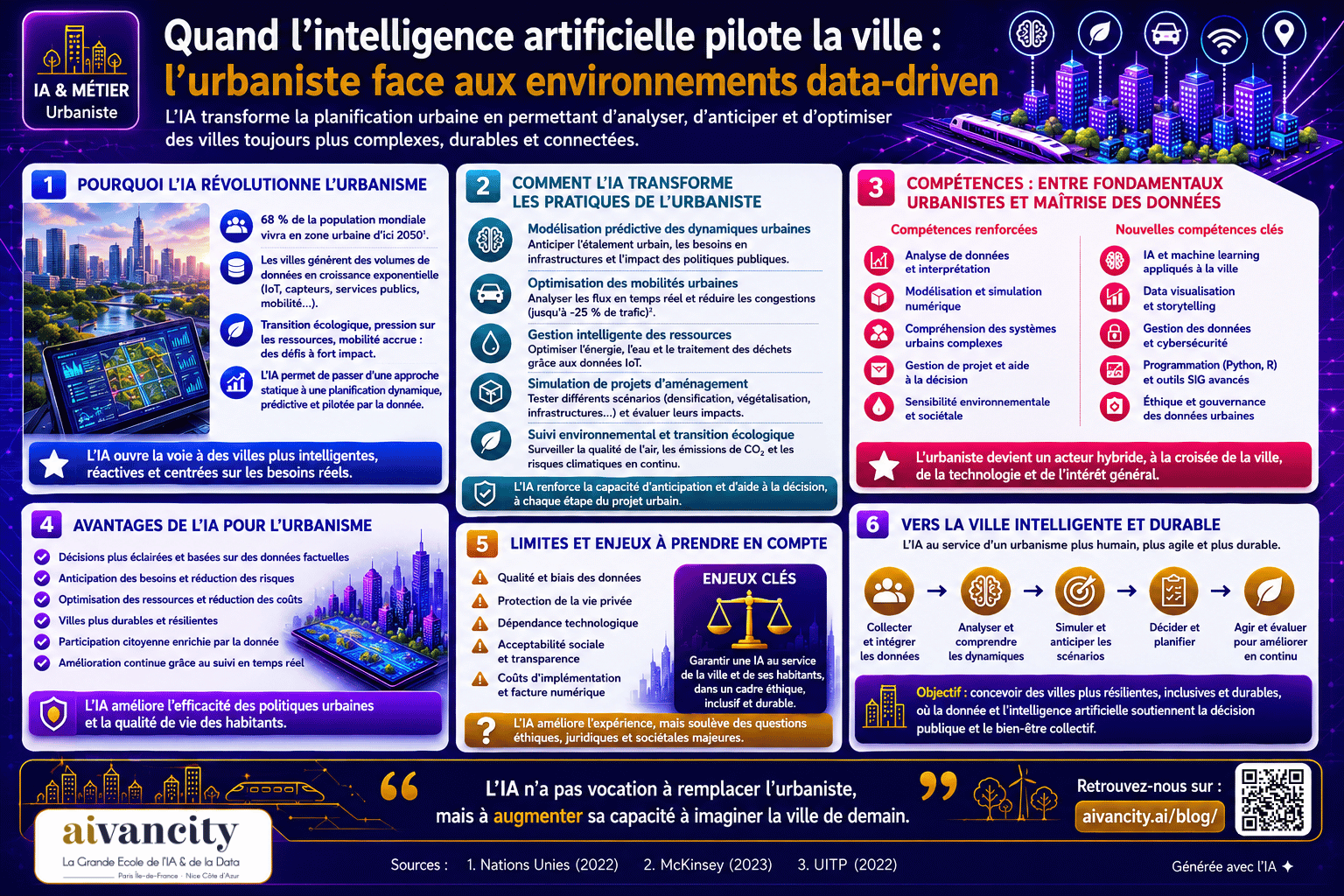
How AI Is Transforming Urban Planning Practices
Artificial intelligence is not only transforming urban planning tools; it is fundamentally redefining the way cities are designed, analyzed, and managed. Historically, the work of urban planners relied on forward-looking studies, aggregated statistical data, and decision-making processes that were often lengthy and sequential. Digital tools existed, but remained primarily descriptive, focused on mapping and static modeling. With the rise of smart systems, connected infrastructure, and massive volumes of urban data, an increasing portion of these activities is now automated, augmented, and driven by data. Urban planners thus operate in an environment where systems can simulate development scenarios, anticipate territorial dynamics, and analyze flows in real time, profoundly transforming professional practices.
This trend is evident at several key levels of urban management and planning.
- Predictive modeling of urban dynamics: Traditional tools relied on linear projections that were often limited. AI now makes it possible to integrate multiple types of data—demographic, economic, and environmental—to simulate how regions will evolve. It helps anticipate urban sprawl, infrastructure needs, and the impacts of public policies. According to a McKinsey study, cities using advanced data analytics solutions can significantly improve the quality of their planning decisions2.
- Optimizing urban mobility: Smart systems analyze transportation flows in real time, including road traffic, public transit, and active transportation. They enable infrastructure adjustments, improve traffic flow, and reduce congestion. Some cities have seen a 15% to 25% reduction in traffic thanks to the use of AI-based solutions3.
- Smart urban resource management: AI is used to optimize energy consumption, water management, and waste treatment. By analyzing data from sensors, it enables real-time adjustments to usage patterns and improves the efficiency of urban services.
- Simulation of development projects: Urban planners can test different scenarios before implementation, such as densification, greening, and the development of new infrastructure. These simulations help assess environmental, economic, and social impacts, facilitating more informed decisions.
- Environmental monitoring and the green transition: Smart systems enable continuous monitoring of air quality, CO₂ emissions, and urban heat islands. AI helps identify critical areas and guide public policy toward more sustainable solutions.
- Citizen engagement and usage analysis: Data from digital platforms and citizen interactions make it possible to incorporate residents’ actual needs into urban projects. AI can analyze this data to better understand usage patterns and adapt urban planning accordingly.
These changes are fundamentally transforming the nature of the profession. Urban planners are no longer limited to designing plans or analyzing areas in a static manner. They must now interact with intelligent systems, interpret predictive models, and incorporate real-time data to inform their decisions. Urban planning is thus becoming a hybrid discipline at the intersection of planning, data, and digital technologies.


A new role for the urban planner
The growing integration of artificial intelligence into urban systems is not only transforming planning tools; it is also fundamentally redefining the role of the urban planner within communities. Long viewed as an expert in planning and regulation, urban planners are now becoming strategic players in the transformation of cities. Their role no longer consists solely of designing spaces, but of analyzing complex data, managing smart systems, and contributing to public decisions that are increasingly dynamic and interconnected.
In a context marked by the proliferation of urban data, the acceleration of environmental transitions, and the increasing complexity of land uses, the value of an urban planner now lies in their ability to interpret, structure, and contextualize information generated by artificial intelligence systems. The challenge is no longer simply to design a territory, but to anticipate its evolution, evaluate complex scenarios, and ensure that decisions made remain consistent with residents’ needs and environmental constraints.
This trend has led to several major changes in the industry.
- Architect of the data-driven city: Urban planners design projects that incorporate data from multiple sources, including urban sensors, mobility data, environmental data, and citizen usage patterns. They develop planning models capable of adapting to regional dynamics.
- Smart City Systems Supervisor: Urban infrastructure is increasingly incorporating automated systems for traffic management, energy, and public services. The urban planner helps design these systems and oversees their operation to ensure their efficiency and overall coherence.
- Regional Dynamics Analyst: Analyzing big data helps identify trends, imbalances, or areas of tension. Urban planners develop enhanced analytical skills to anticipate demographic, economic, and environmental changes.
- A key player in the ecological transition: The integration of environmental data and predictive models is transforming the way we address climate challenges. Urban planners help design more resilient communities by incorporating goals related to energy efficiency, emissions reduction, and risk adaptation.
- Ensuring consistency and regulation: The use of smart systems in urban management involves regulatory frameworks and complex trade-offs. Urban planners ensure that projects are consistent with public policies, legal constraints, and objectives of public interest.
- Bridge between citizens, decision-makers, and technology: Urban planners play a central mediating role. They translate data-driven analyses into understandable and acceptable decisions, while incorporating residents’ expectations into development projects.
According to an OECD analysis, professions related to land-use planning and infrastructure management will undergo significant changes as a result of digital transformation and the integration of data into public policy4.
As a result, the urban planner of tomorrow will no longer be merely a designer of spaces. They will become a key player in the smart city, capable of coordinating complex systems, leveraging data on a large scale, and ensuring a balance between technological innovation, quality of life, and regional sustainability.
What skills do urban planners need in the age of generative AI?
The fundamentals of the urban planning profession—an understanding of territorial dynamics, mastery of regulatory frameworks, and the ability to design development projects while integrating social and environmental considerations—remain the indispensable foundation of the profession. The ability to organize space, anticipate the needs of communities, and coordinate multiple stakeholders remains at the heart of the practice. However, the rise of artificial intelligence, the widespread use of urban data, and the digital transformation of regions are significantly expanding the scope of expected competencies. Urban planners must no longer merely design spaces; they must understand intelligent systems, analyze complex flows, and adopt a data-driven approach to regional management.
This transformation is redefining training, professional conduct, and the culture of the profession.
Technical and digital skills
- Understanding artificial intelligence systems applied to urban planning: Urban planners must have a solid grasp of the machine learning principles used in urban modeling, scenario simulation, and predictive analysis of territorial dynamics. They must also understand the limitations of these models and the conditions under which they should be used.
- Leveraging Urban Data: Access to growing volumes of data—on mobility, the environment, energy, and citizen behavior—requires skills in analysis and interpretation. Urban planners are becoming advanced users of geographic information systems and data platforms.
- Mastering simulation and modeling tools: Software with built-in AI capabilities allows for the testing of complex development scenarios. Using this software requires technical skills to configure settings, analyze data, and interpret results.
- Understanding the challenges of cybersecurity and data governance: Managing sensitive geographic data requires special attention to its protection, quality, and traceability.
According to a study by the World Economic Forum, smart cities that rely on data and digital technologies are expected to see significant growth in the coming years, driving up demand for hybrid skills5.
Analytical and decision-making skills
The urban environment is becoming increasingly complex and data-driven.
- Maintain a critical mindset when evaluating predictive models: AI systems can generate recommendations or simulations, but they do not replace human analysis. Urban planners must be able to question the assumptions and results.
- Analyzing complex regional dynamics: Population growth, mobility, and environmental transitions require a systemic approach that takes into account multiple, interdependent variables.
- • Making decisions in an uncertain environment: Urban projects are long-term endeavors that involve significant uncertainties. Urban planners must weigh their options while taking into account risks, impacts, and constraints.
Ethical, Legal, and Regulatory Competencies
The integration of artificial intelligence into urban planning raises issues of governance and accountability.
- Understanding Regulatory Frameworks for Urban Planning and Data: Urban planners must be well-versed in the requirements related to data protection, land-use planning, and public policy.
- Ensuring transparency in decision-making: The use of algorithmic models requires the ability to explain planning decisions to decision-makers and citizens.
- Ensuring the responsible use of technology: Urban planners must ensure that AI tools do not exacerbate regional inequalities or planning biases.
Interdisciplinary and strategic skills
The profession is increasingly moving toward a collaborative and systemic approach.
- Collaborating with multidisciplinary teams: Urban planners work with engineers, data scientists, public policymakers, and private-sector stakeholders. The ability to communicate effectively with these professionals is essential.
- Integrating economic and political considerations: Planning decisions have a direct impact on regional development. Urban planners must understand economic constraints and strategic priorities.
- Supporting regional transformation: Urban planners are becoming key players in the digital and ecological transition, helping to shape public policies tailored to today’s challenges.
Thus, the urban planner of tomorrow will not merely be a designer of spaces. They will become a hybrid professional, at the intersection of urban planning, data, and technology, capable of leveraging smart systems while ensuring balanced, sustainable planning that is centered on the needs of local communities.

Can artificial intelligence make urban planning more reliable?
One of the strongest arguments in favor of artificial intelligence in urban planning lies in its ability to improve the accuracy of analyses, the anticipation of needs, and the consistency of land-use decisions. By processing massive volumes of real-time data—including mobility, energy consumption, urban density, and environmental data—machine learning models can identify dynamics invisible to human analysis, anticipate imbalances, and ensure the effectiveness of planning strategies. In an environment where cities are becoming increasingly complex and interconnected, these capabilities are profoundly transforming the way territories are planned and managed.
Specific examples:
- Optimizing Urban Mobility: AI-based systems continuously analyze traffic flows, public transportation usage, and travel patterns. They help identify congestion hotspots, adjust infrastructure, and improve the flow of urban traffic. Some cities using these technologies have significantly reduced travel times and traffic-related emissions.
- Anticipating infrastructure needs: Predictive models make it possible to estimate population trends, housing needs, and the use of public facilities. These tools help urban planners better scale infrastructure and reduce regional imbalances.
- Smart Urban Resource Management: Smart systems help optimize energy consumption, water management, and waste treatment. By analyzing data from urban sensors, they help improve the efficiency of public services and reduce operational costs.
- Real-time environmental monitoring: AI helps identify areas exposed to pollution, heat islands, or climate risks. This capability supports more resilient planning that is better suited to today’s environmental challenges.
- Simulation and Risk Mitigation in Urban Projects: Urban planners can test different scenarios before implementing a project. Simulations help assess social, economic, and environmental impacts in order to reduce the risks associated with planning decisions.
The results are already starting to show. According to a study by the McKinsey Global Institute, smart city technologies that incorporate advanced data analytics and artificial intelligence capabilities can improve certain indicators of urban quality of life by 10 to 30%1. Artificial intelligence thus appears to be a significant driver for improving urban management and the effectiveness of urban policies.
However, these advances also bring new challenges.
- The risk of reliance on automated systems: Overreliance on predictive tools can undermine public decision-makers’ ability to think critically and adapt.
- The opacity of algorithmic models: Some systems operate like black boxes, making it difficult to understand the recommendations they generate and complicating their acceptance by policymakers and the public.
- Biases in urban data: Incomplete or socially biased data can lead to inequitable planning decisions or an inaccurate representation of residents’ needs.
- Data Surveillance and Protection Challenges: The large-scale use of urban data raises important questions regarding privacy, data governance, and the cybersecurity of smart infrastructure.
Thus, artificial intelligence can significantly enhance the reliability of urban planning, but it does not replace the role of the urban planner. The most effective systems are based on a synergy between automation and human expertise, where technology supports decision-making without replacing it, ensuring a balance between innovation, sustainability, and quality of life in communities.
What will the field of urban planning look like in the future with AI?
The urban planner of tomorrow will operate in an environment where artificial intelligence systems are deeply integrated into urban infrastructure and public decision-making processes. Planning tools will become more powerful, spatial data more abundant, and urban systems increasingly automated and interconnected. In this context, the role of the urban planner will not disappear; rather, it will evolve toward a role focused on analysis, oversight, and strategic management within complex and dynamic urban areas.
Several significant changes are already evident.
- The Rise of Data-Driven Urban Planning: Systems will incorporate advanced analytical capabilities to model urban dynamics, anticipate infrastructure needs, and optimize planning policies. Urban planners will spend less time on descriptive analysis and more on interpreting data and developing forward-looking scenarios.
- The emergence of autonomous urban systems: Smart infrastructure, traffic management, energy networks, and public services will become capable of adapting in real time. Urban planners will need to oversee these systems and ensure they align with regional objectives.
- The emergence of new hybrid roles: The line between urban planning, data science, and engineering will become increasingly blurred. New roles will emerge, such as urban planner-data analyst, smart city specialist, spatial modeling expert, and urban data governance manager.
- Data Security and Governance in Urban Planning: Urban digital systems will become critical infrastructure. Urban planners must ensure the quality, reliability, and protection of the data used in decision-making processes.
- Stronger collaboration between humans and intelligent systems: Tools will be able to propose urban planning scenarios, identify high-risk areas, and optimize urban traffic flows. Urban planners will play a central role in validating these proposals, adapting them to local realities, and incorporating social and political considerations.
- Greater integration into ecological and social transition strategies: Urban planners will play an active role in designing more sustainable and resilient cities. The use of data will help optimize resource use, reduce the environmental footprint, and improve residents’ quality of life.
According to a United Nations analysis, the transition to smart and sustainable cities will require professionals capable of combining expertise in urban planning with proficiency in digital technologies in the coming decades1.
In this environment, urban planners will no longer be merely designers of spaces. They will become strategic players in the data-driven city, capable of managing complex systems, analyzing data on a large scale, and linking technological innovations to environmental, economic, and societal challenges.
AI-Enhanced Urban Planning: At the Heart of Human Decision-Making
Artificial intelligence is profoundly transforming the way in which urban areas are analyzed, planned, and managed, but it does not change their ultimate purpose. It accelerates the analysis of complex data, automates certain stages of planning, and makes it possible to identify urban dynamics that are difficult to perceive on a human scale. It shifts the priorities of the field: less descriptive analysis, more modeling; less static planning, more real-time management; fewer isolated decisions, more large-scale data correlation.
Yet, at the heart of this transformation, one thing remains constant: the city remains a deeply human space.
Augmented urban planning does not mean the complete automation of land-use decision-making. It relies on the synergy between algorithmic intelligence and the urban planner’s judgment. Artificial intelligence systems can analyze flows, simulate development scenarios, and suggest optimizations. But it is the urban planner who interprets these results, contextualizes them, and adapts them to the social, economic, and political realities of the area.
This distinction is crucial. A land-use decision is not merely an algorithmic calculation. It affects residents’ quality of life, regional balance, the sustainability of infrastructure, and the coherence of public policies. It requires a nuanced understanding of land uses, local needs, and community issues—factors that systems can only partially grasp.
From this perspective, the role of urban planners is increasingly to ensure the controlled and responsible use of artificial intelligence.
This includes, in particular:
- Rigorous validation of predictive models to ensure their relevance in complex and evolving regional contexts.
- Continuous monitoring of analytical systems to identify biases, limitations, or discrepancies related to the data used.
- Transparent governance of urban data, enabling decisions to be explained and building trust among citizens and public officials.
- Constant human oversight, particularly in large-scale projects where decisions have long-lasting impacts on local communities.
The rise of augmented urban planning also opens up significant opportunities. It enables the optimization of mobility, better resource management, the anticipation of urban changes, and the design of more sustainable and resilient cities. It contributes to better coordination of public policies and a more efficient use of spatial data.
But this transformation goes beyond the purely technological realm. It raises questions about the role of urban planners in an environment where certain decisions may be supported—or even suggested—by intelligent systems. It calls for a redefinition of expertise, no longer viewed solely as technical or regulatory knowledge, but as the ability to manage complex systems with discernment, responsibility, and strategic vision.
In a world where systems are becoming capable of analyzing data faster and on a larger scale, the value of an urban planner will not lie in the speed of execution, but in their ability to interpret, mediate, and make balanced decisions.
Technology can optimize. Urban planners, however, must continue to design livable communities.
What if, ultimately, the true transformation brought about by artificial intelligence in urban planning were not to replace professionals, but to reinforce what lies at the heart of the profession: designing cities for residents with responsibility, vision, and collective intelligence, in an increasingly complex environment.
Learn more
To broaden your perspective and understand how AI is reshaping other professions—from human resources to finance, and from healthcare to communications—we invite you to explore our dedicated section “AI & Professions”, which analyzes the concrete impact of intelligent technologies on skills, practices, and the organization of work.
References
1. United Nations. (2022). World Urbanization Prospects.
https://www.un.org
2. McKinsey Global Institute. (2023). Smart Cities: Digital Solutions for a More Livable Future.
https://www.mckinsey.com
3. World Economic Forum. (2022). Shaping the Future of Cities.
https://www.weforum.org
4. OECD. (2023). The Future of Cities and Urban Planning in the Digital Age.
https://www.oecd.org
5. World Economic Forum. (2023). Smart Cities and the Future of Urban Development.
https://www.weforum.org
6. United Nations. (2023). Smart Cities and Sustainable Urban Development.
https://www.un.org