
When people think of Midjourney, they immediately think of generative artificial intelligence, photorealistic images, and the creative revolution that has transformed the design, advertising, and film industries. Few people would have imagined that the company would one day tackle one of the most complex and heavily regulated fields in the world: healthcare. Yet that is exactly what the company founded by David Holz has just done by announcing the Midjourney Scanner, a medical imaging system capable of scanning the entire human body in just 60 seconds.
The announcement surprised both artificial intelligence experts and healthcare professionals. Midjourney claims to have developed a radically new imaging technology capable of producing a complete three-dimensional map of the human body at a speed up to 100 times faster than that of some conventional MRI scans. If these promises are fulfilled, it could mark the first true technological breakthrough in medical imaging since the advent of MRI and modern CT scans in the 1970s.1
But behind this technological feat lie important questions about regulation, the medicalization of bodily data, and the role that artificial intelligence could play in future diagnostics.
An innovation that is completely outside Midjourney's usual scope
Since its inception, Midjourney has established itself as one of the leading players in generative AI for image creation. Its models have demonstrated a remarkable ability to produce complex visuals from simple textual descriptions, to the point of becoming a global benchmark in the field of AI-assisted creation.2
The announcement of the creation of Midjourney Medical therefore marks a major strategic shift. Rather than further improving its image-generation models, the company has decided to invest in a sector where innovation often progresses more slowly due to scientific and regulatory constraints.
For David Holz, the goal is ambitious: to completely rethink the way humans examine their own bodies and detect health abnormalities. According to the company, current technologies are still based on fundamental principles developed several decades ago. While CT scans, MRIs, and ultrasounds have certainly become more accurate, their basic operating principles have changed little since their inception.
The Midjourney Scanner aims precisely to break with this continuity.
How does the Midjourney Scanner work?
The device consists of a cylindrical capsule filled with water, into which the patient is gradually submerged during the examination.1
Unlike a conventional CT scan or an MRI, the system uses neither X-rays nor strong magnetic fields. It relies exclusively on ultrasound and a very large-scale computed tomography architecture.
The patient slowly descends into a tank at the center of an imaging ring. The ring contains hundreds of thousands of microtransducers capable of emitting and receiving high-frequency ultrasonic pulses.
The principle is similar to that used by certain marine mammals, such as dolphins: acoustic waves are sent out into the environment and then analyzed after they are reflected off various structures they encounter.
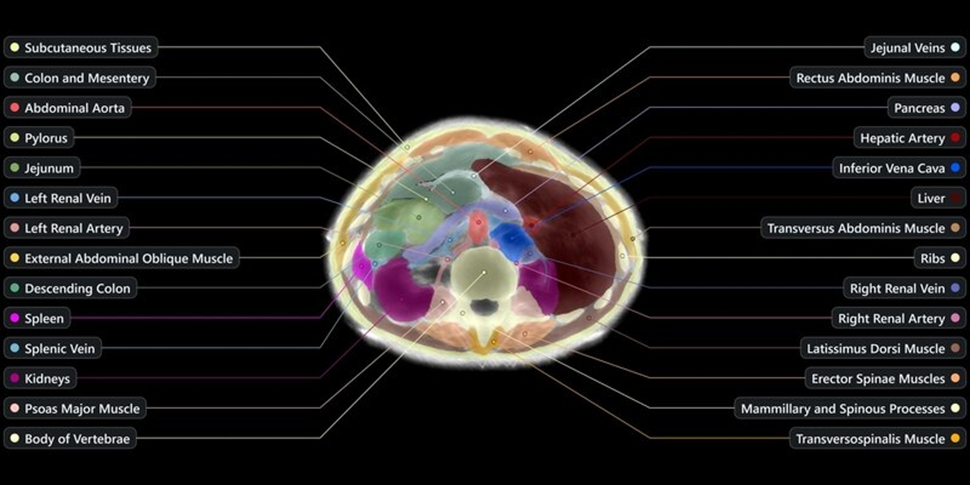
In the case of the Midjourney Scanner, these echoes make it possible to reconstruct an extremely detailed three-dimensional representation of the entire human body:
- muscles;
- organs;
- soft tissues;
- grease;
- vascular structures;
- skeleton.
Water plays a fundamental role because it ensures uniform propagation of ultrasound waves through the various anatomical layers.
Unparalleled computing power
The speed reported by Midjourney depends largely on the system's computing capabilities.
The company states that each scanner includes a computer capable of delivering approximately two petaflops of computing power, a level comparable to that of several high-end graphics cards running simultaneously.1
The volume of data generated is enormous.
According to Midjourney, the system processes more than 17 gigabytes of raw data every second. To put this amount into perspective, the company states that a single second of scanning is equivalent to hundreds of hours of high-definition video.
This processing power is necessary to reconstruct a complete three-dimensional model of the body in near real time.
The entire process would take about 60 seconds, whereas some MRI scans can take several tens of minutes to analyze a single anatomical region.
A revolution… but without artificial intelligence
One of the most surprising aspects of the project is that the Midjourney Scanner currently does not rely on any generative AI to produce medical images.
This clarification is important.
While Midjourney is known worldwide for its artificial intelligence models, the scanner primarily uses mathematical methods of computed tomography to reconstruct anatomical images.3
According to the company, this decision is intended to avoid potential risks associated with hallucinations or reconstruction errors that could occur with certain generative systems.
AI could, however, play a role in the future by:
- improve image quality;
- detect anomalies;
- assist radiologists;
- speed up clinical interpretation.
For now, the system is limited to producing a detailed map of the body without performing any automated medical diagnosis.
"Midjourney Spas": A Strategy That Intrigues
The other surprise concerns the business model the company has chosen.
Rather than selling its scanners directly to hospitals or medical imaging centers, Midjourney plans to open its own facilities called “Midjourney Spas.”4
The first location is expected to open in San Francisco by the end of 2027.
These centers would bring together:
- body scanners;
- wellness areas;
- gyms;
- saunas;
- cold baths.
The idea is to transform the physical exam into an experience focused on prevention and personalized care rather than a traditional medical procedure.

© Midjourney Medical
This approach also offers a major regulatory advantage.
By positioning itself as a body mapping and wellness service rather than a medical diagnostic device, Midjourney could circumvent certain regulatory restrictions imposed on traditional medical devices.
This strategy is already sparking a great deal of debate within the medical community.
An Extraordinary Global Ambition
Midjourney makes no secret of its ambitions.
The company plans to install up to 50,000 scanners worldwide by 2031 and ultimately aims to reach one billion scans per month.4
To achieve this goal, the company is relying in particular on a partnership with Butterfly Network, a specialist in ultrasound-on-a-chip technology. The agreement calls for the integration of advanced ultrasonic imaging modules into every system developed by Midjourney.5
These figures are impressive, but they also raise several questions.
Today:
- Only a handful of people were scanned;
- No large-scale clinical validation studies have been published;
- The FDA has not yet approved the system as a diagnostic device;
- Its actual effectiveness in medical settings has yet to be demonstrated.
The gap between the stated vision and operational reality therefore remains considerable.
Can we really call this a medical revolution?
If Midjourney lives up to its promises, the potential impact could be significant.
A full-body scan performed in one minute could transform:
- early detection;
- monitoring of chronic diseases;
- preventive medicine;
- access to medical imaging.
Shortening examination times would also make it possible to significantly increase the number of patients treated while reducing certain operating costs.
However, several steps are still essential.
Performance must be scientifically validated. Health authorities must assess the system's reliability. Healthcare professionals must also demonstrate that the images produced provide real clinical value.
At this point, the Midjourney Scanner represents more of a technological promise than a medical revolution that has already come to pass.
The Ethical Implications of Large-Scale Body Mapping
Beyond the technical aspects, the project raises several important questions.
The first concerns biometric data. A complete three-dimensional map of the human body represents a considerable amount of sensitive information.
Who will control this data? How will it be stored? Can it be used for research or to train future artificial intelligence models?
Another issue concerns access to technology. If the scanners are initially deployed in high-end centers, there is a risk that advanced preventive medicine will become available only to the wealthiest segments of the population.
Finally, the line between wellness and medicine could become more blurred. When a system detects an anomaly without officially providing a diagnosis, determining how to interpret the results can become complicated for both users and healthcare professionals.
Midjourney is opening an unexpected new chapter
With the Midjourney Scanner, Midjourney has undoubtedly achieved one of the most surprising diversifications in the tech industry in recent years.
The company that helped revolutionize visual design through artificial intelligence now aims to transform medical imaging, a sector whose technological foundations are evolving much more slowly.
The project is still in its early stages, and many uncertainties remain. But it perfectly illustrates a fundamental trend: players in the field of generative AI are now seeking to apply their expertise far beyond the digital realm, venturing into fields as strategic as healthcare.
If these promises are kept, scanning an entire body in 60 seconds could become one of the most significant breakthroughs of the decade.


Learn more
The announcement of a body scanner capable of producing a complete 3D model in just a few seconds illustrates the growing convergence between artificial intelligence, advanced imaging, and precision medicine. On a related topic, check out our article “Artificial Intelligence Improves Cancer Detection by More Than 10%, Pioneering Study Reveals”, which analyzes how AI models are transforming the interpretation of medical data and opening up new possibilities for early diagnosis and prevention.
References
1. Midjourney Medical. (2026). Introducing the Midjourney Scanner.
https://medical.midjourney.com
2. Midjourney. (2026). About Midjourney and Future Research.
https://www.midjourney.com
3. Midjourney Medical. (2026). Technical Architecture of the Midjourney Scanner.
https://medical.midjourney.com
4. Midjourney Medical. (2026). Midjourney Spa Initiative and Global Deployment Plan.
https://medical.midjourney.com
5. Butterfly Network. (2025). Partnership Announcement with Midjourney Medical.
https://www.butterflynetwork.com