
By Fayçal Braham, Data Scientist & IT Project Manager | Tenured Professor at aivancity
March 2026. Yann LeCun leaves Meta, raises a billion dollars, sets up his headquarters in Paris, and announces that the dominant paradigm of artificial intelligence is a dead end. Social media erupts. The debate immediately crystallizes into a binary opposition: LLMs versus World Models, ChatGPT versus JEPA, today’s AI versus tomorrow’s AI. I believe this opposition is a misreading of the situation—and that the real question lies elsewhere.
In this article, when I refer to World Models, I am referring to the approach proposed by LeCun: JEPA and its variants—I-JEPA, V-JEPA, and LeWM—which are the most advanced implementations to date.
Let's take a step back. The history of AI isn't a straight line—it's a series of conceptual breakthroughs, each of which would have been unthinkable given the one before it. I'm simplifying, but that's the idea:
Perceptron → Backpropagation → CNN → Reinforcement Learning → Transformers → LLMs
Each new stage did not destroy the previous one. It incorporated it, moved beyond it, and opened up a realm of possibilities that no one had truly anticipated. And each time, the scientific community initially resisted, before eventually coming around. This is the natural rhythm of deep science, which tends to be slow to change.
What characterizes the current race around LLMs is precisely that it lacks that disruptive quality. More parameters, more computation, more data, upscaling—it’s a process of maximization with a few optimizations here and there, but no real breakthrough. A linear race in a field that has always advanced in leaps and bounds. This doesn’t mean that LLMs are a dead end: they have represented a real, massive breakthrough with significant applications. But they’re hitting a ceiling.
It is in this context that I read Yann LeCun’s work—not as the revealed truth of a Turing Award winner, but as the patient work of a researcher who refuses to be swept up by commercial pressures. Fifteen years spent on ideas that have struggled to prove themselves and gain acceptance. Publications released on the day he left Meta, serving as a scientific legacy rather than a publicity stunt. In an ecosystem where many confuse computational power with depth of understanding, this profile deserves our attention.
But LeCun isn’t an oracle, and JEPA isn’t necessarily the next big thing—it may just be one of the most promising candidates. What interests me here is something else: understanding why LLMs and World Models have more in common than we realize—starting with Transformers themselves—and highlighting what the real divide reveals: not which architecture will prevail, but rather whether AI research still has the means and the courage to think disruptively rather than exhausting itself in a linear, short-sighted race.
Two Philosophies of Research
There’s a question I find more interesting than “who’s right in the LLMs vs. World Models debate”: How is it that an idea can develop behind the scenes for fifteen years, without recognition from the community, while the rest of the world is rushing in a different direction—and yet emerge today as one of the most promising paths toward AGI?
That's exactly what happened with JEPA. And it tells us something important about how AI research is actually progressing.
Behind this debate, there are actually two philosophies that have been silently clashing for years.
The first approach relies on brute force: feeding more data, more computation, and more parameters into Transformers and LLMs and letting intelligence emerge—with a few optimizations added here and there: RLHF, RLAIF, DPO, MoE, GRPO, long contexts, or even test-time compute—letting the model explore multiple lines of reasoning before responding, as in OpenAI o1, DeepSeek R1, and Kimi k1.5. This is the dominant approach today—and it has produced real, indisputable results.
The second approach relies on mathematical depth: finding the right concepts, structures, and representations that break through a barrier. Not by pushing harder on what already exists, but by shifting to a different level. This is what convolutions did for computer vision—not by feeding more data to perceptrons, but by finding the right mathematical and computational approach. JEPA follows this same philosophy—the MPC and LeJEPA’s isotropic Gaussian are not empirical workarounds; they are deep mathematical concepts applied to a new problem.
The history of AI suggests that it is breakthroughs in the second philosophy that lead to real leaps forward. But today, it is the first philosophy that holds sway. Perhaps that is where the real tension lies—not between LLMs and world models, but between two ways of conceiving scientific progress.
Plato’s cave is a useful metaphor here—not to refer to those who are mistaken, but to highlight a structural tension inherent in all fundamental research: the most robust results take time to become apparent. Convincing shadows—coherent texts, impressive benchmarks, spectacular demos—can mask profound limitations. And anyone who says, “Wait, let’s look at what’s really going on,” runs the risk of being ignored, sometimes for a long time. LeCun himself acknowledges this: he is both the one who worked in the dark for fifteen years and the one who is only now beginning to emerge from it—with no certainty that he has seen the full light.
This isn’t a criticism of LLMs. It’s an observation about the ecosystem: when investment, talent, and media attention are overwhelmingly focused on a single paradigm, what areas are we no longer funding? What avenues are we unwittingly closing off?
Perhaps this is the true value of researchers who “march to the beat of their own drum”—not because they are right in principle, but because they keep avenues open that short-term pressures would tend to close off. The history of AI, from perceptrons to Transformers, suggests that the next breakthrough rarely comes from where we expect it.
Despite their limitations, LLMs are a necessary step
LeCun’s criticism of LLMs is well-known, often cited, and sometimes exaggerated. Let’s take the time to understand it precisely—because it highlights something that even LLM advocates are beginning to admit.
An LLM learns by predicting the next token in a text sequence. This mechanism, repeated on a massive scale, produces remarkable systems—and let’s be clear: remarkable within well-defined domains. Text, code, mathematics, computational biology. Wherever knowledge is naturally encoded in symbols, LLMs excel. This is no small feat—it’s a real, massive leap forward with considerable practical implications.
But this mechanism has a structural limitation that scaling does not resolve: it involves no experience of the physical world. An LLM does not know what a table is. It knows that the word “table” appears in certain textual contexts. The distinction may seem philosophical—but it has very concrete consequences.
This is what robotics expert Hans Moravec articulated as early as the late 1980s with his paradox: the tasks that seem simplest to us—picking up an object, crossing a room, understanding that a ball that disappears still exists behind a wall—are the most difficult for machines. Meanwhile, sophisticated tasks like playing chess or passing the bar exam are relatively simple to automate. Forty years later, we have systems that win at the International Mathematical Olympiad. We still don’t have a robot capable of doing what a 10-year-old child does the first time they’re asked.
A striking calculation illustrates this asymmetry: all the text available on the Internet amounts to approximately 10¹⁴ bytes—it would take a human 500,000 years to read it all. A 4-year-old child, on the other hand, has received exactly the same amount of information in four years… but through vision. Vision is a channel with very high bandwidth—and this modest amount is enough to build an understanding of the physical world that no LLM comes close to matching.
This analysis highlights three structural limitations that scaling does not address:
The lack of a physical foundation —LLMs have no representation of causality, time, or physics. They cannot predict what will happen if you drop an object.
The lack of persistent memory —an LLM has only a context window. When the conversation ends, everything disappears. What’s called “memory” in ChatGPT or Claude is a summary injected at the start of each session—we tell the model what it needs to know, but it doesn’t remember it.
The inability to plan —without a model of the world, a system cannot carry out a sequence of actions over the long term to achieve a goal. It reacts; it does not plan.
But is this really a dead end?
Here I would like to point out an important distinction from LeCun’s view. Recent models that break problems down into intermediate steps—the “chain-of-thought” approach—represent an attempt that is certainly limited but nonetheless telling: even within the LLM community, it is recognized that a direct answer is not enough—that intermediate reasoning must be simulated before reaching a conclusion.
And if we take a closer look, the World Models incorporate many of the concepts developed during the LLM period.
Self-supervised learning as a common intuition
BERT masks tokens and asks the model to predict them. JEPA masks image patches or video frames and asks the model to predict their abstract representation. The mechanics differ, but the philosophy is the same: it is by predicting what is missing that a model learns to understand what it sees—without the need for human labels.
Latent Space as Common Ground
Both paradigms operate in embedding spaces—high-dimensional internal representations that capture meaning beyond raw data. And this approach is already more widely adopted than one might think: Flux, DALL-E 3, and Imagen 3 operate in latent spaces, not at the pixel level. CLIP and T5 jointly encode images and text in compatible abstract spaces—architecturally very close to what JEPA aims to do.
A Model of the Emerging World
An LLM trained on enough text develops an implicit model of the world—it knows that Paris is in France, that gravity causes objects to fall, and that contracts have clauses. This is an emergent property, not a deliberate design—but it exists, and we must acknowledge it. The goal of World Models is precisely to construct this model of the world explicitly and physically. Two paths toward the same goal.
Convergence Toward Agents
Both paradigms are currently being used to build autonomous agents. LLM agents plan using text. World Model agents simulate the consequences of their actions in a latent space before planning their next steps. Two different approaches, but the same goal: to carry out a sequence of actions over the long term to achieve an objective.
So this is not a religious war between two irreconcilable camps. It’s a difference of opinion about what we’re trying to produce—plausible text on one side, effective actions in the real world on the other. And this difference raises a question that I find more interesting than “which side will win”: what if the next step were not to replace LLMs with World Models, but to integrate them?
From Reaction to Anticipation: The Heart of the Debate
To understand the vision behind World Models, we must first understand why virtually all current AI—including LLMs—still operates in reflex mode.
Psychologists distinguish between two modes of thinking. System 1 is reactive and immediate—like an experienced driver who drives without thinking, or a tennis player who returns the ball without deliberating. We perceive, encode, and act. System 2 is deliberate—we use a mental model of the world to imagine different sequences of actions, evaluate their consequences, and choose the best one before acting. This is what we do during the first few hours of learning to drive: we hesitate, imagine scenarios, and plan each maneuver. Gradually, this becomes part of System 1 and turns into an automatic process.
The “chain-of-thought” process in LLMs, often presented as a form of planning, illustrates this limitation precisely: the model generates steps in text—which resembles System 2—but without constructing an internal plan grounded in a model of the world. It is System 1 in disguise.
Virtually all current AI operates in System 1. Reinforcement learning—the method that enabled AlphaGo to defeat the best Go players—is the perfect example: the system tries an action, receives a reward or a penalty, adjusts its parameters, and repeats the process millions of times. It’s pure trial and error, without any planning.
The reality is stark: a teenager learns to drive in 10 to 20 hours of practice. We have millions of hours of data available to train self-driving cars—and we still haven’t reached Level 5, a fully autonomous car where you never need to touch the steering wheel.
This observation ties directly into the issue of limitations raised in the introduction: RL has enabled spectacular advances in well-defined environments—board games, optimization of closed systems. But like LLMs when confronted with the physical world, it struggles with the open-ended complexity of the real world. Two dominant paradigms, two different structural limits.
The answer: equipping machines with a model of the world
The goal of World Models is conceptually simple: to give systems the ability to anticipate the consequences of their actions before acting. Not to trial and error millions of times as in RL—but to mentally simulate, like a chess player who calculates several moves ahead without actually making them.
The method combines the World Model with MPC—Model Predictive Control, an optimization technique dating back to the 1960s. The principle is this: based on a model of the system, we seek the sequence of actions that achieves an objective while satisfying certain constraints. We execute the first action, observe the actual result, and recalculate. What’s new here is that instead of manually writing the equations that govern the system—which is impossible in a complex real-world environment—we learn the World Model from the data.
The complete loop: the system perceives the current state of the world, generates an abstract representation, predicts “if I take this action, this is what the state will be in a moment, ” evaluates whether that brings it closer to its goal, optimizes the sequence of actions, executes the first one, observes, and starts over. This is planning—not reaction.
But at what level of abstraction should we plan?
This is where the real challenge lies. This planning must be hierarchical —and that is one of the most difficult problems in AI today.
A simple example illustrates this: a trip from New York to Paris. It’s impossible to plan it down to the millisecond in terms of muscle contractions. You first have to decide to “take a plane,” then “go to the airport,” then “leave the building,” and then “get up from your chair.” Each level uses a different model of the world, at a different level of abstraction. Even its designers agree that building this hierarchy automatically is one of the major unsolved problems in AI.
Four major changes that this approach entails
This paradigm shift involves four profound conceptual breaks from the dominant approach:
- Generative models → in favor of joint-embedding architectures such as JEPA. Stop predicting pixels or tokens; start predicting abstract representations.
- Probabilistic models → in favor of energy-based models. An LLM predicts the next word by generating a probability distribution across the 128,000 possible tokens—which is manageable for discrete text. But in continuous spaces such as videos or sensor data, these distributions become mathematically unmanageable. Energy-based models get around this: instead of calculating probabilities, they calculate an “energy” value—low if a configuration is plausible, high if it isn’t. Simpler, more manageable, and free from the mathematical problems associated with distributions over infinite spaces.
- Contrastive methods → in favor of regularized methods, which are more stable and can be generalized to videos and sensor streams.
- Reinforcement Learning as the primary driver → in support of Model Predictive Control.
An important point about RL
It’s not about abandoning RL entirely—but about changing its role. When used as the primary learning engine, it is extremely inefficient. When used as a correction mechanism—when MPC planning fails, when the actual result diverges from what the World Model predicted—it becomes useful again. This is RL as a diagnostic tool, not as the primary engine. It’s a fundamental difference in role.
We're in a transitional phase—it's uncomfortable, and that's exactly where basic research is most valuable.
JEPA: Fifteen Years in the Dark
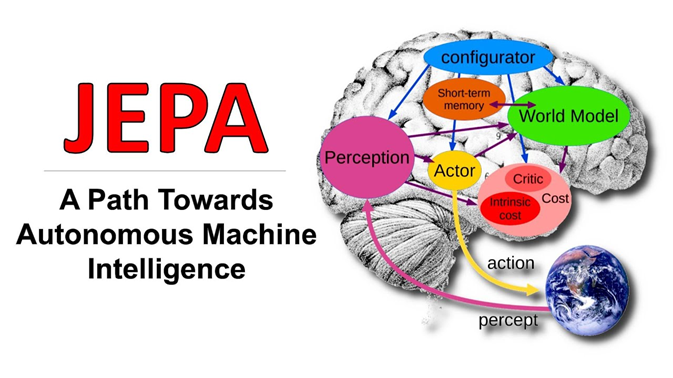
There is something striking about JEPA’s history that the announcements in March 2026 tend to overshadow: it took fifteen years for this architecture to become operational. Ten years of failures. And during that time, the rest of the world was building LLMs.
This may be the most concrete illustration of what I mentioned in the introduction regarding Plato’s cave—not as a romantic metaphor, but as the reality of fundamental scientific work. An idea that we sense is right, that we don’t yet know how to make work, and that we continue to explore while the spotlight is elsewhere.
The Pen Problem
The initial question is simple: How can we learn to predict what happens next in a video? The answer turned out to be a formidable challenge.
When you show four frames from a video to a neural network and ask it to predict the next ones, there are an infinite number of plausible continuations. The example of a pen standing upright, with its tip on the table and an index finger resting on the cap, illustrates this perfectly: we know it will fall as soon as we lift our finger, but it’s impossible to predict in which direction—to the right, to the left, or toward us—a different direction each time.
The network optimizes to minimize the average prediction error. It therefore calculates the average of all possible futures. The average of “falls to the right” + “falls to the left” + “falls toward oneself” results in a blurry image at the center of all possibilities. Mathematically correct, but completely useless.
For years, attempts to correct this—notably by adding hidden variables to account for uncertainty—worked in very simple cases but failed as soon as real videos were introduced. The amount of information needed to predict all the details of a complex scene is simply unmanageable.
The key: breaking free from the tyranny of the pixel
The solution—which seems obvious in hindsight—took years to gain acceptance: don't predict at the pixel level at all.
If the pen falls, there’s no need to predict exactly where each pixel will end up. We can predict that “the pen will be in a horizontal position somewhere on the table.” That’s predictable. That’s useful. That’s where JEPA comes in: instead of predicting the pixels in a video sequence, we predict an abstract representation of that sequence.
The encoder automatically learns to filter out what is unpredictable—the exact direction of the fall, reflections, noise—and retain only what is predictable: basic physics, causal relationships, and the structure of the world.
An analogy from astronomy illustrates this well: if we look at the planets in the sky without the right model, we see complicated paths with epicycles—those circles within circles that ancient astronomers invented to explain the apparent motion of the planets around the Earth. But once we realize that the planets orbit the Sun in elliptical paths, just a few variables are enough to predict Jupiter’s position 50 years from now. The key is always to find the right level of abstraction—not to simulate reality in detail. A World Model is not a world simulator. It is a framework for understanding that allows us to make useful predictions.
JEPA translates this principle precisely into concrete architecture.
What JEPA Does in Practice
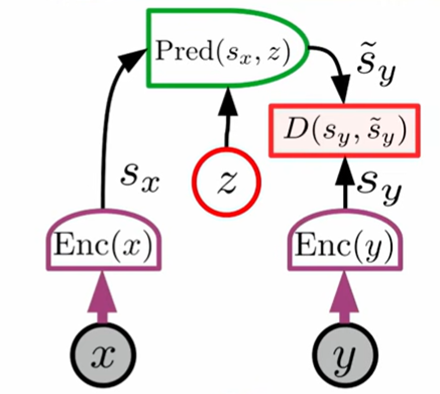
The name directly reflects the architectural choices. Joint: the same encoder processes both parts of the data—the visible context and the masked part—and produces a representation for each in the same abstract space. It is this sharing that is new: in a classical generative architecture, only the input is encoded, and the output is generated at the pixel level. Here, both sides exist in the same space. Embedding: we work on these abstract representations, not on the raw data. Predictive: the predictor takes the visible representation and attempts to guess that of the masked part—never pixels, always an abstract representation. In four words: JEPA (Joint Embedding Predictive Architecture) predicts the future representation, not its pixels.
The predictor also has a free variable Z that quantifies residual uncertainty. By varying Z, it can generate several plausible predictions for the same situation—it is the successor to the latent variables of years past, now operating in a manageable abstract space. And because this space is low-dimensional—a few hundred dimensions rather than millions of pixels—Z can be optimized in a matter of milliseconds during inference to find the action that brings the system closest to the objective. This is where JEPA directly ties into the MPC loop described in “The Answer: Equipping Machines with a Model of the World.”
In practice, the training works like this: you take an image and generate two different views of the same scene—two croppings, two rotations, two lighting conditions. You tell the system: these two views represent the same reality, so the encoder must produce the same abstract representation for both. It is this mechanism that forces the encoder to learn what is invariant in reality—what remains unchanged despite variations in viewpoint, lighting, or angle. This is exactly what we want in a World Model: a representation that captures the stable structure of the world, not superficial details.
But using the same encoder for both parts creates a major risk. First, an important clarification: the encoder is not fixed in advance. It is not a predefined function—it is a neural network whose weights are initialized randomly and adjusted gradually during training. The representations it produces are therefore not imposed; they are learned and evolve at each stage.
It is precisely this freedom that creates the danger: nothing prevents the encoder, a priori, from converging to the trivial solution—producing the same constant vector, say zero, for absolutely every input, regardless of the image. Visible part → zero. Hidden part → zero. The predictor then has a trivial task: it always predicts zero. The error is zero. The system has “won” mathematically, but it has learned nothing about the world. It has simply learned to ignore everything.
The Collapse: When the System Learns to Learn Nothing
Here’s an analogy: a student is asked to summarize a book and is graded by comparing their summary to that of another student. If both students turn in a blank page, the difference between the two summaries is zero—but neither of them has read the book.
Solving this problem—forcing the system to produce rich and distinctive representations—has been one of the central focuses of research in self-supervised learning over the past decade. Contrastive methods, regularized methods, and then DINO with its teacher-student architecture developed by Meta’s FAIR lab in Paris—each approach has made progress, but none had a rigorous mathematical foundation. DINO itself “works for mysterious reasons” —the exact mechanism that prevents collapse is not fully understood theoretically.
It is precisely this shortcoming that LeJEPA addresses; it was published on November 11, 2025—the very day Meta’s departure was announced—as a scientific legacy. The proof: the optimal distribution for representations in a JEPA is the isotropic Gaussian, as mathematically proven. No more tinkering, no more heuristics—two loss terms, a single hyperparameter, zero approximation. Whereas previous methods required up to seven terms to be balanced manually, LeJEPA boils down to the essentials.
What is striking about this journey—fifteen years, ten years of failures, and a final solution of mathematical elegance—is that it resembles an excavation more than a race. Not the optimization of an existing system, but the patient search for the right level of representation. This is exactly what the current ecosystem—with its frenetic announcement cycles and record-breaking fundraising rounds—tends to overlook—until the work on World Models, conducted behind the scenes, finally takes center stage in the debate.
LeWorldModel: When Machines Learn to Think
In March 2026, LeWorldModel—LeWM—reached a significant milestone: the first end-to-end trainable system starting from raw pixels, running on a single GPU, without a frozen pre-trained encoder or technical workarounds.
The numbers are striking. At a time when the industry is building infrastructure for LLMs with trillions of parameters, LeWM uses only 15 million. It trains in just a few hours on a single GPU—not on a billion-dollar cluster. It is 200 times more efficient and 48 times faster at planning a physical action than current generative architectures.
But what's most remarkable isn't its effectiveness—it's what the model learns and how it does so.
Learning Like a Baby
Unlike LLMs, LeWM does not learn by reading Wikipedia. It observes raw pixel data from videos, attempts to predict the next state in its abstract representation space, makes mistakes, and adjusts its internal model. This is pure self-supervised learning—much like a baby observing the world and gradually developing an intuitive understanding of physics.
After a few hours of training, something remarkable happens: the model seems to deduce the laws of physics from what it observes. It understands that an object cannot pass through a wall, that a ball must bounce, and that gravity is a constant. It wasn’t taught physics—it discovers it through observation.
What Sets LeWM Apart from Traditional Deep Learning
En deep learning classique — et c’est ici que le contraste avec les LLMs est éclairant — un modèle apprend P(x_{t+1} | x_t) : étant donné l’état actuel, prédit l’état suivant. Pas d’action, pas d’agent. Le système observe et décrit, sans jamais modéliser sa propre capacité à intervenir sur le monde.
LeWM réintroduit une variable que les LLMs avaient évacuée : l’action. Le modèle apprend P(x_{t+1} | x_t, a_t) — l’état futur prédit conjointement à partir de l’état actuel et d’une action envisagée. Ce n’est pas une invention ex nihilo : c’est l’ADN du contrôle optimal depuis Bellman, du RL model-based — dont MuZero de DeepMind est un exemple emblématique — et du MPC.
What’s new is not so much the variable itself as what it opens up in this specific context: counterfactuality—reasoning about possible worlds. We’re moving from a model that describes the world to one that answers “What if I did that?” Prediction becomes conditional on an acting subject—which allows us to explore imaginary trajectories and optimize them before taking action.
It is less a revolution than a return of the agent to a setting that language models had abandoned.
The Problem of Hidden Action
But most of the available videos do not show the action directly. We see the initial state, we see the final state—but the action itself, the intentions, and the forces applied are hidden. Without that, we learn about correlations, not causations.
The solution developed in early 2026: inferring a latent action based solely on the initial state/final state pair. An internal module attempts to deduce which action caused the transition, even without having seen it. By observing only the initial and final states of a scene, the system deduces something resembling a concept—for example, “move to the right.” When applied to a new situation, this concept produces the same effect on another person in a different context.
This limitation is openly acknowledged: the system can infer a causality that does not exist. It’s like young children who think that the moving leaves are what cause the wind. Causality is difficult to identify correctly—even for humans. This is one of the most promising areas of research at AMI Labs.
Where do we really stand?
The initial experimental results are significant: a video model trained with JEPA detects physically impossible events—such as a ball disappearing mid-flight—exactly as 10-month-old babies would, widening their eyes in response to the unexpected. It is the first known system to have acquired a form of physical intuition.
But a cold irony puts things into perspective: a robot arm trained using self-supervision on 100 years’ worth of videos manages to figure out how to move a glass. “100 years’ worth of videos is just one day’s worth of uploads on YouTube.” That’s not much—and moving a glass remains a trivial task for a 2-year-old.
These results are both proof that the approach is on the right track and a stark reminder of how far we still have to go. We’ve emerged from the cave—but only just. The light is there, somewhere ahead. The next step isn’t visible yet.
AMI Labs: A Long-Term European Commitment
In November 2025, Yann LeCun officially announced the creation of AMI Labs—Advanced Machine Intelligence—with its headquarters in Paris. The funding round announced in March 2026 totaled $1.03 billion, the largest seed round in the history of European tech, valuing the company at $3.5 billion even before it had released a product.
The names behind the investment—Nvidia, Samsung, Toyota, Bezos, Bpifrance, and the Dassault Group—send an important message: serious industrial players are betting on an alternative approach to LLMs, led by a team whose scientific credibility is beyond question. This isn’t speculative venture capital—it’s a bet on a paradigm.
Five Areas Where LLMs Fail Structurally
AMI Labs' roadmap specifically addresses the areas of failure identified in the previous sections.
Health first—analyzing and predicting organ behavior, interpreting complex medical data, and aiding in diagnoses. Nabla has been announced as the first partner—a logical choice: Alexandre Lebrun, CEO of AMI Labs, is its founder. This is also a field where a single error can have fatal consequences—which makes the structural reduction of errors not just desirable but necessary.
Next,industry —modeling the behavior of an aircraft engine, a power plant, or a production line to predict failures or optimize processes. These are fields where physical causality is central and where an LLM without a connection to the real world cannot operate.
Robotics — a humanoid robot in a home environment encounters new situations every day. Reinforcement learning (RL) cannot anticipate everything during training. A World Model allows it to mentally simulate what will happen before acting — which would enable the robot to move from narrow, repetitive tasks to general adaptability.
The self-driving car —despite billions in investment, no one has yet reached Level 5. Waymo is a case in point: semi-autonomous cars that operate only in mapped areas and can call a human operator in the event of an unexpected situation. That’s not true autonomy—it’s just handling known cases. A World Model can project scenarios and adjust its path accordingly, even without having encountered that specific situation in the training data.
Finally, AI agents —an LLM agent can break down a task into steps, but its planning remains textual, without a world model to verify that each step is actually executable. An agent based on a world model simulates the actual consequences of each action and can detect an inconsistency before carrying it out.


The European Question
AMI Labs explicitly positions itself as “one of the few cutting-edge AI labs that is neither Chinese nor American.” I think this statement is worth pausing to consider—not as a slogan, but as an observation.
In a few years, most of our interactions with the digital world will take place through AI assistants. If these assistants are produced by just a handful of American or Chinese companies, this creates a form of cultural, linguistic, and political dependence that we underestimate. It’s as if all the world’s information were available only through a single newspaper.
Yann LeCun, Demis Hassabis—co-founder and CEO of Google DeepMind—the founders of Mistral, the founders of Hugging Face: Europe is producing researchers and entrepreneurs capable of thinking outside the box, resisting short-term pressures, and building credible alternatives to the American and Chinese giants. This potential exists. What has been missing so far is the ability to transform it into research labs capable of competing on a global scale. AMI Labs may be one answer—or at least a serious attempt.
AMI Labs: Three Possible Futures
One question remains unanswered, and it is more important than the fundraising effort: What will be the real impact of AMI Labs in the coming years?
There are three possible scenarios. The first, and most ambitious: AMI Labs contributes to the next step toward an AI that truly understands the world—a major stride toward AGI. The second, more likely in the short term: AMI Labs establishes itself as a leader in targeted fields—medicine, robotics, industry—without necessarily changing the overall paradigm. Concrete, meaningful, but limited applications. The third, the most low-key but perhaps the most enduring: AMI Labs lays scientific groundwork that others, in ten or twenty years, will use without even citing the original work. This is often how science advances—the one who lays the foundation is not always the one who crosses the threshold.
The real test isn't fundraising, but what the basic research at AMI Labs will produce over the next three to five years.
What if the real question lay elsewhere?
Let’s return to the question posed in the introduction. Not “LLMs or World Models?”—but what this debate reveals about the state of AI research and the choices we make collectively.
Three conclusions emerge from this analysis.
LLMs aren't a dead end—but they're probably just a stepping stone, not the final one.
What GPT, Gemini, and Claude have accomplished is real and massive. Systems capable of reasoning in natural language, generating code, and assisting with medical diagnoses—this is a historic milestone. But the history of AI teaches us that every milestone eventually hits its structural limits. The perceptron hit a wall with XOR. Reinforcement learning (RL) is stymied by the complexity of the real world. Large language models (LLMs) are stymied by physical constraints, memory, and real-world planning. To call this a dead end would be unfair. To fail to see it would be naive.
LLMs and world models are not mutually exclusive—they are converging on the same problem.
They share common building blocks—self-supervision, embedding spaces, and Transformers. They differ in what they optimize—tokens or abstract representations of the world. But this difference is not a contradiction—they are two different approaches exploring the same space. Multimodal models, chain-of-thought, and the emergence of planning capabilities in the latest LLMs—all of this suggests that the two paradigms are operating in the same space. The next step may be a conceptual and practical synthesis, much like our five human senses, which, though each incomplete on its own, together produce a coherent perception of the world.
Europe has a role to play—provided it gives itself the resources and time to do so.
Europe has exceptional scientific talent. What has been lacking so far is the ability to turn that talent into laboratories capable of competing on a global scale. AMI Labs may be one answer. But a startup—even a well-funded one—is not enough. The real question is whether Europe is ready to invest in basic research with the patience it requires—not with an eye toward the next quarter, but toward the next milestone.
How the World Model / JEPA Is Truly Changing Our Understanding of AI
Beyond the technical debate, JEPA raises a question that I find fundamental: What does it mean to learn? An LLM learns by absorbing texts produced by human intelligence—it inherits a representation of the world that has already been formulated. A World Model learns by observing the world directly—it constructs its own representations from raw data. These are not the same epistemologies—and this difference has profound implications for what we can expect from these systems.
A slide displayed in red at the conclusion of a recent conference sums up the LeCun team’s position: “If you are interested in human-level AI, don’t work on LLMs.” It’s a deliberate provocation—and a legitimate scientific position. But I’d rather focus on the question it raises: What is intelligence that truly understands the world?
We may be in the same situation as the prisoner in the cave who is beginning to turn around—not yet out, not yet in the full light, but aware that the shadows on the wall are not the whole reality.
The next milestone won’t be an announcement, a funding round, or a benchmark. It will be the moment when a machine does something reasonable that it wasn’t taught to do—and that we can’t immediately explain. The moment when LLMs’ “hallucinations” would be nothing more than plausible scenarios. When a robot would learn as quickly as a baby. When a medical AI would anticipate a complication without ever having been shown that specific case.
Learn more
Read our analysis of Meta’s DINOv3, which explores the I-JEPA architecture and the self-supervised learning models developed by Meta—the research that now forms the technological foundation of AMI Labs.
References
1. Euronews. (March 2026). AMI, a French AI startup.
https://fr.euronews.com/2026/03/10/ami-une-startup-francaise-de-lia-annonce-une-levee-de-fonds-dun-milliard-de-dollars
2. TechCrunch. (March 2026). AMI Labs raises $1.03 billion.
https://techcrunch.com/2026/03/09/yann-lecuns-ami-labs-raises-1-03-billion-to-build-world-models/
3. LeCun, Y. (2022). A Path Toward Autonomous Machine Intelligence.
https://openreview.net/pdf?id=BZ5a1r-kVsf
4. Garrido, Q., LeCun, Y., et al. (2026). Learning Latent Action World Models In The Wild.
https://arxiv.org/abs/2601.05230
5. LeCun, Y. (2026). “Perspectives on AI” Lecture, Gustave Eiffel University.
https://www.youtube.com/watch?v=nqDHPpKha_A
6. LeCun, Y. (2026). Special Lecture on AI and World Models. NYU / AMI Labs.
https://www.youtube.com/watch?v=vJKC31YpA8c