
For a long time, the global race for artificial intelligence seemed to be dominated by American research labs. OpenAI, Anthropic, Google, and xAI held the top spots in international rankings, while Chinese models struggled to compete on the most demanding benchmarks. This dynamic is changing rapidly. Following DeepSeek, GLM-5.2, and Qwen3.7-Max, a new competitor is now grabbing everyone’s attention: Kimi K3, the latest model developed by the Chinese startup Moonshot AI.
With a Mixture of Experts (MoE) architecture comprising 2,800 billion parameters, Kimi K3 aims to rival the most advanced proprietary models on the market while maintaining an open approach. More than just a technical improvement, its launch confirms the spectacular acceleration of China’s artificial intelligence ecosystem and illustrates the gradual narrowing of the gap with U.S. leaders.
Moonshot AI Wants to Shift the Global Balance of Power in AI
Founded in Beijing in 2023, Moonshot AI has quickly established itself as one of China’s most ambitious companies in the field of large language models. After releasing several versions of its Kimi family, the startup is now unveiling Kimi K3, a model designed to meet the needs of both developers and businesses.
Like its main competitors, Kimi K3 can generate code, analyze complex documents, assist with research tasks, automate business processes, and even serve as the foundation for AI agents capable of executing complete workflows.
The goal is clear: to offer a credible alternative to the models developed by OpenAI, Anthropic, or Google, while focusing on making the ecosystem more open.


The Kimi K3 Joins the Ranks of the Top-Performing Models
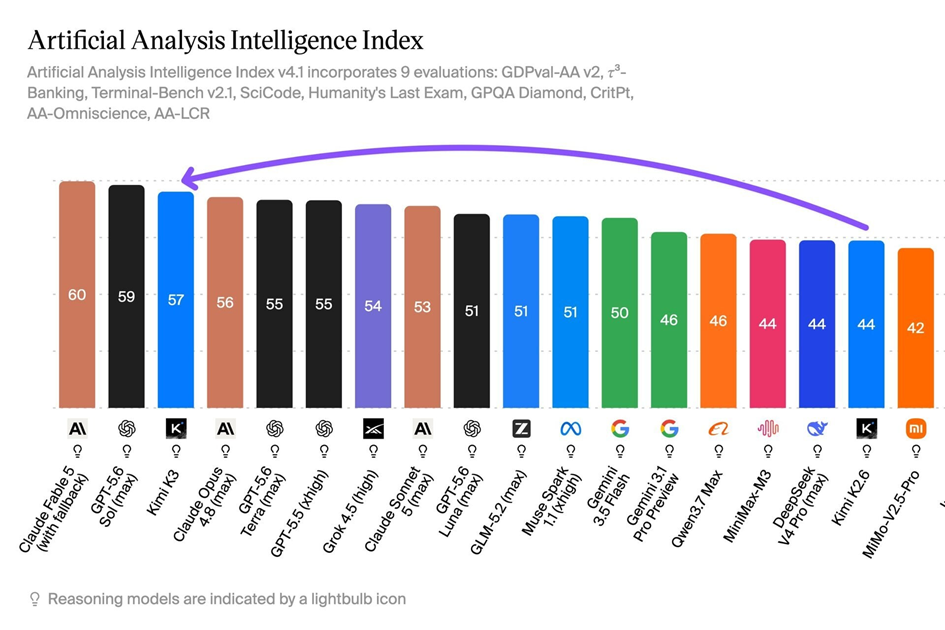
Just a few days after its launch, Kimi K3 is already among the world's top-ranked artificial intelligence models.
According to the Artificial Analysis Intelligence Index v4.1, which aggregates several leading benchmarks such as Humanity’s Last Exam, GPQA Diamond, SciCode, and Terminal-Bench, Kimi K3 now ranks third globally, just behind Claude Fable 5 and GPT-5.6 Sol. In particular, the model outperforms Claude Opus 4.8, GPT-5.6 Tetra, Grok 4.5, Gemini 3.5 Flash, DeepSeek V4-Pro, and GLM-5.2.1
This improvement is particularly impressive when comparing Kimi K3 to its predecessor. While Kimi K2.6 was still among the mid-tier models, the new version has made a spectacular leap forward and narrowed the gap with the best proprietary AIs on the market to just a few points.
Notable Achievements in Software Development
One reason Kimi K3 attracts so much attention is its performance in software development.
Evaluations published by Moonshot AI show that the model achieves particularly high scores on several specialized code-generation benchmarks. In some tests, it even outperforms several U.S. proprietary models.
Kimi K3 also stands out on Frontend Code Arena, an independent ranking that evaluates models' ability to produce modern, functional web interfaces that developers can use right away. These results reinforce its position as a tool designed for both software engineers and development teams that use coding assistants.
AI Designed for Agents and Automation
Beyond coding, Moonshot AI places a strong emphasis on agent-based applications.
In particular, Kimi K3 achieves one of the highest scores on GDPval-AA v2, a benchmark that measures models’ ability to perform real-world tasks autonomously, ranging from analyzing information to executing complex processes.
This shift confirms a broader trend observed across all major tech companies: AI models are no longer designed solely to answer questions, but are gradually becoming engines capable of powering autonomous assistants, automating business workflows, and interacting with various software tools.

An open architecture with 2,800 billion parameters
One of the key features of Kimi K3 is its Mixture of Experts (MoE) architecture.
The model is based on 2,800 billion parameters, but only a subset of these experts is activated for each query. This approach significantly increases the model's capabilities while limiting computational costs during inference.
Moonshot AI also offers Kimi K3 through a so-called " open" approach, allowing developers, researchers, and companies to study it, adapt it, or deploy it within their own infrastructure in accordance with the terms defined by the company.
This strategy aligns Kimi K3 with the open-model initiatives spearheaded in recent months by DeepSeek and Qwen and helps make access to very large models more widely available.
China Confirms Its Accelerated Progress in Artificial Intelligence
The launch of the Kimi K3 goes far beyond a simple technology announcement.
In less than two years, several Chinese companies have succeeded in developing models capable of competing with the best international benchmarks. DeepSeek, Alibaba, Zhipu AI, Moonshot AI, and MiniMax are now helping to make China one of the world’s leading centers for research and innovation in artificial intelligence.
This rise in influence is gradually shifting the balance of power in the industry. Whereas U.S. manufacturers once largely dominated international rankings, competition is now much more open, with several Chinese models capable of achieving comparable performance levels on many benchmarks.
A New Milestone in the Global LLM Competition
With Kimi K3, Moonshot AI demonstrates that open models can now come close to matching the performance of the most advanced proprietary systems.
This development is excellent news for developers and businesses, who now have an ever-wider range of high-performance models to choose from based on their technical needs, sovereignty requirements, or deployment costs.
More broadly, Kimi K3 confirms that the next phase of the global competition in artificial intelligence will no longer be limited to OpenAI, Anthropic, and Google. Chinese players are now emerging as competitors capable of having a lasting impact on the evolution of large language models.
How does Kimi K3 work?
Kimi K3 is a large language model (LLM) developed by the Chinese startup Moonshot AI. Designed to compete with the most advanced models from OpenAI, Anthropic, and Google, it is based on a Mixture of Experts (MoE) architecture with 2,800 billion parameters. Unlike traditional dense models, this architecture activates only a portion of the parameters for each query, which improves performance while limiting computational costs. This approach offers a better balance between power, execution speed, and energy efficiency.
Kimi K3 is a versatile model capable of understanding and generating text, writing code, analyzing documents, solving complex problems, and automating tasks. It has been trained on large volumes of multilingual data and optimized for reasoning, programming, and the use of artificial intelligence agents capable of performing a sequence of actions autonomously.
One of the key features of Kimi K3 is its positioning as an open-source model (Open Weights). Moonshot AI makes the model’s weights available so that researchers, developers, and companies can study, adapt, or deploy it in their own environments. This strategy fosters innovation and offers an alternative to the fully proprietary models offered by major U.S. research labs.
Kimi K3’s performance quickly caught the attention of the artificial intelligence community. According to the Artificial Analysis Intelligence Index v4.1, the model ranks among the top three AI systems on the market. It also achieves excellent results on several specialized benchmarks in code generation, web development, and the automation of complex tasks, confirming its focus on professional applications and software development.
- Mixture of Experts (MoE) Architecture: 2,800 billion parameters with selective activation of experts to optimize performance
- Advanced Reasoning: Complex Problem Solving, Logical Analysis, and Decision Support
- Software development: code generation, explanation, correction, and optimization in multiple programming languages
- Task Automation: Support for Complex Workflows and Integration with Artificial Intelligence Agents
- Multilingual Processing: Understanding and Generating Content in Multiple Languages
- Open Model (Open Weights): Researchers and companies can deploy the model on their own infrastructure
- Top-tier performance: ranked among the world's best models according to several independent benchmarks
- Despite being open-source, Kimi K3 requires significant hardware resources to run locally due to its very large size
- The performance observed in benchmarks does not necessarily reflect all use cases in a business or production environment.
- Like other large language models, Kimi K3 can produce factual errors or hallucinations and requires human validation for critical uses
- The model remains primarily optimized for the languages most heavily represented in its training data; therefore, performance may vary depending on the language and application domain.
- Its deployment in a professional environment involves security, data governance, and regulatory compliance challenges comparable to those of other state-of-the-art LLMs
Learn more
The arrival of the Kimi K3 confirms the rise of open-weight models capable of competing with industry leaders while promoting greater openness in the AI ecosystem. On a related topic, check out our article “ MiniMax’s M3: A New Open-Weight Giant Challenges OpenAI and Anthropic,” which analyzes how a new generation of open models is redefining global competition among AI labs and accelerating innovation in the field of large language models.
References
1. Artificial Analysis. (2026). Artificial Analysis Intelligence Index v4.1.
https://artificialanalysis.ai/