
Artificial intelligence is taking another step forward in its integration into professional workflows. With this development, Gemini is no longer limited to answering questions or generating text; it is now capable of directly producing complete deliverables, structured PDFs, spreadsheets, or ready-to-use presentations. This advancement marks a significant turning point, as it brings AI closer to traditional office tools by eliminating a key step: formatting and final production.
This development is part of a broader trend in which AI assistants are becoming execution tools, capable of transforming an intention into a concrete result. Whereas users previously had to copy, structure, and adapt the generated content, Gemini now handles the entire process. AI no longer simply produces a response; it generates a document that is immediately usable, which profoundly changes workflows.
From text generation to the production of complete documents
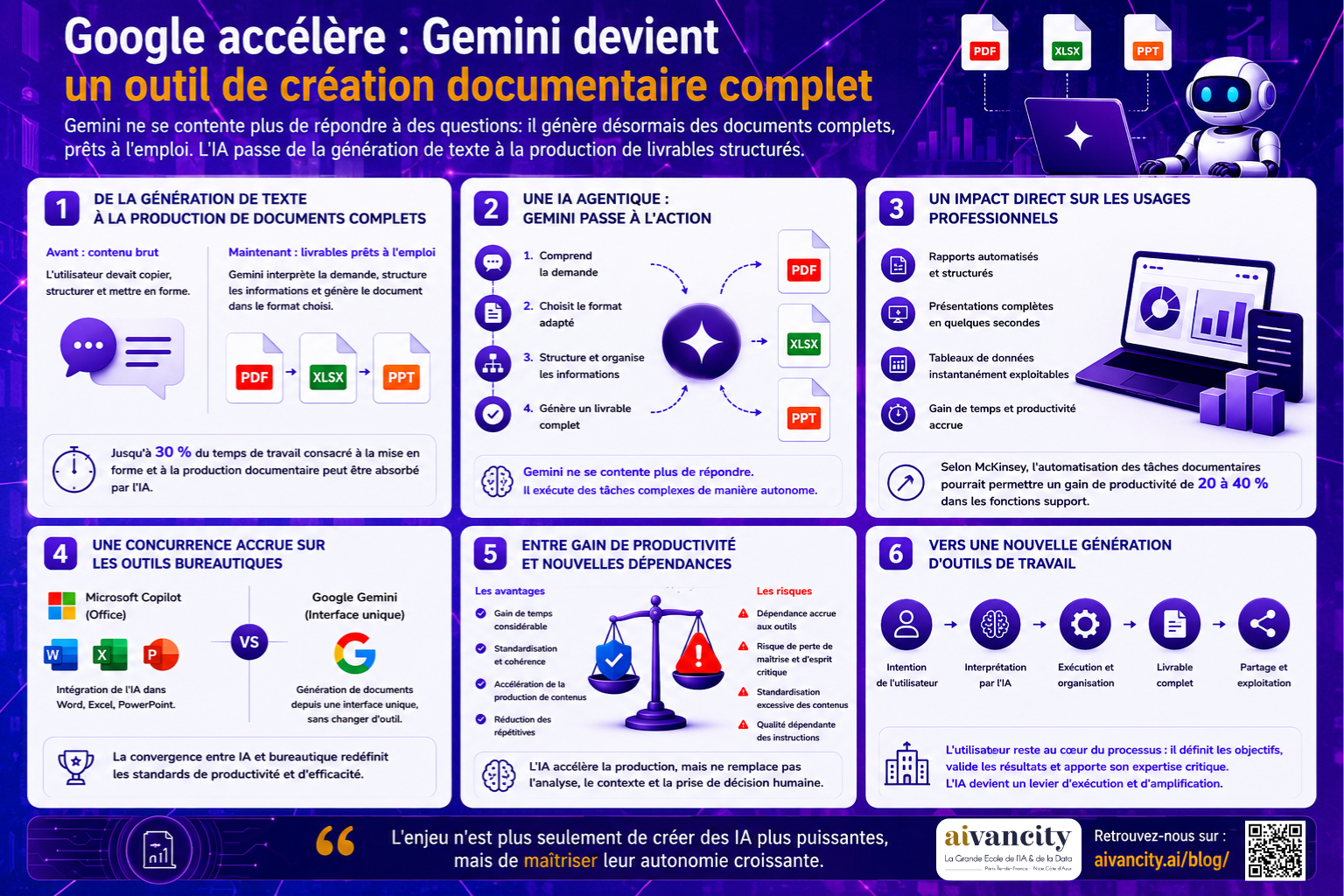
Until recently, generative AI tools were primarily used to produce raw content, such as text, ideas, or drafts. Users were still responsible for transforming these elements into usable documents. With this new capability, Gemini has taken a decisive step forward by integrating structuring, formatting, and document logic into the generation process.
In practical terms, users can now request the creation of a PDF report, a structured data table, or a presentation, and immediately receive a ready-to-use result. This automation significantly reduces the time required to produce documents. According to several industry estimates, formatting tasks account for up to 30% of the time spent on certain office projects—time that AI can now handle.
A shift toward agent-based AI
This feature perfectly illustrates the rise of agent-based AI. Gemini no longer simply responds; it takes action. It interprets a request, identifies the appropriate format, structures the information, and generates a complete output. This ability to perform multiple steps autonomously marks a significant departure from previous generations of AI.
This approach positions Gemini more as an assistant capable of performing complex tasks than as a simple conversational tool. The user expresses an intention, and the AI translates it into action. This paradigm shift transforms the user interface, turning it into a single entry point for creating, organizing, and sharing information.


A direct impact on professional use
The integration of document generation opens up a wide range of use cases. In businesses, Gemini can be used to produce reports, create sales presentations, or organize data in spreadsheets. This capability reduces the friction between ideation and execution, enabling a quick transition from idea to deliverable.
In the fields of marketing, finance, and consulting, this trend can speed up content production while standardizing certain formats. For example, a team can generate a complete presentation based on a brief, or produce a data table that is immediately usable. According to a McKinsey study, automating document-related tasks could lead to productivity gains of 20 to 40 percent in support functions.
Increased competition in office software
With this development, Google is strengthening its position against established players in the office software market. Microsoft, with Copilot integrated into Office, is following a similar path by incorporating AI into Word, Excel, and PowerPoint. Gemini is joining this competition by offering a more centralized approach, where documents are generated directly from a single interface.
This convergence of AI and office software is transforming the market. These tools are no longer merely productivity software, but intelligent systems capable of assisting users at every step. This evolution could redefine productivity standards by reducing reliance on traditional tools and fostering more integrated environments.
Between increased productivity and new dependencies
While this automation offers clear advantages, it also raises some questions. The ease of generating content can lead to increased reliance on tools, with the risk of losing control over document structure. Furthermore, the quality of the results always depends on the relevance of the instructions provided to the AI.
Content standardization is also a challenge. By automating production, documents can become more uniform, at the risk of reducing the diversity of approaches. AI can speed up production, but it does not replace the human ability to analyze, contextualize, and make decisions.
Toward a new generation of work tools
With this feature, Gemini exemplifies a broader transformation in digital tools. AI is no longer limited to providing assistance; it is becoming a central player in the production process. This evolution marks the shift from passive tools to systems capable of performing complex tasks autonomously.
This shift does not mean the end of traditional tools, but rather their evolution. The user remains at the heart of the process, setting objectives, validating results, and providing critical expertise. AI becomes a driver of productivity, but it is people who determine its use and value.
How does document generation work with Gemini?
Document generation in Gemini is based on a multimodal artificial intelligence architecture that combines natural language processing, data structuring, and document format generation. Unlike traditional models that produce only text, Gemini is capable of interpreting a complex request, transforming it into a logical structure, and then generating a complete document in a usable format, such as a PDF, spreadsheet, or presentation.
The system operates in several stages. It first analyzes the user’s intent, identifies the expected document type and the necessary elements (content, structure, data), and then generates a well-organized and consistent version. This capability is based on models capable of handling text, tables, and visual elements, while adhering to formatting constraints.
Integration with the Google ecosystem also allows these documents to be linked to other tools, enhancing their usefulness in a professional and collaborative setting.
- Generation of complete documents: creation of PDFs, spreadsheets, and presentations
- Automatic structuring: logical organization of content according to the requested format
- Contextual adaptation: taking into account business needs and document type
- Multimodality: a combination of text, data, and visual elements
- Google Integration: Native Compatibility with Workspace and Collaboration Tools
- Dependence on instructions: a quality related to the precision of the user prompt
- Standardization: the risk of creating formats that are too uniform
- Needs review: the generated content needs to be proofread and approved
- Complexity of advanced cases: limitations regarding highly specialized or regulated documents
- Governance Issues: Management of Sensitive Data and Information Confidentiality
Learn more
Gemini’s evolution into a comprehensive document creation environment illustrates a broader transformation in AI-powered productivity tools. On a related topic, check out our article “OpenAI is changing research with Prism, its free AI workspace”, which analyzes how AI platforms are evolving into true integrated workspaces capable of combining research, summarization, writing, and information organization.