Artificial intelligence continues to expand its scope, and design is now among the fields undergoing the most profound transformation. With the launch of Claude Design, powered by the Opus 4.7 model, Anthropic is taking a significant step forward by offering a system capable of designing interfaces, visuals, and presentations based on simple text instructions. This development is not merely a technological advancement; it marks a shift in how creative projects are conceived, produced, and iterated. By leveraging high-performance reasoning and multimodal generation capabilities, Anthropic positions its tool as a credible alternative to traditional solutions, to the point of directly impacting financial markets, with an immediate reaction in Adobe and Figma stock prices.
Performance that reflects a genuine upward trend
One of the most notable aspects of the Opus 4.7 release is its performance on industry-standard benchmarks, particularly in agent-based tasks and complex reasoning. On SWE-bench Pro, a key evaluation metric for measuring autonomous coding capabilities, the model achieved 64.3%, compared to 53.4% for Opus 4.6 and 57.7% for GPT-5.4, reflecting significant progress. On SWE-bench Verified, the score climbs to 87.6%, confirming improved reliability in more constrained environments.
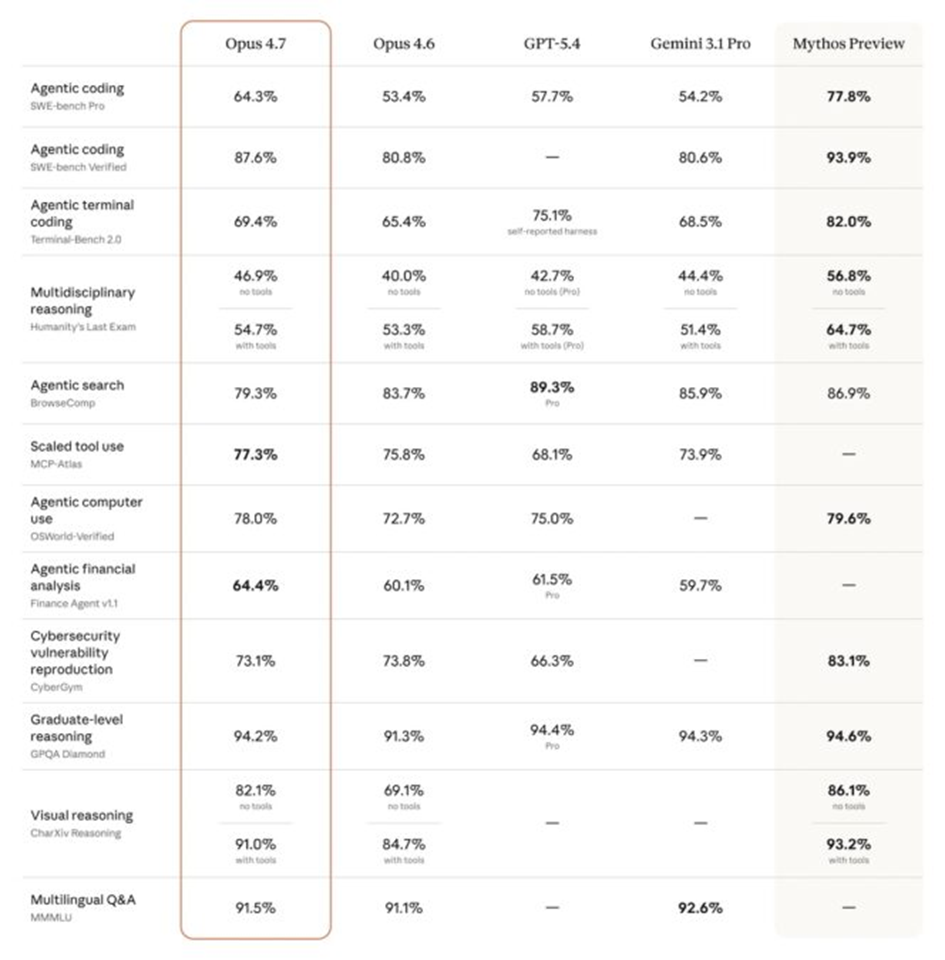
Benchmark comparison of Opus 4.7 versus Opus 4.6, GPT-5.4, Gemini 3.1 Pro, and Mythos Preview across 13 evaluations.
© Anthropic.
More broadly, the results show significant improvement across all key dimensions, from multidisciplinary reasoning to the use of tools in real-world contexts. In particular, the model achieves a score of 94.2% on GPQA Diamond, a doctoral-level benchmark, placing it on par with the most advanced models on the market. This progress is not limited to isolated scores; it reflects an increased ability to handle long, complex, and interconnected tasks.
Significant progress in agent-based modeling
The data provided by Anthropic also shows a steady improvement in performance as computational effort increases. At each level—from low to max—Opus 4.7 outperforms its predecessor, delivering greater efficiency for a comparable or lower number of tokens. This ability to optimize the balance between performance and computational cost represents a strategic advantage, particularly for companies deploying these models at scale.
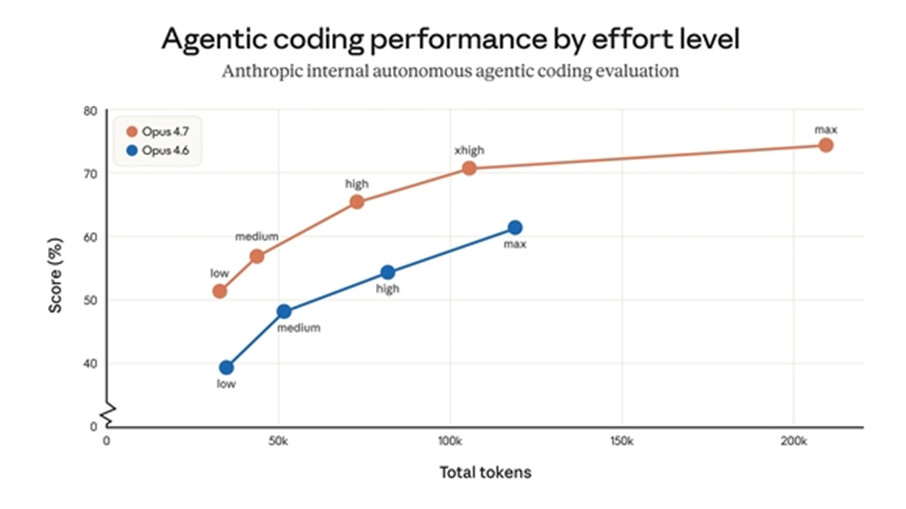
Agentic coding performance by effort level (low, medium, high, xhigh, max): Opus 4.7 outperforms Opus 4.6 at every level, delivering higher performance with fewer tokens.
© Anthropic.
This advancement is part of a broader trend—agent-based AI—in which models no longer simply generate responses, but autonomously perform complex tasks by utilizing tools and adjusting their strategy in real time.
Claude Design: Toward Design Driven by Intention
Beyond technical performance, Claude Design introduces a new approach to visual design. Users no longer manipulate design tools directly; instead, they express an intention, which the AI translates into a concrete result. This approach makes it possible to generate interfaces, presentations, or app prototypes in a matter of seconds, while still allowing users to iterate and refine the result.
This approach is fundamentally transforming the role of creative tools. Design is becoming a conversational process, in which AI acts as a partner capable of suggesting, refining, and improving designs. This shift is bringing design tools closer to software development environments, where abstraction and automation drive greater efficiency.
Enhanced multimodal capacity
One of the major improvements in Opus 4.7 concerns the processing of visual content. The model is capable of handling images at a significantly higher resolution than previous versions, which directly improves the quality of the generated interfaces. This capability is essential for design-related applications, where visual accuracy and graphic consistency play a crucial role.
This development is part of the convergence between text and images that characterizes multimodal models. It enables Claude Design to produce richer content that is better suited to professional needs by combining text and image generation within a single workflow.
A strategy that directly impacts the market
The launch of Claude Design is not merely a technological innovation; it is part of a strategy aimed at capturing a share of the creative tools market. Historically dominated by players such as Adobe and Figma, this sector is now undergoing rapid transformation, driven by artificial intelligence.
The financial markets’ reaction to Anthropic’s announcement illustrates this trend. Figma’s stock price fell significantly, while Adobe’s stock was also affected, reflecting investors’ concerns about the emergence of new business models. This reaction underscores a key point: AI is no longer merely improving existing tools; it is redefining the rules of the game.
Adoption facilitated by broad integration
Claude Design is directly accessible through existing Anthropic subscriptions, as well as via major cloud platforms and APIs. This integration makes it easier for businesses to adopt the tool, as they can incorporate it into their existing workflows without requiring major changes to their infrastructure.
The model also maintains a stable pricing policy, with a fee of $5 per million tokens for deposits and $25 for withdrawals, which contributes to its competitiveness. This strategy aims to accelerate adoption while remaining consistent with previous offerings.
Ethical Issues and the Transformation of Creative Practices
The rise of tools like Claude Design raises important questions about the evolution of creative professions. The ability to quickly generate visuals or interfaces can reduce the need for certain technical tasks, while increasing the importance of skills related to design, strategy, and creativity.
It also raises questions about intellectual property, content standardization, and the role of humans in the creative process. In this context, the challenge lies not only in the performance of the models, but also in how they are integrated into professional practices.
Toward a new generation of creative tools
With Claude Design and Opus 4.7, Anthropic isn’t just offering a new tool—it’s introducing a new way of approaching design. AI takes center stage, capable of understanding complex intentions, producing coherent results, and adapting to users’ needs.
This trend could permanently transform the landscape of digital design by making tools more accessible, more powerful, and more integrated. It also raises a strategic question: will established platforms be able to adapt to this new paradigm, or will their position gradually come under threat?
How does Claude Opus 4.7 work?
Claude Design is built on an advanced architecture that combines generative artificial intelligence, agent-based reasoning, and multimodal capabilities. The system is based on the Opus 4.7 model, which can simultaneously process text, images, and complex structures to generate complete designs based on natural language instructions.
Unlike traditional design tools, which require direct manipulation of visual elements, Claude Design allows users to describe an overall concept that the model then translates into interfaces, presentations, or functional prototypes. The system operates through continuous interaction between several modules: the model analyzes the request, breaks the problem down into subtasks, generates the necessary elements, and verifies the consistency of the result before outputting it.
This self-checking capability, combined with an expanded context window, enables the management of complex, multi-stage projects while maintaining overall consistency. Integration with external tools and development environments reinforces this approach, allowing the system to act as an agent capable of orchestrating complete workflows.
- Conversational design: creating interfaces and visuals based on prompts
- Multimodal generation: a combination of text, images, and project structure
- Agent-based reasoning: decomposition and autonomous execution of complex tasks
- Self-check: validation of results before reporting
- High-resolution support: creation of precise and detailed visuals
- Model dependency: quality related to the performance of the Opus 4.7 model
- Complexity of the results: difficulty in interpretation for non-expert users
- Risk of standardization: homogenization of generated designs
- Ownership Issues: Uncertainties Regarding Rights to Produced Content
- Computational cost: resources required for complex tasks
Learn more
Canva’s rise to prominence is a broader illustration of how artificial intelligence is transforming creative tools, amid increasing competition among platforms. On a related topic, check out our article “Meta x Midjourney: A Strategic Alliance to Revolutionize AI Images and Video”, which analyzes how partnerships and technological innovations are reshaping the balance of power in the visual creation industries.