
Agent-based artificial intelligence continues to evolve at a rapid pace. After reserving its most advanced capabilities for Claude Opus 4.8 for several months, Anthropic is now shifting its strategy with the launch of Claude Sonnet 5. More autonomous, more powerful, and significantly more affordable, this new model aims to offer an experience very similar to that of Opus while being accessible to a wider range of companies and developers. Capable of browsing the web, using a terminal, planning complex actions, and verifying its own work, Sonnet 5 marks a new milestone in the democratization of artificial intelligence agents.1
This announcement comes amid particularly fierce competition. While OpenAI, Google, Anthropic, and new Chinese players are now competing on the performance of their models, companies are no longer solely seeking the most powerful AI. They also expect economically viable solutions capable of automating complex tasks without driving up operating costs. With Claude Sonnet 5, Anthropic appears to be aiming to meet precisely this new market demand.
Anthropic is making premium model capabilities accessible to everyone
For several months now, the evolution of large language models has been moving toward a new generation of artificial intelligence known as “agent-based” AI. Unlike traditional conversational assistants, which merely respond to a query, these models are capable of independently organizing a sequence of actions to achieve a goal set by the user. They can search for information, use various tools, verify their results, and adapt their strategy as they work.
Until now, this level of autonomy has been reserved primarily for the most expensive models, such as Claude Opus 4.8. With Sonnet 5, Anthropic is significantly narrowing this gap. The company is also touting this new model as the most agent-like Sonnet ever designed, capable of handling tasks that previously required the performance of a premium model.1 This development reflects a shift in philosophy: the goal is no longer simply to produce better responses, but to enable more organizations to deploy AI agents in their daily processes.
Claude Sonnet 5 is becoming capable of acting almost on its own
The main improvement in Claude Sonnet 5 is its behavior. When given a complex task, the model no longer responds immediately with a simple text-based answer. It begins by analyzing the requested objective, develops an action plan, and then uses various tools to complete the task independently.
Specifically, Claude Sonnet 5 can open a web browser, perform searches, operate a computer, execute system commands, generate code, automatically verify its operation, and then correct certain errors detected during execution.1 This self-verification capability represents a significant advance over previous generations, which often required multiple interactions with the user before achieving a satisfactory result.
This added autonomy is of particular interest to developers, but also to companies looking to automate more complex processes. Instead of guiding the AI step by step, users can now assign it a complete task, which the model breaks down on its own into a series of successive actions until it is completed.
A new reasoning system that can be adapted to meet specific needs
One of the most significant innovations introduced by Claude Sonnet 5 is its variable-effort reasoning system. Anthropic now allows users to choose the level of reasoning employed by the model based on the complexity of the task at hand. Five levels are available, ranging from a low mode intended for quick queries to a maximum mode reserved for the most complex lines of reasoning.2
This approach offers a particularly attractive balance between cost, speed, and the quality of results. For a simple task, Sonnet 5 uses few resources and responds quickly. On the other hand, when a problem requires more analysis, the model can devote more time to reasoning, explore multiple avenues, use more tools, and produce a more accurate response. This dynamic management of computing power represents a major advancement for companies seeking to optimize their costs while maintaining a high level of performance.
Performance comparable to Claude Opus 4.8
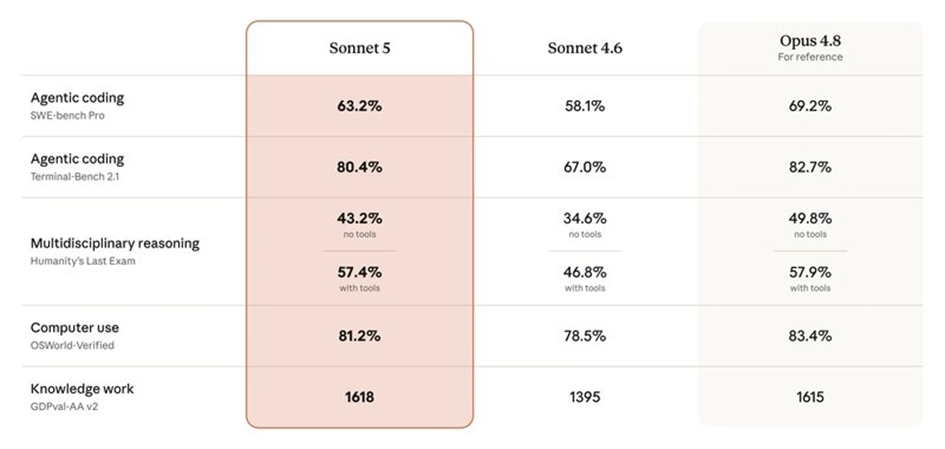
In addition to its new features, Claude Sonnet 5 also outperforms on the major benchmarks used to evaluate artificial intelligence models. On SWE-bench Pro, a benchmark for evaluating agent-based software development, the model achieved 63.2%, compared to 58.1% for Sonnet 4.6. Claude Opus 4.8 retains the lead with 69.2%, but the gap is narrowing considerably.1
© Anthropic
Anthropic also notes that Sonnet 5 achieves excellent results on evaluations focused on complex reasoning, knowledge-based tasks, and the coordinated use of digital tools. In certain scenarios evaluated by GDPval-AA v2, the model even manages to slightly outperform Opus 4.8. These results confirm that the gap between the Sonnet and Opus product lines is narrowing, while the price difference remains significant.
A pricing strategy designed to accelerate adoption
One of the most compelling arguments in favor of Claude Sonnet 5 is its price. Through August 31, 2026, Anthropic is offering an introductory rate of $2 per million tokens for input and $10 per million tokens for output.1 Effective September 1, these rates will increase to $3 and $15, respectively.
Even after this price increase, Sonnet 5 remains significantly more affordable than Claude Opus 4.8, whose current rates are $5 per million tokens for input and $25 for output. This cost difference could encourage many companies to favor Sonnet 5 for their day-to-day use, while reserving Opus for the most demanding scenarios requiring the highest level of reasoning.
Anthropic is also improving the reliability of its model
The increased autonomy of these models naturally raises safety concerns. The more an AI system operates on its own, the more necessary it becomes to limit undesirable behavior and potential errors. Anthropic states that it has strengthened several safety mechanisms in Claude Sonnet 5 to reduce hallucinations, improve robustness against prompt-injection attempts, and restrict certain sensitive uses.1
The company notes, in particular, that the model failed to produce a fully functional exploit during tests focused on developing attacks against Firefox. Although Claude Sonnet 5 is making significant progress in programming and defensive cybersecurity, Anthropic emphasizes that it was not trained to automate offensive attacks. This approach illustrates the desire to balance the growing capabilities of AI agents with the management of risks associated with their autonomy.


A model poised to become the industry standard for businesses
Anthropic isn't reserving Claude Sonnet 5 for just a few select customers. The model is now the default for users of the Free and Pro plans, while also being available in the Max, Team, and Enterprise plans, Claude Code, the developer platform, and the official API.2 This widespread availability demonstrates that the company intends to make Sonnet 5 its new benchmark model for professional use.
This strategy could profoundly transform the language model market. Until now, truly agent-like capabilities have been largely limited to the most expensive solutions. With Sonnet 5, Anthropic demonstrates that it is now possible to achieve performance levels close to those of top-tier models while maintaining a cost structure compatible with large-scale deployment in enterprises.
Ethical Issues: To What Extent Should We Allow AI Agents to Act?
The arrival of Claude Sonnet 5 goes far beyond a simple technical improvement to a language model. By becoming capable of planning actions, using various tools, and correcting certain errors on its own, the model is gradually coming closer to functioning like a true autonomous digital agent.
However, this development raises new questions. To what extent can a company delegate tasks to artificial intelligence? What human controls must be maintained when an agent can interact with a browser, manipulate code, or take certain initiatives? How can we ensure the traceability of decisions made automatically? As models become more autonomous, governance, oversight, and audit mechanisms will become just as important as their technical performance.
A New Step Toward the Democratization of Agent-Based AI
With Claude Sonnet 5, Anthropic isn’t just launching a new version of its mid-range model. The company is evolving its strategy by making capabilities available that were, until recently, reserved for its most expensive models. This democratization of agent-based AI could accelerate its adoption in businesses, where artificial intelligence will no longer be used solely to answer questions, but to carry out entire tasks autonomously.
In a competition that now pits OpenAI, Google, Anthropic, and the new Chinese models against one another, the battle is no longer solely about benchmark performance. It now hinges on the ability to deliver powerful, reliable, and economically accessible artificial intelligence. Claude Sonnet 5 is a clear illustration of this new stage in the evolution of large language models.
How does Claude Sonnet 5 work?
Claude Sonnet 5 is a language model developed by Anthropic that ushers in a new generation of agent-based artificial intelligence, capable not only of generating text or code, but also of planning actions, using external tools, and carrying out complex tasks with a level of autonomy far surpassing that of previous generations. Unlike a traditional chatbot, which responds only to a single query, Sonnet 5 is designed to reason through multiple steps, make intermediate decisions, and adapt its strategy until it achieves the goal set by the user.
The model’s operation is based on a dynamic reasoning architecture. Depending on the difficulty of the task, the user can choose different levels of computational effort, ranging from a fast mode designed for simple queries to a maximum mode that utilizes more computational resources to solve complex problems. This approach allows for the continuous optimization of the balance between accuracy, execution speed, and cost of use.
One of the key advancements in Claude Sonnet 5 is its ability to interact with digital tools. The model can open a web browser, view web pages, use a computer, manipulate files, execute commands, and even generate code before automatically verifying that it works correctly. Anthropic has also enhanced the self-verification mechanisms: Sonnet 5 is capable of evaluating its own outputs, identifying certain errors in reasoning or programming, and proposing corrections on its own before providing its final result, thereby reducing the risk of hallucinations on complex tasks.
- Agent-based reasoning: autonomous planning of tasks involving several successive steps
- Adaptive Effort Levels: Five Reasoning Modes for Adjusting Computing Power Based on Mission Complexity
- Use of tools: native interaction with a web browser, a computer, and various software environments
- Advanced Software Development: Automatic Code Generation, Analysis, Testing, and Correction
- Self-check: detection and correction of certain errors before the result is returned
- Knowledge-based work: processing complex documents, analyzing information, and summarizing content
- Professional API: Integration with Claude Code, Claude Platform, and business applications via API
- Performance is still slightly lower than Claude Opus 4.8 on certain highly advanced reasoning tasks
- Computational cost that increases with higher levels of reasoning
- Dependence on the quality of the external tools used (browser, device, API)
- The Need for Human Oversight for Critical or Regulated Decisions
- Errors may still occur despite self-checking mechanisms
- Use is subject to the security policies established by Anthropic to restrict sensitive uses
Learn more
The arrival of Claude Sonnet 5 confirms the rise of agents capable of performing complex tasks independently. On a related topic, check out our article “Claude Tag: The AI That Tracks Your Projects, Anticipates Your Needs, and Takes Action in Slack, ” which shows how Anthropic is extending this agent-based approach directly into corporate collaboration spaces.
References
1. Anthropic. (2026). Introducing Claude Sonnet 5.
https://www.anthropic.com/news
2. Anthropic Documentation. (2026). Claude Sonnet 5 Model Documentation.
https://docs.anthropic.com