
Alibaba continues to gain momentum in the global race for artificial intelligence. Long considered a minor player compared to OpenAI, Google, and Anthropic, the Chinese giant is now making significant strides with its Qwen family of models. Its new AI, Qwen3.7-Max, marks an important milestone in this strategy, with significantly improved performance in complex reasoning, agentic coding, and long-term task management.
But beyond the benchmarks, it is the model’s positioning that is drawing the most attention. Alibaba no longer presents Qwen simply as a conversational chatbot, but as a platform capable of orchestrating autonomous AI agents within complex workflows. This evolution illustrates the rise of agent-based AI in the global technology ecosystem.
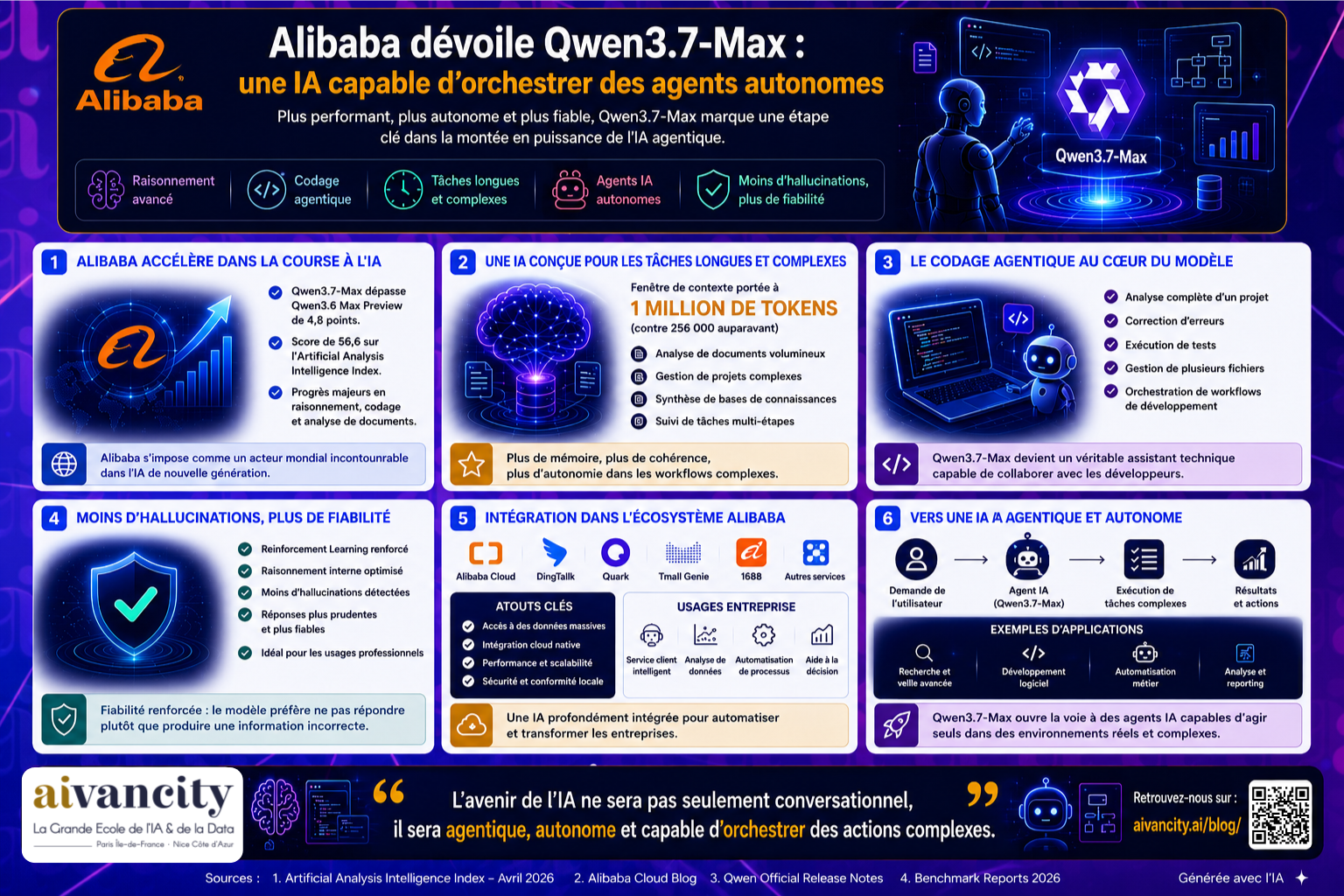
Alibaba is stepping up its game in the global competition for AI models
For several months now, Alibaba has been investing heavily in its AI infrastructure to close the gap with U.S. research labs. With Qwen3.7-Max, the company is clearly seeking to bolster its credibility among developers, businesses, and enterprise cloud environments.
The model now scores 56.6 on the Artificial Analysis Intelligence Index1, representing a 4.8-point increase over Qwen3.6 Max Preview. In the world of large language models, a difference of just a few points can represent a significant leap in the system’s actual capabilities.
Alibaba particularly highlights the progress made in:
- scientific reasoning,
- advanced coding,
- the analysis of long documents,
- and multi-step workflows.
This strategy shows that Chinese laboratories are no longer merely seeking to replicate Western capabilities, but are instead developing models capable of competing in advanced professional applications.
AI designed for long and complex tasks
One of the major improvements in Qwen3.7-Max is its context window, which has now been expanded to one million tokens, up from 256,000 previously. This capability allows the model to process massive amounts of information in a single session.
In practical terms, this paves the way for much more complex applications such as:
- the analysis of large documents,
- the management of large-scale software projects,
- the synthesis of knowledge bases,
- or tracking tasks that require multiple steps of reasoning.
This increase in contextual memory is becoming a strategic factor in the new generation of agent-based AI. The more information a model can retain at once, the better it is able to manage long, coherent workflows without losing track of previous interactions.
Alibaba is seeking to position Qwen3.7-Max as an AI capable of working on complex tasks over the long term, rather than as a simple, one-off conversational assistant.
Agentic coding is becoming a central focus
Qwen3.7-Max also demonstrates significant progress in AI-assisted software development. Alibaba places particular emphasis on the model's performance in agent-based coding environments and tasks that require multiple tools.
This development reflects a strong market trend. Companies are no longer looking solely for AI systems capable of generating code, but for systems capable of:
- to analyze a complete project,
- correct errors,
- run tests,
- manage multiple files,
- and orchestrate complex development workflows.
The goal is to gradually transform AI models into technical assistants capable of actively collaborating with developers.
This rise in agentic coding is becoming one of the main battlegrounds between OpenAI, Anthropic, Google, and now Alibaba.


A reduction in hallucinations highlighted
Alibaba also claims to have improved the reliability of Qwen3.7-Max through significant investments in reinforcement learning techniques and in optimizing the model's internal reasoning.
Initial independent evaluations show a significant decrease in the hallucination rate compared to Qwen3.6 Max. The model appears to take a more cautious approach when reliable information is lacking, sometimes choosing not to respond rather than producing incorrect content.
This development is particularly significant in professional settings where:
- accuracy,
- consistency,
- and the reliability of the responses
are becoming essential criteria.
Companies are gradually beginning to favor AI systems capable of acknowledging their limitations rather than models that systematically generate a response, even if it is incorrect.
AI That Is Still Text-Centric
Despite its advances, Qwen3.7-Max remains, for the time being, primarily limited to text-based interactions. Alibaba has not yet integrated certain advanced multimodal capabilities already offered by several U.S. competitors, including:
- image generation,
- video analysis,
- or certain advanced audio processing techniques.
This limitation shows that the Chinese group is currently prioritizing:
- reasoning skills,
- technical tasks,
- and professional applications—
—rather than a general-purpose, multimodal approach.
Alibaba seems to believe that AI's next major economic opportunities lie more in the automation of complex workflows than in creative applications for the general public.
A Strategy Focused on Agent-Based AI
The positioning of Qwen3.7-Max shows, above all, that Alibaba wants to establish itself in the field of agent-based AI. Unlike traditional conversational assistants, agent-based systems are capable of:
- to use tools,
- plan actions,
- perform several steps,
- and interact with various digital environments.
This approach is profoundly transforming the role of AI models. Users are no longer simply asking for an answer or a piece of text; they are gradually delegating entire tasks to systems capable of acting semi-autonomously.
Alibaba is thus joining the trend already evident at OpenAI with Operator, at Anthropic with Claude Code, and at Google with Gemini Spark.
The Rise of Chinese Laboratories
Qwen3.7-Max also illustrates the rapid progress of Chinese players in the global artificial intelligence ecosystem. For a long time, American models largely dominated advanced benchmarks. That gap is gradually beginning to narrow.
Although Qwen 3.7-Max still lags behind certain premium models from OpenAI, Anthropic, and Google in several global rankings, its progress is now rapid enough to shift the market balance.
The competition is no longer just about technical performance, but also about:
- inference costs,
- cloud infrastructure,
- access to developers,
- and the ability to build comprehensive AI platforms.
Alibaba appears to be aiming to use its vast cloud and e-commerce ecosystem to accelerate the adoption of Qwen among Asian and international companies.
A New Phase in the Global AI Competition
With Qwen3.7-Max, Alibaba is clearly demonstrating that the next generation of AI models will focus on:
- autonomy,
- complex workflows,
- intelligent agents,
- and operational capabilities.
The era of simple conversational chatbots seems to be gradually giving way to systems capable of interacting with complex tools, documents, and digital environments in a much more autonomous manner.
The global race for artificial intelligence is now entering a new phase in which models will need not only to understand human language but also to act effectively in real-world contexts.
How does Qwen3.7-Max work?
Qwen3.7-Max is based on an artificial intelligence architecture designed for advanced reasoning, agent-based coding, and the management of complex tasks with very long contexts. Developed by Alibaba, the model belongs to a new generation of AI designed not only to generate text, but also to orchestrate multi-step workflows and interact with various digital tools.
Unlike traditional conversational models, which are limited to short exchanges, Qwen3.7-Max can store and process a massive volume of information thanks to a context window of up to one million tokens. The system first analyzes the user’s objective, identifies the context and necessary data, and then breaks down certain complex tasks into coherent sub-actions.
The model can then generate code, analyze large documents, produce summaries, or perform technical reasoning on long sequences. This capability is based on a combination of natural language processing, multi-step reasoning, reinforcement learning, and agent orchestration. Alibaba is thus seeking to transform Qwen3.7-Max into a platform capable of supporting complex professional environments that require continuous and structured processing.
- Extended Context Window: Processing Conversations and Documents of Up to One Million Tokens
- Advanced Reasoning: Analysis of Scientific, Logical, and Multi-Step Tasks
- Agent-based coding: support for complex software development workflows
- Reducing hallucinations: improving reliability and cautious responses
- Managing Long-Running Tasks: Maintaining Context Across Large-Scale Projects
- Optimization via Reinforcement Learning: Continuous Improvement of Reasoning Abilities
- Cloud compatibility: integration with the Alibaba Cloud ecosystem and business tools
- A model primarily focused on text, with few advanced multimodal capabilities
- Significant cloud resource requirements for high-usage scenarios
- Residual risk of errors or delusions in certain complex lines of reasoning
- Dependence on the quality of the data and instructions provided
- The Need for Human Supervision in Critical Applications
- A gap still exists between these models and certain premium American models on several overall benchmarks
Learn more
The emergence of models capable of coordinating multiple autonomous agents confirms the evolution of AI toward increasingly organized systems capable of managing complex workflows. On a related topic, check out our article “With ChatGPT Atlas, OpenAI Combines Navigation, Analysis, and Intelligent Automation”, which examines how AI platforms are evolving into environments capable of orchestrating tasks, interacting with various tools, and automating advanced processes.
References
1. Artificial Analysis. (2026). AI Intelligence Index.
https://artificialanalysis.ai