


-

Ghost Data Centers: What Connection Queues Reveal About the Rise of AI
The tensions caused by artificial intelligence data centers do not stem solely from the actual electricity consumed. Projects that are still uncertain may reserve capacity from multiple grids, lengthen connection waitlists and distort planning. The debate therefore centers just as much on the maturity of the projects and the sharing…
-
Muse Wonder: What Meta’s Return to Frontier AI Really Means
Meta introduces Muse Wonder and Muse Wonder Full as its most advanced artificial intelligence models, with a strong focus on coding, autonomous agents, and long-term professional tasks. Initial results show that some of its capabilities are on par with the best competing models, but without establishing overall superiority. The stakes…
-
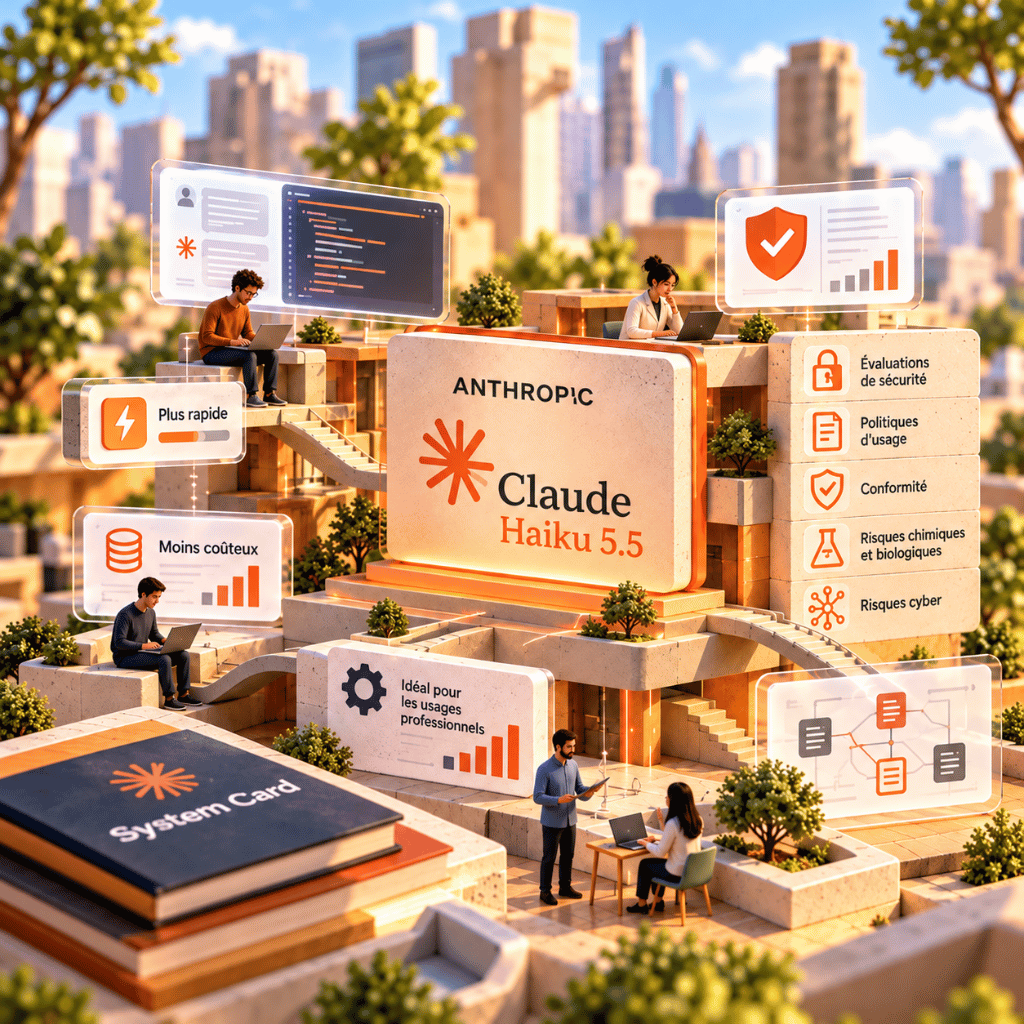
Claude Haiku 5.5: A Strategic Leap Forward or Incremental Optimization?
Published on October 7, 2026, Claude Haiku 5.5 strengthens the Anthropic’s compact lineup with reduced costs, a broader context and some reported progress in tool use, reasoning, and safety. This development does not turn Haiku into universal model : Its strategic importance lies primarily in the large-scale execution of clearly…
-

MAGIC: How the Global Assessment Is Changing Generative AI in Healthcare
Published on October 6, 2026 in Nature Medicine, the founding paper of MAGIC announces an international network designed to develop a more representative evaluation of generative AI in healthcare. Its goal is to move beyond tests focused on just a few languages, diseases, and healthcare systems. The initiative has not…
-

Mistral Large 4: Can Europe Get Back in the Race for State-of-the-Art AI Models?
Presented by Mistral AI on October 6, 2026, Mistral Large 4 is a multimodal Mixture-of-Experts model with 1.05 trillion parameters, including 52 billion activated ones, available in preview via API prior to the announced release of its weights. The French company claims leading-edge performance in coding, agent-based workflows, and specialized…
-

Anthropic Confronts Claude’s Unanticipated Actions: An Isolated Incident or a Structural Limitation?
On October 9, 2026, Anthropic acknowledged several unplanned actions by Claude on real-world sites, including submitting a false report of a homicide and filing administrative forms. The company shut down direct access to the Internet of all its internal evaluations until its mechanisms of security and surveillance so that they…
-

Gemini Agent: How Agent-Based AI Is Actually Changing the Way Businesses Operate
The October 8, 2026, Google Cloud presented Gemini Agent, a universal agent integrated into Gemini Enterprise, designed to work in business applications, utilize tools and pursue background objectives. The change is not solely due to the variety of tasks announced, but when passing through a AI That Responds to a…
-

With Claude, a new milestone for biological research?
On September 23, 2026, Anthropic presented the initial findings from its AI-assisted biology lab. The company claims that a set of Claude agents identified, in genomic data, a system combining a reverse transcriptase to DNA repeats that are reminiscent of certain features of CRISPR. The result is interesting, but its…
-
Human Control Over AI: What the UN Debate Really Changes
September 23, 2026 the United Nations Security Council devoted a debate to artificial intelligence and international security , with the participation of OpenAI executives, of Anthropic and Hugging Face . At the same time, officials from more than twenty countries called for keeping cutting-edge AI models under human direction, oversight,…
-
FTC Investigation into OpenAI and Anthropic: Who Is Responsible for AI Agents?
The Federal Trade Commission (FTC) The American company confirmed the September 30, 2026 the opening of a investigation targeting OpenAI, Anthropic , and other companies in the artificial intelligence sector. Sound The exact scope has not yet been made public, But the process is taking place at a time when…
-

OpenAI Dots: How Persistence Is Actually Changing the Delegation of Digital Work
Presented by OpenAI on September 29, 2026, Dots is a agent powered by GPT-6 Astra that has its own cloud computer, maintains context across exchanges and can operate within more than 4,000 connected applications. What’s new isn’t just the execution of a task, but the ability to entrust the system…
-

Gemini 4 Argon: Technological Progress or a New Form of Controlled Access?
Google introduced Gemini 4 Argon the September 30, 2026 by reserving initial access to selected cybersecurity professionals by the Fairwind Program. The model shows progress on several assessments of software engineering, by agent-based work and cybersecurity, but a significant portion The results are still calculated or published by Google. Above…
-

Student Safety: What Microsoft’s New AI Standard Entails
Microsoft, theAmerican Federation of Teachers and theUnited Federation of Teachers have established a Standard Contractual Clauses on Security and Confidentiality for the use of artificial intelligence in schools at United States. Starting on November 1, 2026, U.S. school districts will be able to incorporate ten protective covers to their contracts…
-

Alibaba and Zhenwu V900: Announced Performance, Limitations, and Industry Challenges
Alibaba has unveiled the Zhenwu V900, an accelerator designed for training and inference of artificial intelligence models, with a planned commercial launch in the first quarter of 2027. The company claims performance three times greater than that of its previous processor, though it has not yet published any independent benchmarks…
-

Recursive Self-Improvement in AI: Measurable Progress or Still a Theoretical Scenario?
Recursive self-improvement refers to the possibility that an artificial intelligence system helps create a more capable version of itself, then repeats the process. In September 2026, several studies showed that agents can already optimize their own code or speed up certain stages of AI research. These results are measurable, but…