
The race for generative artificial intelligence is no longer just about producing the most spectacular images. Now, the industry’s major players are seeking to make these technologies fast and cost-effective enough to be integrated into thousands of everyday applications. With Nano Banana 2 Lite, Google is taking this strategy a step further. This new, streamlined version of its image-generation model promises to produce or modify visuals in a matter of seconds while significantly reducing computational costs.1
The goal is not to replace Nano Banana 2, but to expand its range of applications. While the most powerful models prioritize maximum quality, Nano Banana 2 Lite focuses on achieving a better balance between performance, speed, and resource consumption. For Google, this development addresses growing demand from businesses, developers, and content creators who want to integrate image generation into their tools without compromising the user experience.
Google Wants to Scale Up AI-Powered Image Generation
Over the past two years, models capable of generating images have seen spectacular progress. Midjourney, DALL-E, Imagen, and Stable Diffusion have demonstrated that artificial intelligence can produce photorealistic or artistic illustrations in a matter of seconds. But behind these achievements lies a less visible reality: each image generation requires significant computational resources, which increases operating costs and sometimes limits large-scale use.
With Nano Banana 2 Lite, Google is seeking to solve this problem. Rather than focusing solely on improving visual quality, the company is now looking at the model’s efficiency. The idea is to enable millions of users to create or edit images almost instantly, without requiring the most expensive infrastructure. This approach mirrors the strategy already adopted with Gemini Flash in the field of language models: offering artificial intelligence that is slightly less computationally intensive but powerful enough to handle most everyday use cases.1
This development reflects a fundamental trend. AI labs are no longer focused solely on developing the most powerful models. They now aim to create models that can be deployed on a massive scale in mobile apps, collaborative platforms, office tools, and future AI agents.
A Lite version designed for speed
Contrary to what its name might suggest, Nano Banana 2 Lite is not a simplified or scaled-down version of Nano Banana 2. Google explains that it has optimized its architecture to significantly reduce the time required to generate or modify an image while maintaining a level of quality very close to that of the main model.1
This low latency opens up new possibilities. Developers can now integrate image generation directly into their applications without forcing users to wait several seconds. Designers can test more ideas in real time. Content creators can generate multiple variations of the same visual without interrupting their creative process. The faster the generation process becomes, the more naturally artificial intelligence integrates into the workflow.
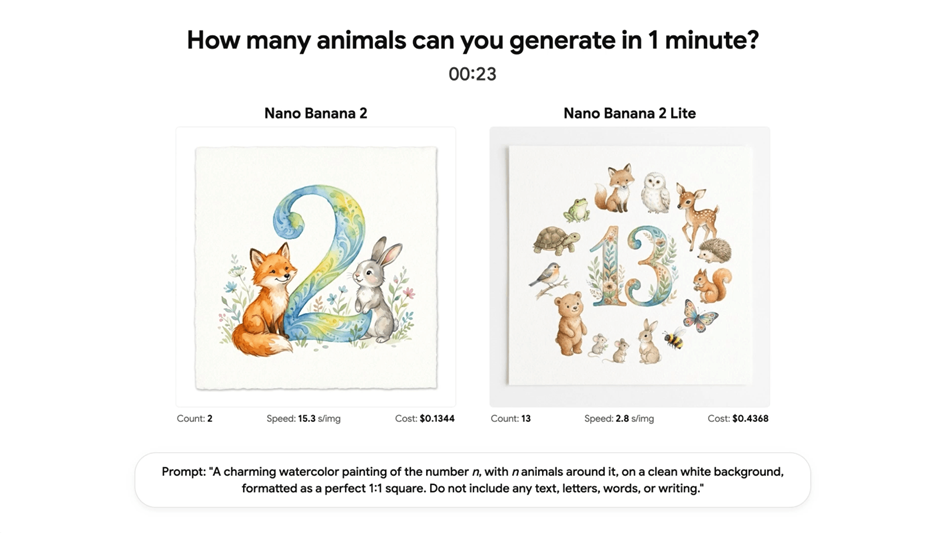
Google also notes that this Lite version retains several features that contributed to the success of Nano Banana 2. The model remains capable of maintaining a character’s consistency when an image is modified, performing highly localized edits without altering the entire image, and using its knowledge of the real world to better interpret requests made in natural language.
Reduce costs to produce more images
Speed, however, is only part of the equation. The real challenge of Nano Banana 2 Lite lies in its ability to reduce generation costs.
Today, generating a high-quality image requires significant computing power. Each request engages multiple specialized processors for several seconds, which represents a significant cost when thousands or millions of images must be generated daily. This constraint further limits the development of many artificial intelligence-based applications.
With Nano Banana 2 Lite, Google claims to have optimized its model's resource consumption to enable the generation of very large volumes of images at a significantly lower cost than that of heavier models.2 This cost reduction could accelerate the adoption of generative AI in collaborative design platforms, presentation software, marketing tools, and assistants capable of automatically producing personalized visual content.
For businesses, this development is of major interest. It is now possible to generate thousands of images every day without the cost of computing resources becoming a financial obstacle.

Artificial intelligence designed for developers… but not just for them
Google isn't limiting Nano Banana 2 Lite to professional users. The model is immediately available through several services in its ecosystem, including Google AI Studio, the Gemini API, and Gemini Enterprise Agent, which is designed for companies developing their own AI agents.2
But the company also plans to gradually integrate it into the Gemini app, Google Search’s AI mode, and other consumer-facing services. This strategy underscores a clear ambition: to make image generation a native feature across its entire ecosystem rather than a tool reserved for a select few specialists.
For developers, Nano Banana 2 Lite offers a particularly attractive solution. Its speed makes it possible to integrate visual creation features directly into applications without compromising the fluidity of the user experience. Users can thus generate an illustration, edit a photograph, or create multiple variations of the same visual almost instantly.
Another step toward agents capable of creating their own content
The arrival of Nano Banana 2 Lite goes beyond the realm of graphic design. This type of model is one of the essential components of future artificial intelligence agents capable of performing complex tasks autonomously.
An AI agent tasked with preparing a presentation, drafting a marketing campaign, or producing an illustrated report must be able to generate images without slowing down its performance. The most resource-intensive models remain suitable for very high-quality output, but they quickly become costly when they need to be called upon hundreds of times a day.
By offering a more streamlined model, Google is thus preparing its ecosystem for much broader automation of creative tasks. Image generation will no longer be an exceptional operation. It will become a feature integrated into the normal functioning of digital assistants, business applications, and future AI agents.
Ethical Challenges: Producing Faster Without Sacrificing Trust
Like all advances in the field of generative AI, Nano Banana 2 Lite raises several ethical questions. Lower costs and faster image generation will likely enable the mass production of visual content, bringing significant benefits to businesses but also increasing the risks of misinformation, deepfakes, and the spread of misleading images.
This democratization also makes it more challenging to protect copyrights and identify the source of automatically generated content. Platforms will need to strengthen their mechanisms for traceability, labeling synthetic images, and detecting misuse in order to maintain user trust.
Finally, the widespread adoption of models capable of generating thousands of images in just a few minutes could bring about lasting changes to certain professions in the field of visual creation. More than ever, the added value provided by professionals will depend on their ability to define an artistic direction, develop original concepts, and oversee the work produced by artificial intelligence.
Google Is Accelerating the Widespread Adoption of Visual AI
With Nano Banana 2 Lite, Google isn't just aiming to offer a faster model. The company is pursuing a much more ambitious strategy: making image generation fast, cost-effective, and reliable enough to be integrated into its entire ecosystem and into the applications of millions of developers.
This development confirms that the next battle in generative artificial intelligence will no longer focus solely on the quality of the images produced. It will also hinge on the models’ ability to operate in real time, at scale, and at a cost compatible with everyday use. Nano Banana 2 Lite perfectly illustrates this new phase, in which the industrialization of AI is becoming almost as important as its performance.
How does Nano Banana 2 Lite work?
Nano Banana 2 Lite is an image generation and editing model developed by Google within the Gemini ecosystem. Unlike traditional image generation models, which prioritize maximum quality above all else, this Lite version was designed to optimize three key parameters: processing speed, computational cost, and the accuracy of the results. The goal is to enable the creation of visual content almost instantly while significantly reducing the computational resources required.
The model is based on a multimodal architecture capable of simultaneously understanding text prompts, existing images, and the context of the request. When a user enters a prompt or uploads an image to edit, Nano Banana 2 Lite analyzes the provided elements, identifies the areas to be modified, and then generates a new version of the image in just a few seconds. This approach allows users to create entirely new illustrations as well as make localized edits while maintaining consistency with the rest of the image.
One of the key innovations of Nano Banana 2 Lite is its low latency. Google has optimized its architecture to minimize processing time while retaining the essential features of the main model. As a result, the system can generate multiple variations of a single image or make successive edits almost in real time, significantly improving the creative workflows of designers, developers, and content creators.
Nano Banana 2 Lite also retains the semantic understanding capabilities developed for the Gemini models. It is capable of interpreting complex descriptions, preserving a character’s visual identity across multiple edits, maintaining the consistency of objects within a scene, and drawing on real-world knowledge to produce images that are more realistic and better aligned with the user’s intentions.
- Ultra-fast image generation: Create visuals in just a few seconds thanks to an optimized architecture
- Smart Editing: Precise editing of specific areas of an image without altering the rest of the composition
- Low latency: reduced response time to facilitate real-time creation and experimentation
- Multimodal Comprehension: Joint Interpretation of Text, Images, and User Context
- Character Consistency: Maintaining Visual Characteristics Through Successive Modifications
- Cost Optimization: Reduced consumption of computing resources to facilitate large-scale deployments
- Integration into the Gemini ecosystem: available via Google AI Studio, the Gemini API, Gemini Enterprise, and several Google services
- Level of detail slightly lower than that of the heavier models for certain highly complex generations
- Dependence on the quality of the prompts provided by the user
- Some highly artistic or photorealistic designs may require the full Nano Banana 2 model
- Persistent risks of misleading content or deepfakes being generated, despite built-in safeguards
- Lower cost, but still dependent on the volume of images generated in high-usage scenarios
- Compliance with security policies and content filters defined by Google
Learn more
The launch of Nano Banana 2 Lite demonstrates Google’s commitment to accelerating the creation of visual content through artificial intelligence. On a related topic, check out our article “Over 70 Languages, One Conversation: Gemini 3.5 Reinventing Real-Time Translation , ” which shows how Google is also applying this optimization approach to speech translation models to make AI faster, more accessible, and more integrated into everyday life.
References
1. Google AI. (2026). Introducing Nano Banana 2 Lite.
https://developers.googleblog.com/
2. Google AI Studio. (2026). Nano Banana 2 Lite Documentation.
https://ai.google.dev/