
A functional update that transforms ChatGPT into an integrated business assistant
OpenAI has taken another strategic step toward transforming ChatGPT into a professional platform. The company recently announced the launch of connectors, a new feature that allows ChatGPT to natively integrate with the business tools used by its users, without requiring complex development. This innovation, seemingly subtle, could profoundly change how generative AI is used in business. This feature is not available in the free version of ChatGPT. Connectors are reserved for users of the Plus and Pro plans (excluding the European Union, Switzerland, and the United Kingdom), as well as subscribers to the Team, Enterprise, and Education plans.
AI that integrates into the user's software ecosystem
Until now, ChatGPT’s capabilities were limited to its own ecosystem: natural language processing, text generation, creating custom agents via GPTs, and document analysis. With the introduction of connectors, OpenAI is opening up its model to dynamic integrations with third-party tools such as Salesforce, Google Sheets, Slack, and Jira1.
These connectors enable ChatGPT to act as an intelligence layer on top of existing workflows, querying or updating data in real time. They thus transform the conversational agent into an operational assistant capable of centralizing, automating, and interpreting routine tasks: ticket tracking, generating reports from spreadsheets, or providing automated responses in collaborative environments.
A wide range of professional tools already available
OpenAI’s official announcement (below) confirms the range of integrations available at the launch of the connectors. The AI can now interact with popular tools such as Outlook, Teams, Google Drive, and Gmail. For users of the Team, Enterprise, and Edu editions, services such as SharePoint, Dropbox, and Box are also integrated2.
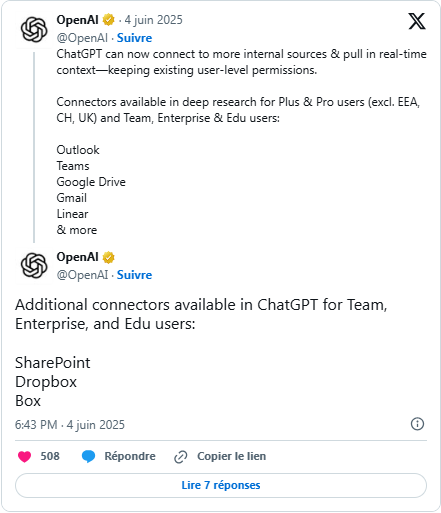
This list, which is set to expand, underscores OpenAI’s commitment to covering all of the most widely used collaborative SaaS environments in the enterprise.
A feature designed for the workplace
This development is significant. It reflects OpenAI’s clear intention to position ChatGPT as a central hub in productivity environments, complementing—or even replacing—certain RPA (robotic process automation) tools3. Unlike traditional plugins or integrations, connectors are designed to operate transparently through a unified and secure interface.
Users can now trigger a context-specific business action with a simple text command: “Generate a sales summary report in Salesforce,” or “Notify my team on Slack that Project X has been approved in Jira.” This paves the way for accessible, no-code automation centered on natural language.
First use cases identified in the workplace
This interoperability is already paving the way for cross-sector applications in many industries:
- Marketing and CRM: Extract campaign data from HubSpot or Salesforce, and automatically generate customer summaries or meeting minutes.
- Finance: Retrieve KPIs from Google Sheets and update monthly reports.
- IT and Support: Interact with Jira or Zendesk ticket databases and propose solutions based on similar cases.
- HR and project management: centralize Slack conversations and assign tasks in Asana or Notion using simple commands.
These use cases illustrate a gradual shift from generative AI toward integrated agent-based AI, capable of coordinating multiple tools within a single business process.
A response to competition from enterprise AI
OpenAI is part of a broader strategic trend. Google (with Gemini for Workspace), Microsoft (with Copilot in 365), and Salesforce (with Einstein Copilot) are all seeking to turn their AI systems into integrated, context-aware assistants. By focusing on interoperability through connectors, OpenAI offers a cross-platform alternative that is independent of specific software vendors.
The key to this approach: modularity. By opening up to the entire SaaS ecosystem, ChatGPT positions itself as a universal assistant capable of adapting to each organization’s software configurations.
Toward an architecture of interconnected autonomous agents
The introduction of connectors is not an end in itself. It is a building block in the creation of an environment where specialized agents, powered by AI systems such as GPT-4.5 or GPT-5, can interact with one another and with the user’s digital environment, with a view to seamlessly orchestrating tasks4. OpenAI is thus paving the way for a “digital nervous system” where agents converse, act, and coordinate complex processes within the enterprise.
References
1. OpenAI. (2025). ChatGPT Connectors are now available for tools such as Gmail, Google Drive, and more.
https://twitter.com/OpenAI/status/1798010152645542092
2. The Verge. (2025). ChatGPT gets Gmail, Google Drive, and Dropbox integrations for enterprise users.
https://www.theverge.com/
3. Gartner. (2024). RPA to Generative Automation: How AI Is Transforming Workflow Management.
https://www.gartner.com/
4. Aivancity. (2024). Toward the Agentification of AI: From Tool to Cognitive Ecosystem.
https://blog.aivancity.ai
