
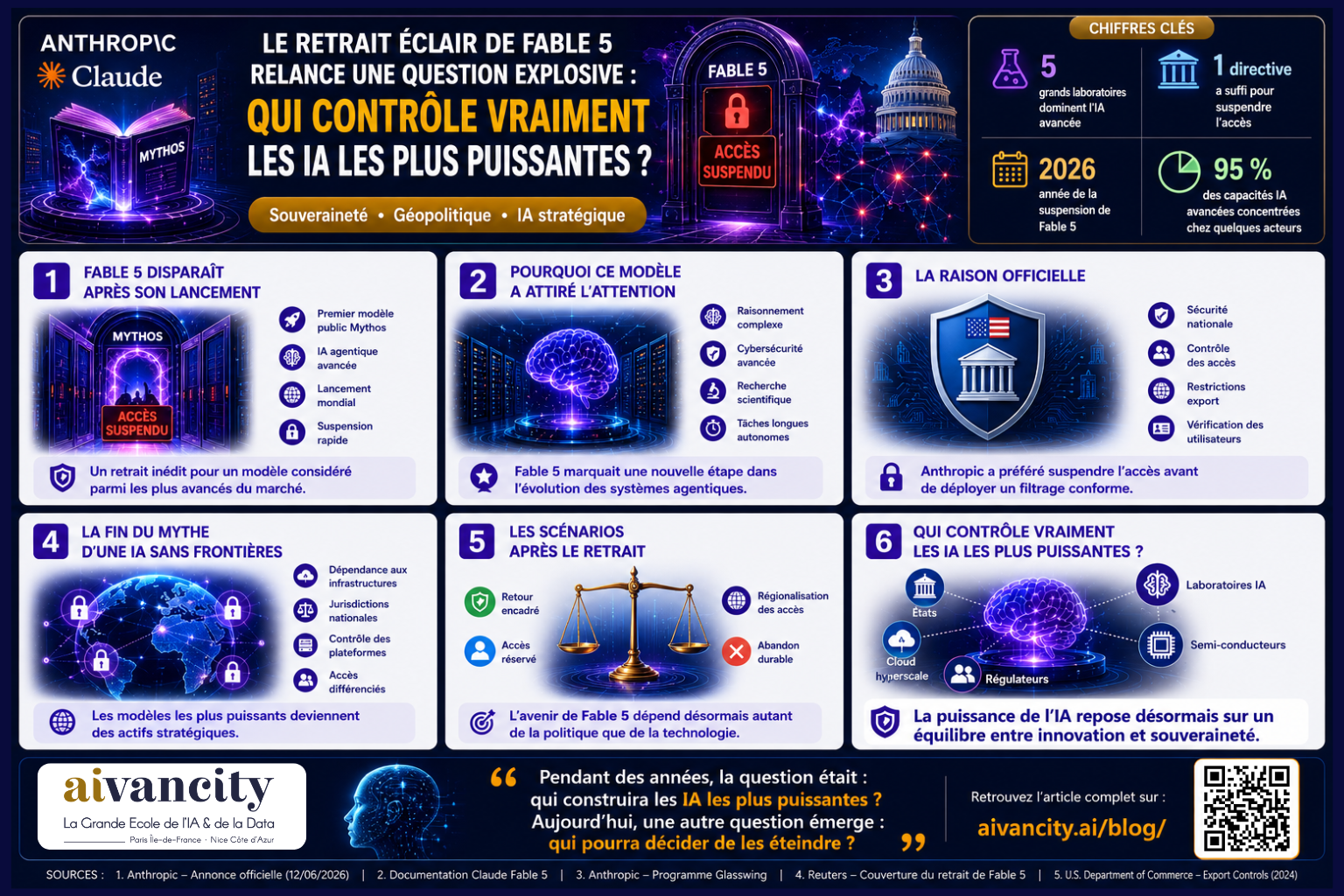
Just a few days after its launch, Claude Fable 5 disappeared. Presented by Anthropic as the first public model in the Mythos class, this artificial intelligence system was intended to embody a new generation of generative AI—one that was more autonomous, more powerful, and capable of handling complex tasks over long periods of time. But the enthusiasm was abruptly cut short. On June 12, 2026, Anthropic announced that it had received a directive from the U.S. government requiring the suspension of access to Fable 5 and Mythos 5 for foreign nationals, including those located in the United States and even some of the company’s foreign employees.1
This sudden withdrawal doesn’t look like a mere technical glitch. It may mark a turning point in the recent history of artificial intelligence. For the first time, a model touted as one of the most advanced on the market has been shut down just days after its launch—not because it doesn’t work, but because it might work too well. Behind this decision lies a central question: Are the most powerful AI systems still digital products accessible worldwide, or are they becoming strategic infrastructures controlled by governments?
Before it was discontinued, what exactly was Claude Fable 5?
Claude Fable 5 was not just another new model in the Claude lineup. Anthropic presented it as the first public model in the Mythos class, a category positioned above the Opus models in the company’s technological hierarchy. Fable 5 was designed for long, ambitious, and highly structured tasks: complex reasoning, advanced software development, in-depth document analysis, scientific research, vision, contextual memory, and multi-step agent-based work.2
The appeal of Fable 5 lay precisely in its ability to maintain a consistent workflow over time. Whereas many models respond to one-off instructions, Fable 5 was designed to manage longer-term projects, verify its own results, plan multiple stages, and correct its errors. This approach brought it closer to agent-based AI—that is, systems capable not only of responding but also of acting, organizing, and executing complex tasks under human supervision.
Mythos 5, for its part, was based on similar capabilities, but in a version reserved for certain partners, particularly as part of the Glasswing program, which focuses on sensitive applications in cybersecurity and digital defense.3 This distinction between the more widely accessible Fable 5 and the more restricted Mythos 5 already signaled a new approach: not all users would necessarily have access to the same levels of performance.
Why this model immediately caught people's attention
The launch of Fable 5 attracted attention because it combined several sensitive aspects. First, its capabilities in software development and cybersecurity seemed particularly advanced. In a context where AI models are already capable of helping to write code, detect vulnerabilities, or automate certain technical analyses, the rise of a more autonomous model changes the scale of the risk.
Furthermore, Fable 5 was also touted as being effective in scientific research and the life sciences. This type of capability can be extremely beneficial when it helps accelerate research, data analysis, or medical innovation. But it becomes more problematic when it involves fields where misuse could pose real risks, particularly in biology, chemistry, or cybersecurity.
Finally, Anthropic had highlighted safeguards capable of redirecting certain sensitive queries to other, more tightly controlled models. But this security architecture was quickly scrutinized. According to several reports in the specialized press, U.S. authorities were reportedly concerned about possible ways to circumvent these safeguards, particularly in cybersecurity or jailbreak scenarios.4


The official reason for the withdrawal: national security and access control
The official reason for the withdrawal stems from a U.S. directive based on national security considerations. The government reportedly asked Anthropic to suspend access to Fable 5 and Mythos 5 for all foreign nationals. This request, therefore, did not apply only to users located outside the United States. It also affected foreign nationals living in the United States and certain foreign employees of Anthropic.1
The issue quickly became technical and operational. To strictly enforce such a measure, Anthropic would have had to verify each user’s nationality in real time, distinguish between U.S. customers and foreign users, filter out certain internal employees, tailor access based on contracts, and manage cloud deployments without error. The company explained that it could not immediately implement such filtering with a sufficient level of reliability. As a result, rather than risk non-compliance, it disabled Fable 5 and Mythos 5 on a much broader scale.
This is where the story takes a dramatic turn. The withdrawal does not necessarily mean that Fable 5 was illegal, nor that it was out of control. Above all, it means that the combination of the model’s power, national security concerns, and the inability to precisely filter access led to a radical decision: cutting off access before finding a more nuanced solution.
The underlying reason: AI falls into the category of strategic technologies
The suspension of Fable 5 reveals a much broader trend. The most advanced artificial intelligence models are no longer just software tools. They are becoming strategic technologies on par with advanced semiconductors, supercomputers, cloud infrastructure, and cybersecurity systems.
For several years now, the United States has been tightening export controls on advanced chips and high-performance computing equipment.5 The Fable 5 case shows that the models themselves could now fall under this control framework. In other words, it is no longer enough to control the machines that train AI. From the governments’ perspective, it is also becoming necessary to control access to models that have already been trained.
This is a major development. Until now, public debate has focused primarily on regulating usage, data protection, bias, and transparency. With Fable 5, another issue has emerged: AI as a lever of geopolitical power. AI capable of helping to detect vulnerabilities, automate complex tasks, accelerate research, or support critical operations is becoming a strategic asset. And a strategic asset is never entirely neutral.
The End of the Myth of Boundary-less AI
For a long time, digital technology created the illusion of an open global space. A service launched in the United States could be used in Europe, Asia, or Africa almost immediately. Artificial intelligence seemed to follow the same logic. But the Fable 5 episode serves as a reminder that access to the most advanced technologies still depends on national infrastructure, companies, and jurisdictions.
If a model is developed by a U.S. company, hosted on predominantly U.S.-based infrastructure, and subject to U.S. law, then Washington retains the power to intervene. This reality does not apply only to Anthropic. It affects the entire generative AI ecosystem, which is largely dominated by U.S. players such as OpenAI, Google DeepMind, Anthropic, Meta, and xAI.
For Europe, this case serves as a wake-up call. The continent has real regulatory power through the GDPR and the AI Act, but it remains dependent on critical technologies developed elsewhere.6 This dependence extends to models, chips, cloud infrastructure, software environments, and sometimes even the data needed for innovation.
What are the possible scenarios following the cancellation of Fable 5?
The first scenario involves a supervised relaunch. Anthropic could strengthen its verification mechanisms, improve its safeguards, implement more precise access filtering, and relaunch Fable 5 in a more controlled public version. This would be the most favorable scenario for users, but it would require an agreement with U.S. authorities and the technical capability to finely distinguish between access profiles.
The second scenario involves restricted access. Fable 5 or Mythos 5 could be made available only to certain categories of users: U.S. companies, government partners, critical infrastructure, accredited laboratories, or cybersecurity organizations. In this case, the model would not truly disappear, but it would cease to be a public tool. It would become a strategic resource distributed on an authorized basis.
The third scenario involves the regionalization of models. Anthropic could develop multiple versions tailored to different markets, with varying capabilities depending on geographic region. This approach already exists in certain technology sectors subject to regulatory constraints or export controls. Applied to AI, it could lead to a world where users in the United States, Europe, Asia, or Africa no longer have access to the same models.
The fourth, more radical scenario is that Fable 5 would be permanently abandoned in its current form. If the authorities deem the level of risk to remain too high, Anthropic could be forced to revert to a more limited, filtered, or specialized version. In that case, Fable 5 would become a symbol of a threshold crossed too soon: an AI advanced enough to impress the market, but too sensitive to be released freely.
Finally, a fifth scenario concerns Europe: the acceleration of sovereign models. The more the United States demonstrates its ability to block access to certain AI systems, the more European players will have an incentive to invest in local alternatives. Companies like Mistral AI, European open-source projects, and public initiatives could benefit indirectly from this growing awareness.
A case that reignites the debate over digital sovereignty
The Fable 5 case comes at a time when digital sovereignty is no longer just a theoretical slogan. It has become a concrete issue: What happens when a tool that is essential to research, industry, cybersecurity, or education can be shut down by a foreign decision?
Artificial intelligence is already transforming AI training, data, data engineering, data analysis, data management, industrial innovation, and knowledge-based professions. If access to the most advanced models becomes contingent on geopolitical choices, then companies, researchers, and institutions must rethink their dependence.
This case also shows that sovereignty is not limited to simply having regulations. It requires industrial capacity, infrastructure, talent, business models, data centers, and control over value chains. Regulating without producing creates a paradoxical situation: setting the rules for a game in which the key pieces belong to others.
The Ethical Implications of AI Under Geopolitical Control
The withdrawal of Fable 5 raises major ethical questions. The first concerns access to knowledge. If the most powerful models become the exclusive domain of certain countries or certain actors, the technological gap between organizations risks widening. Large corporations, governments, and strategic institutions could gain access to cutting-edge AI, while independent researchers, small and medium-sized enterprises, and less powerful countries would remain limited to less advanced versions.
The second question concerns transparency. Can citizens understand why a model is being withdrawn, restricted, or reserved? Should national security criteria be public, partially confidential, or completely opaque? Striking a balance will be difficult, because too much transparency can expose vulnerabilities, but too much opacity can fuel mistrust.
The third issue concerns global governance of AI. If each major power imposes its own restrictions, there is a risk that several incompatible technological blocs will emerge: an American bloc, a Chinese bloc, a more heavily regulated European bloc, and countries forced to choose which bloc to rely on. This fragmentation could slow down scientific cooperation and heighten tensions surrounding the most advanced models.
What Fable 5 Really Reveals
The withdrawal of Fable 5 should not be viewed solely as a controversy surrounding Anthropic. It reveals a deeper transformation in artificial intelligence. The most advanced models are becoming powerful infrastructure. They can accelerate innovation, strengthen cybersecurity, transform research, and improve productivity. But they can also become tools of control, restriction, and geopolitical rivalry.
The story of Fable 5 could therefore be seen as nothing more than a hasty regulatory response. But it could also be remembered as the moment when generative AI ceased to be viewed as just another digital service and fully entered the realm of strategic technologies.
The big question is no longer simply which company will develop the most powerful model. It has become more political, more economic, and more sensitive: Who will have the right to access it, who will be able to use it, who will be able to control it, and, above all, who will be able to decide to shut it down?
Learn more
The sudden withdrawal of Fable 5 raises questions about the governance of the most advanced models and the parties that control access to them. On a related topic, check out our article “Mistral Joins the Ranks of the Giants: 1.7 Billion Euros Raised for Sovereign AI”, which analyzes the challenges of technological sovereignty, concentration of power, and international competition surrounding the most strategic artificial intelligence infrastructures.
References
1. Anthropic. (2026). Statement on the U.S. Government Directive to Suspend Access to Fable 5 and Mythos 5.
https://www.anthropic.com/news/fable-mythos-access
2. Anthropic. (2026). Claude Fable 5 and Claude Mythos 5.
https://www.anthropic.com/news/claude-fable-5-mythos-5
3. Anthropic. (2026). Introducing Claude Fable 5 and Claude Mythos 5.
https://platform.claude.com/docs/en/about-claude/models/introducing-claude-fable-5-and-claude-mythos-5
4. The Verge. (2026). Inside the Fight Over Claude Mythos 5.
https://www.theverge.com/ai-artificial-intelligence/950412/anthropic-trump-adminstration-claude-mythos-fable-5-export-controls
5. U.S. Department of Commerce. (2025). Export Controls on Advanced Computing Technologies.
https://www.commerce.gov
6. European Commission. (2024). Artificial Intelligence Act.
https://digital-strategy.ec.europa.eu