
Anthropic has taken another step forward in scaling up its artificial intelligence services. The company has just announced a significant increase in the usage limits for Claude Code, as well as an expansion of the capabilities of its Claude Opus API, thanks to a strategic agreement with SpaceX. Behind this technical announcement lies a central issue in the current race for generative AI: access to computing power.
For several months, developers using Claude Code have regularly encountered limitations they considered too restrictive, particularly during long work sessions and periods of high traffic. With the explosion of agent-based applications and AI-assisted development, computing demand has surged, putting pressure on the infrastructure of major AI labs. Anthropic is now addressing this strain by securing a massive new supply of GPUs through SpaceX.
Limits Doubled for Claude Code
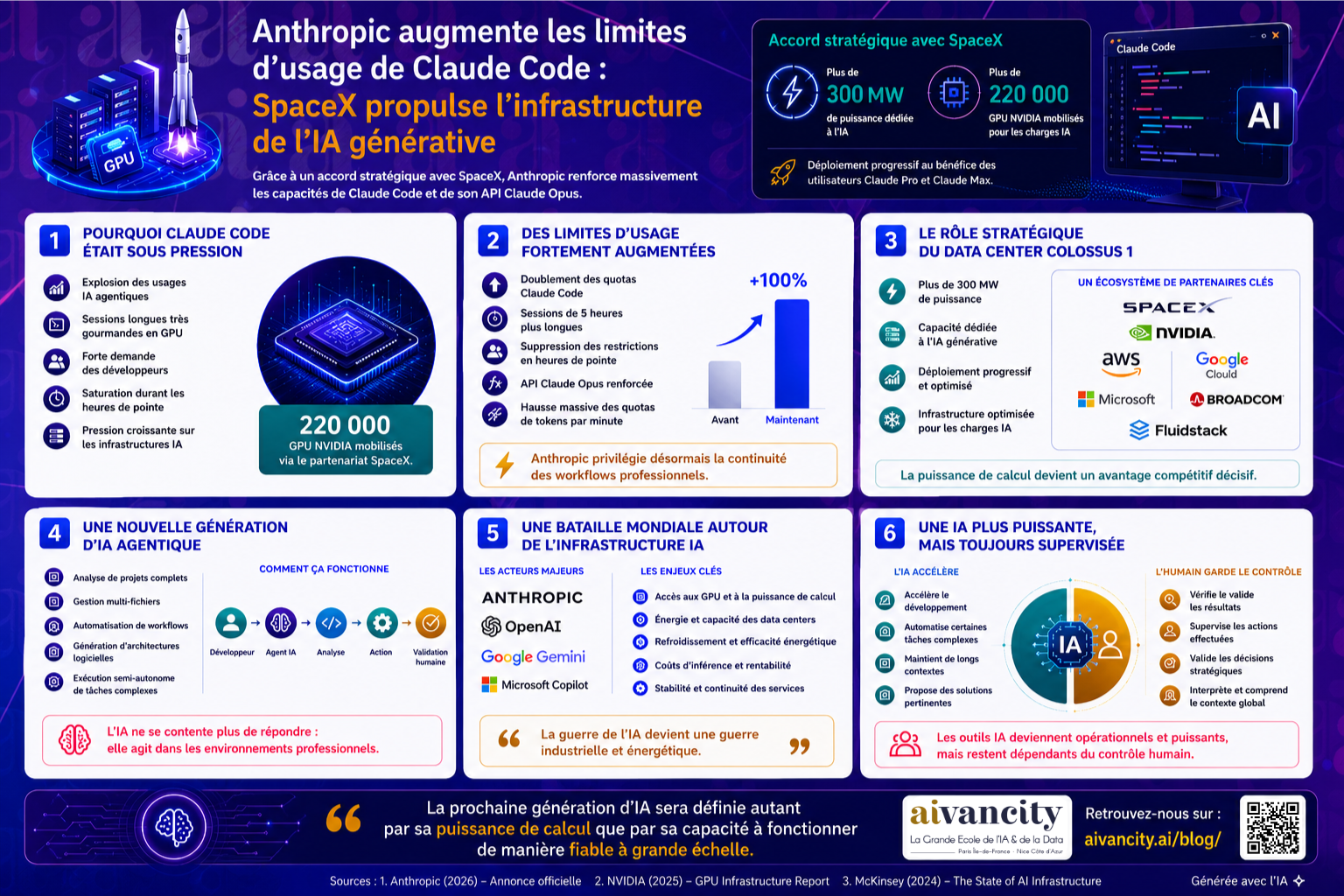
The most noticeable change affects Claude Code users. Anthropic has announced that it is doubling the quotas for five-hour sessions for several paid subscription plans, including Pro, Max, Team, and Enterprise. In practice, this means that developers will be able to run more complex or time-consuming tasks before reaching their usage limits.
Anthropic has also significantly raised the limits for the Claude Opus API, with a massive increase in token quotas per minute depending on subscription tiers.
The company is also removing the specific restrictions that applied during peak hours for Pro and Max accounts. Until now, some users experienced reduced performance or interrupted sessions when demand became too high. This decision directly addresses criticism from part of the developer community, which had complained about an experience that was sometimes unstable despite paid subscriptions.
Anthropic notes, however, that the change primarily affects long sessions. The overall weekly limits remain unchanged, which means that users will be able to concentrate more work into a single session, but not necessarily increase their total usage over the course of a full week.
Why Claude Code Was Under Pressure
The issue of usage limits has become particularly sensitive in the generative AI ecosystem. AI-powered coding tools consume a significant amount of resources, especially when they utilize advanced agent-based capabilities that can analyze an entire project, modify multiple files, or perform complex tasks autonomously.
This shift is fundamentally transforming infrastructure requirements. A typical chatbot already consumes a significant amount of computing power, but AI agents used in software development require even more processing power, as they must maintain long-term context, perform complex reasoning, and interact with multiple environments simultaneously.
Anthropic had already faced these challenges last spring. The company briefly tested removing Claude Code from certain Pro plans to ease the strain on its infrastructure, before quickly reversing the decision under pressure from users. The partnership with SpaceX thus appears to be a structural response to this surge in demand.
A strategic agreement regarding the Colossus 1 data center
The agreement signed with SpaceX covers the entire capacity of the Colossus 1 data center. According to Anthropic, this represents more than 300 megawatts of additional power and more than 220,000 NVIDIA GPUs dedicated to AI workloads1. This capacity is being rolled out gradually and is expected to directly benefit users of the Claude Pro and Claude Max offerings.
This agreement underscores the strategic importance of infrastructure in the competition among major AI players. Today, the performance of models no longer depends solely on algorithmic advances, but also on the ability to secure sufficient computing power to train and run these systems at scale.
Anthropic is also expanding its partnerships in this area:
- agreements with Amazon regarding AWS Trainium,
- in collaboration with Google and Broadcom,
- strategic partnership with Microsoft and NVIDIA,
- investments with Fluidstack,
- and now a major deal with SpaceX.
This diversification shows that the battle for artificial intelligence is also becoming an energy and industrial battle.
The Rise of Agent-Based AI
The improvements to Claude Code come at a time when the use of agent-based AI is booming. Unlike traditional chatbots, AI agents are capable of performing complex tasks semi-autonomously, such as analyzing a GitHub repository, modifying multiple files, generating software architectures, or automating entire workflows.
These applications consume a tremendous amount of computational resources. The more autonomous agents become and the better they are able to maintain long-term contexts, the greater the demand for GPUs. The rise of Claude Code thus reflects a broader transformation in the industry: AI is no longer content with simply answering questions; it is gradually becoming an operational tool integrated into professional workflows.
According to several industry estimates, global spending on AI infrastructure could exceed $400 billion annually by 20302. Companies capable of securing massive computing resources will therefore have a significant strategic advantage.


A direct response to OpenAI, Google, and Microsoft
This announcement also comes amid fierce competition among the major players in generative AI. OpenAI is developing its own AI agents based on ChatGPT and Codex, Google is ramping up its efforts with Gemini, while Microsoft is enhancing Copilot within its business tools.
Anthropic is seeking to consolidate its position in the AI-assisted development market. Claude Code is particularly valued for its ability to handle long-form contexts and maintain consistency in complex projects. By expanding its usage limits, Anthropic aims to increase its appeal to professional developers and businesses.
This strategy also shows that the competition is no longer solely about benchmarks. Users now expect:
- more stability,
- longer sessions,
- fewer interruptions,
- and tools capable of running continuously in real-world workflows.
Infrastructure is becoming the new focal point of the AI war
The agreement between Anthropic and SpaceX highlights a major shift in the industry: infrastructure is becoming just as important as the models themselves. AI labs must now secure massive amounts of computing power, energy, and GPUs to meet skyrocketing demand.
This trend is gradually transforming AI into a major industry. Giant data centers, energy consumption, GPU supply chains, and cooling capabilities are becoming issues just as strategic as software advancements. Players capable of mastering this infrastructure will likely have a decisive advantage in the coming years.
Anthropic seems to have recognized this reality early on. The company is no longer focused solely on building better models, but on ensuring sufficient computational capacity to support the rapid growth of professional applications of artificial intelligence.
AI that is more accessible, but still under human supervision
Even with these new capabilities, Claude Code remains a tool to assist developers, not a replacement for them. The increased usage limits allow for the execution of longer and more complex tasks, but errors, inconsistencies, or approximations are still possible.
The challenge for companies, therefore, is not simply to increase automation, but to build workflows in which AI speeds up the work while remaining under human supervision. Claude Code exemplifies this trend: an artificial intelligence that is increasingly integrated into software development, yet still relies on user validation and oversight.
How does Claude Code work?
Claude Code is Anthropic’s AI-powered development environment. It is built on the Claude Opus and Claude Sonnet models, which are optimized for long-chain reasoning, understanding complex code, and performing agent-based tasks. Unlike traditional coding assistants limited to autocompletion, Claude Code can analyze entire projects, understand software architectures, modify multiple files simultaneously, and maintain consistency across very long contexts.
This capability requires massive computing power. The models must maintain extensive contextual memory, analyze thousands of lines of code, and generate coherent responses in real time. As applications become increasingly agent-based and autonomous, GPU and energy consumption rise sharply. This is precisely why Anthropic and SpaceX signed a major agreement regarding the Colossus 1 data center.
- More than 300 megawatts of computing power available
- More than 220,000 NVIDIA GPUs are being used for training and inference
- Capacity dedicated to advanced AI applications and Claude models
- Reducing tensions related to user restrictions
- Doubling of Certain Session Limits Claude Code
- Reducing traffic congestion during rush hour
- Expansion of the Claude Opus API's capabilities
- Support for large-scale professional use
- Comprehensive project analysis: understanding multi-file structures and software architecture
- Advanced code generation: creating functions, modules, and workflows
- Long-term context: managing large codebases with conversational consistency
- Agent-based AI: semi-autonomous execution of complex tasks
- Debugging support: error detection and correction
- Automation Developer: Refactoring, Documentation, and Code Optimization
- Conversational Interaction: Driving Development Through Natural Language
- A very long-term context
- Simultaneous reading of multiple files
- Multi-step reasoning
- Planning Complex Actions
- Running standalone workflows
- Verification and correction of the generated code
- Growing reliance on NVIDIA GPUs
- Strategic access to electricity and energy capacity
- Development of advanced cooling systems
- Construction of ultra-high-density data centers
- Deployment of large-scale cloud infrastructure
- Long-term energy and equipment partnerships
- High computational cost
- Weekly limits remain in place
- Dependence on GPU availability
- Risk of errors in complex tasks
- Human oversight is required for critical changes
- High energy consumption of AI infrastructure
Learn more
The expansion of Claude Code’s capabilities highlights the growing importance of specialized AI tools in software development and the automation of technical workflows. On a related topic, check out our article “Claude Code Voice: Anthropic Finally Lets You Control Your Code With Your Voice”, which analyzes how new conversational interfaces are gradually transforming programming and collaboration practices around code.
References
1. Anthropic. (2026). Infrastructure expansion announcement.
https://www.anthropic.com
2. McKinsey. (2025). The Future of AI Infrastructure.
https://www.mckinsey.com