


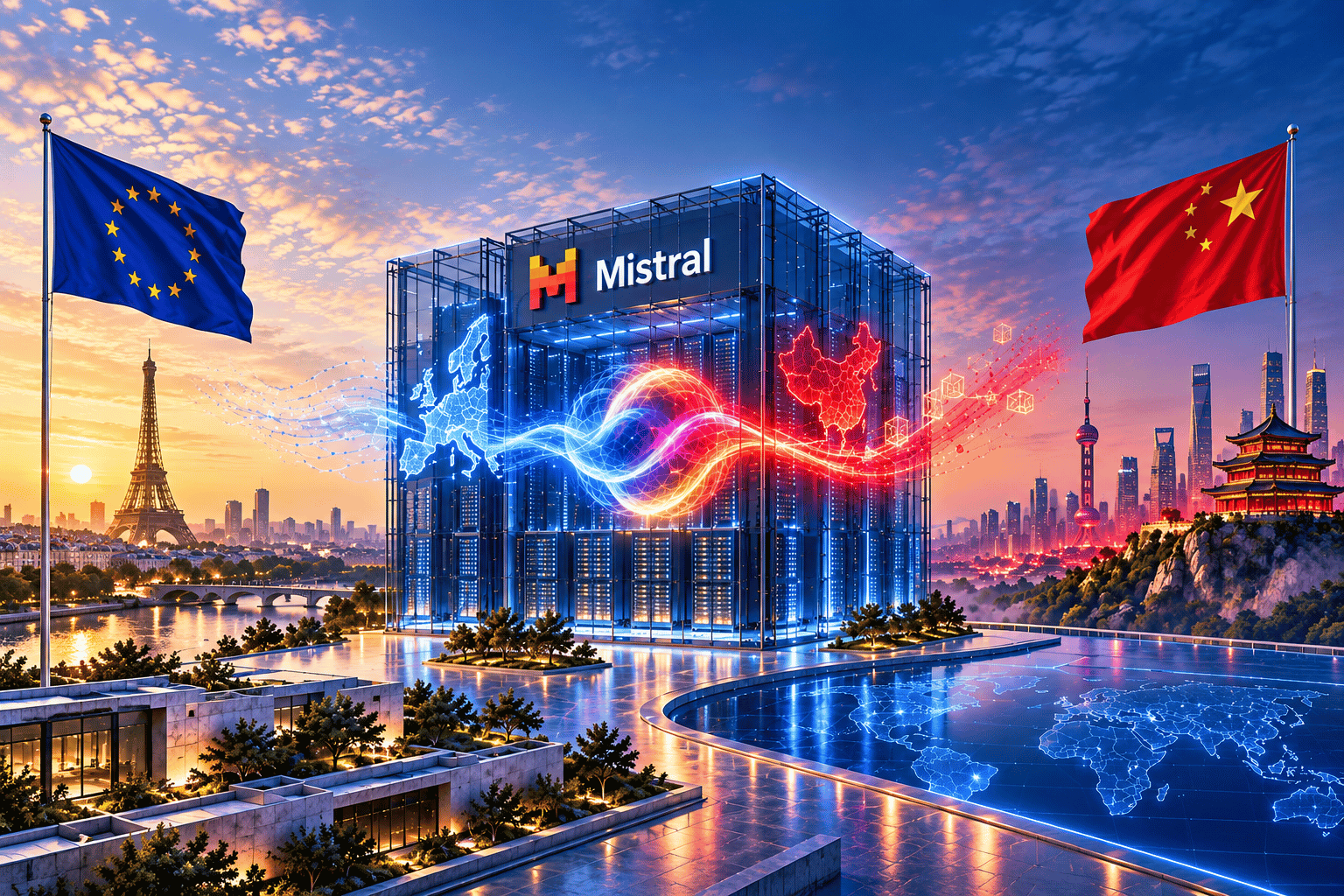
A trilogy to understand what a Chinese model hosted by a French AI champion reveals about the new geopolitics of intelligence.
By Dr. Tawhid CHTIOUI, Founding Presidentof aivancity School of AI & Data for Business & Society; selected by Keyrus as one of the 25 most influential global figures in the field of AI and data (January 2025).
What if we got sovereignty wrong?
Sometimes a national ambition is put to the test by what looks, at first glance, like a simple business decision… On August 11, 2026, Mistral AI announced that it would open its so-called “sovereign” infrastructure to models developed by other companies. The first of these, GLM-5.2, was designed by Z.ai, one of the major players in Chinese artificial intelligence. Mistral makes no secret of its origin or its status: it is indeed a third-party model offered within its European infrastructure (Mistral AI, 2026a).
A few days later, the South China Morning Post summed up, with an irony that is hard to ignore, how this decision might look from Asia: Europe was supposedly “plugging a Chinese AI brain into what would, in practice, be a European shell” (South China Morning Post, 2026, author’s translation).
The phrase is deliberately provocative. It oversimplifies a far more complex technical and industrial reality, but it puts its finger on a contradiction we can no longer sidestep: what does sovereignty still mean when you control the infrastructure, the data, and the execution conditions, but the intelligence itself was designed elsewhere?
Taken in isolation, Mistral’s choice is perfectly defensible. An AI company can hardly claim to meet every need with its own models alone, especially at a time when architectures are multiplying and customers are looking for more choice, performance, and control. Yet in Mistral’s case, this decision carries implications that go far beyond its business strategy.



MSc AI Governance, Risk & Compliance
The Bac+6 program that trains legal professionals to understand AI and data technologies so they can master their governance, risks and compliance.
Because Mistral is not just any French tech company. In a few short years, it has become one of the most visible symbols of France’s, and more broadly Europe’s, ambition not to leave the production of large artificial intelligence models entirely to American platforms.
That is precisely why the arrival of a Chinese model in its sovereign offering is not a mere catalog detail. It acts as a revealing moment.
It forces us to ask a much more fundamental question: what if we were wrong, not about the need to be sovereign, but about what that word really means in the age of artificial intelligence?
A few months earlier, in December 2025, Emmanuel Macron was still urging the French to choose Le Chat over ChatGPT precisely because it was French. He explicitly linked Mistral to reclaiming “cognitive sovereignty,” alongside the computing capacity, data centers, and other technological building blocks that France and Europe are trying to rebuild (Présidence de la République, 2025). This is where the paradox emerges.
Mistral was held up as a symbol that France, and Europe more broadly, need not abandon artificial intelligence to the big American platforms. Three years after its founding, that same champion is choosing to integrate an intelligence designed in China into its sovereign offering.
It would be too easy to see this as a contradiction or a capitulation. Above all, that would miss the most interesting question: what if this episode revealed that we still don’t really know what we mean when we talk about sovereignty in artificial intelligence?
For several years, digital sovereignty has mainly been conceived in terms of control over data, infrastructure, the cloud, computing capacity, or applicable law. These dimensions remain essential, but academic literature already highlights the ambiguity of a concept that covers very different, and sometimes even contradictory, objectives. Daniel Mügge shows that AI sovereignty can refer to technological capability, economic autonomy, political control, or the protection of citizens alike; Francesca Musiani, for her part, points out that digital sovereignty is also built into the concrete infrastructures on which our capacity to act depends (Musiani, 2022; Mügge, 2024).
Artificial intelligence now forces us to add a more troubling dimension to this reflection. A model is not simply software hosted on a server. It is the product of corpora, languages, architecture choices, training methods, alignment rules, and decisions about what to answer, refuse, prioritize, or treat as sensitive. In other words, an artificial intelligence has no nationality in the legal sense of the term, but it is never without a history, a cultural environment, or human choices.
So can an intelligence be considered sovereign simply because it runs in a data center located in France or in Europe?
This question becomes particularly sensitive when the models come from China. All the more so because China no longer occupies the position of mere follower in AI that it was still assigned until recently. The Stanford AI Index 2026 finds that the performance gap between the best American and Chinese models has practically closed: since early 2025, models from both countries have taken turns at the top of several evaluations, while China now holds a major position in AI research, publications, and patents (Stanford HAI, 2026).
China’s progress confronts us with an uncomfortable question. If we ask which values, norms, or representations of the world may be embedded in a model developed in China, why did we ask that question far less often when nearly all the models we used came from the United States? American AI is no more culturally neutral than Chinese AI. The difference may lie in the fact that several decades of American technological dominance have gradually accustomed us to confusing what is globally dominant with what is supposedly universal.
The Mistral case thus raises a question far broader than a model’s nationality. It forces us to think about what we might call our cognitive sovereignty, that is, our ability to understand, choose, and, when necessary, challenge the systems to which we delegate a growing share of access to knowledge, reasoning, and decision-making.
But it also raises another question, perhaps an even harder one for France.

Executive MBA AI & Business
Transformation
The MBA reimagined for the AI era. For experienced executives who want to lead their organization’s transformation. Paris, Nice & Dubai.
Our country has an exceptional mathematical tradition, internationally renowned researchers, and grandes écoles, universities, and laboratories capable of training talent that the world’s largest companies compete for. Yet the experience of recent years shows that scientific excellence, however remarkable, is not enough to create lasting technological power. Between the researcher and the global champion lie capital, compute, energy, infrastructure, market access, public procurement, industrialization capacity, and speed of execution.
France knows how to produce intelligence. The question is whether it still knows how to turn it into power.
It is from this paradox that this series of three op-eds sets out to reflect.
The first will look at what is really at stake behind Mistral’s integration of Chinese models and at the cultural, political, and cognitive dimensions of sovereignty in AI.
The second will seek to understand why France and Europe, despite the quality of their research and talent, continue to struggle to turn that excellence into industrial power in the face of the United States and, now, China.
The third will finally attempt to rebuild the very notion of sovereignty. Because in a world where no country will likely control the entire technology chain on its own, autonomy can no longer mean producing everything yourself. It may have to mean something more demanding: remaining able to choose the intelligences we use, to understand what they carry, to replace them when we wish, and above all, never to give up on producing our own.
Perhaps Mistral is not the subject. Perhaps Mistral is the revealer…