


THE MISTRAL PARADOX: 3 ACTS TO RETHINK SOVEREIGNTY IN THE AGE OF AI
By Dr. Tawhid CHTIOUI, Founding Presidentof aivancity School of AI & Data for Business & Society; selected by Keyrus as one of the 25 most influential global figures in the field of AI and data (January 2025).
Discover the introduction to the series “The Mistral Paradox” and what is at stake: Read the introduction
ACT 1: Mistral and the Chinese paradox: what really happened?
Introduction
For three years, the French narrative on sovereignty in artificial intelligence rested on a fairly simple intuition: to avoid depending exclusively on the big American models, we had to be able to develop our own. Mistral AI rightly became the most visible embodiment of that ambition. France finally had a player capable of defending a degree of technological autonomy against OpenAI, Google or Anthropic.
Yet on August 11, 2026, Mistral introduced a shift that deserves more attention than a mere commercial announcement. The company unveiled a new stage in its “sovereign AI” strategy, built notably on regional control of inference, mastery of compute capacity and access to open models developed by third parties. The first model offered this way is GLM-5.2, developed by the Chinese company Z.ai. Mistral’s technical documentation is particularly clear: the model is hosted by Mistral and “served without modifications” on its part (Mistral AI, 2026a, 2026b).
We need to be precise about what this means. Mistral is not abandoning its own models, is not becoming a mere distributor of Chinese technology and is not necessarily giving up its sovereignty ambition. Its reasoning is in fact consistent: a country or a company would be sovereign as long as it can choose the models it uses, decide where they run, control the compute infrastructure and retain control over the value produced. In this view, using a model designed elsewhere does not automatically mean becoming dependent on whoever designed it (Mistral AI, 2026a).
But it is precisely this consistency that makes Mistral’s choice so interesting.
Because sovereignty then changes its definition. It no longer necessarily lies in producing the intelligence one uses, but in the ability to control the conditions under which one uses it. This shift might seem purely technical were it not happening at the very moment the global geography of artificial intelligence is undergoing a major transformation. The Stanford AI Index 2026 finds that the gap between the best American and Chinese models has practically closed: since early 2025, models from both countries have taken turns at the top of several rankings, while China now holds a dominant position in several dimensions of AI research (Stanford HAI, 2026).
So we are no longer in a world where Europe is simply trying to reduce its dependence on an essentially American technology. A second AI power is now capable of producing models good enough that a French champion finds it rational to offer them to its own customers.
This is where the sovereignty debate becomes far deeper.
As long as we thought of digital sovereignty mainly in terms of data, cloud and infrastructure, the central question was where our information was located and who could access it. Generative AI adds another question: who built the intelligence that will interpret it?
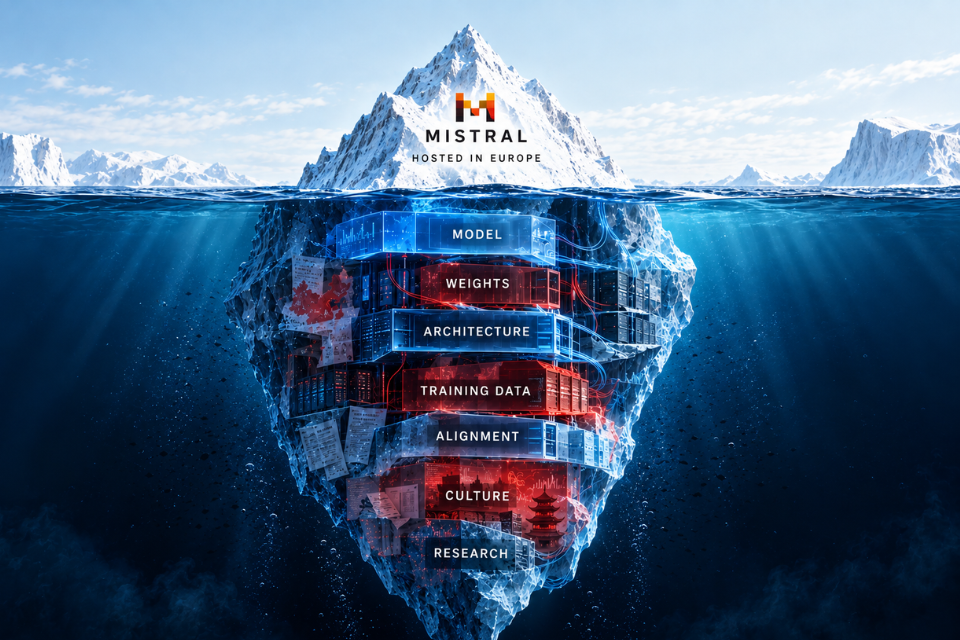
Because a model does not carry only computing power. It was trained on certain corpora, in certain languages, according to certain technical choices; it was then fine-tuned and aligned according to norms, constraints and trade-offs that are never entirely detached from the context in which it was developed.
The Mistral case therefore does not only raise the question of our technological dependence on China. It forces us to ask a question we should have put to the American models themselves long ago: when we entrust a machine with a growing share of our access to knowledge, our analyses and sometimes our decisions, what exactly do we want to remain sovereign over?
Perhaps we are discovering that digital sovereignty is not only about controlling our data and our infrastructure. It now also concerns the representations of the world through which machines learn to answer us.
I. From model producer to orchestrator of intelligences
To understand what is really changing at Mistral, we need to look less at the nationality of GLM-5.2 than at the conception of sovereignty the company is building. In its August 11 announcement, Mistral defines it around three capabilities: controlling the models used, choosing where intelligence runs and having the computing power needed to operate it at the desired scale. Its ambition is therefore no longer only to offer French models capable of competing with those of the major foreign labs; it is also to provide the environment in which different intelligences can be chosen, run, secured and adapted to the needs of organizations (Mistral AI, 2026a).
It is in this logic that the arrival of GLM-5.2 must be understood. Developed by Z.ai, the international brand of the Chinese company historically known as Zhipu AI, the model is presented by Mistral as a third-party model intended notably for coding and long-context agentic use cases. The documentation specifies that it is hosted by Mistral and served “without Mistral modifications” (Mistral AI, 2026b).
This clarification matters because it helps avoid two equally misleading readings. The first would be to say that Mistral is “becoming Chinese,” which makes little sense: the company continues to develop its own models, its own multimodal technologies, its specialized models and its compute infrastructure. The second would be to treat the addition of GLM-5.2 as a catalog detail with no strategic significance. In reality, Mistral is not changing nationality and is not giving up on producing intelligence, but it is significantly broadening its role. It now wants to be at once a model designer, a compute provider, a deployment platform and an intermediary giving its customers access to intelligences designed elsewhere.
This shift is far from anecdotal. A model lab draws part of its power from its ability to produce an intelligence that others use. An orchestration platform draws its power more from its ability to let users choose among several intelligences, run them in a controlled environment and replace them when better ones appear. Value does not disappear, but it moves along the chain: from the model itself toward infrastructure, integration, security, customization and operational control.
This evolution did not begin with GLM-5.2, either. A much more technical, and therefore less visible, signal had appeared eight months earlier with Mistral Large 3.
Introduced in December 2025 as Mistral’s most powerful model to date, Large 3 is a Mixture of Experts model with 675 billion parameters, 41 billion of which are activated to process each token. Mistral says it trained it from scratch on 3,000 NVIDIA H200 GPUs (Mistral AI, 2025). It is therefore not a DeepSeek model that was reused, adapted or retrained.
Its architecture nonetheless bears remarkable similarities to that of DeepSeek-V3, released a year earlier by the Chinese lab DeepSeek. Both models have 61 layers, use a hidden dimension of 7,168, adopt the MLA (Multi-head Latent Attention) attention mechanism and keep three initial dense layers before switching to a mixture-of-experts architecture. Several attention compression parameters are also identical. The differences are nonetheless substantial: Large 3 notably uses fewer but larger experts, activates fewer of them per token, adopts a different positional encoding scheme and adds a vision encoder absent from DeepSeek-V3 (DeepSeek-AI et al., 2024; Mistral AI, 2025).
The point is clear enough that Patrick von Platen, a member of the Mistral team, put it himself in a technical discussion on Hugging Face: Mistral Large 3 was not built or trained “on” DeepSeek-V3, but its architecture is, in his own words, “heavily inspired” by it. At the same time, he highlights the differences in expert structure, positional encoding and vision integration (von Platen, 2025).
The nuance is fundamental because, in public debate, the word “model” often covers very different technical realities.
The architecture describes the overall organization of the system: how its various components are arranged and interact. The weights are the billions of numerical parameters acquired during training, in which much of what the model has learned is crystallized. The training data is the informational raw material from which this learning takes place. The tokenizer, for its part, determines how text is split into units the machine can process. On top of this come the various post-training and alignment stages that shape the behavior of the final model.
Using a similar architecture therefore does not mean reproducing the same model, any more than using a building’s blueprint leads to constructing two identical buildings. The materials can differ, as can the equipment and the uses the building is intended for. Two models can share much of their architecture and produce very different behaviors because their weights, data, tokenizer or post-training are not the same.
This distinction lets us dismiss the simplistic idea that Mistral “copied DeepSeek.” The publicly available information does not support such a claim. What it does establish is something more interesting: some of the architectural solutions that now structure a major model developed in France had been tested and pushed very far by a Chinese lab.
This circulation of architectures should also be placed within the normal history of artificial intelligence. Scientific research has always been built through borrowing, improvement and recombination. The Transformer architecture, which still underpins a huge share of contemporary models, itself comes from a paper published in 2017 by Google researchers (Vaswani et al., 2017). It would therefore be absurd to ask each country to reinvent on its own every technical building block it uses.
What deserves our attention is not the existence of this circulation, but the change in the direction of the flow.
For much of AI’s recent history, the main architectures, training methods and reference models against which the rest of the world sought to measure itself came essentially from American labs. DeepSeek showed that a Chinese lab could now produce innovations efficient enough to become international technical benchmarks in their own right. Its MLA architecture, its mixture-of-experts design and its innovations aimed at reducing training and inference costs were designed precisely in a context of severe constraints on access to the most advanced GPUs. DeepSeek-V3 thus sought to turn a hardware constraint into an efficiency advantage, with a 671-billion-parameter model of which only 37 billion are activated for each token (DeepSeek-AI et al., 2024).
The story emerging from DeepSeek, Mistral Large 3 and then GLM-5.2 is therefore subtler than a simple tale of dependence. In December 2025, a French champion builds its own model drawing heavily on an architecture developed in China. In August 2026, it goes a step further by directly offering, within its own infrastructure, a Chinese model it has not modified.
In both cases, Mistral remains in control of its own technology choices. But in both cases, too, China now appears not only as a huge market, a competitor or an imitator, but as a place from which technologies spread that European players consider relevant enough to integrate into their own strategies.
This is probably the most important change. The global center of gravity of innovation in artificial intelligence is no longer exclusively American, and the question of French sovereignty can no longer be framed as a simple face-off with Silicon Valley. It must now reckon with a China that has also become a producer of standards, architectures and models capable of circulating far beyond its borders.




Executive MBA AI & Business
Transformation
The MBA reimagined for the AI era. For experienced executives who want to lead their organization’s transformation. Paris, Nice & Dubai.
II. China is no longer just AI’s “follower”
The DeepSeek case could still be read as the spectacular emergence of an exceptional player. That would be to underestimate what is happening in China today. A much broader ecosystem has formed around DeepSeek: Alibaba develops the Qwen family, Z.ai the GLM models, Moonshot AI the Kimi family, while MiniMax is pursuing a particularly aggressive strategy on models designed for agentic use cases. These companies differ in their history, resources and technology choices, but their proliferation shows that China’s rise no longer rests on a single isolated lab.
The figures in the Stanford AI Index 2026 help measure the change. Whereas in 2023 the best American models still held considerable advantages on several benchmarks, American and Chinese models have repeatedly traded the top spots since early 2025. In March 2026, the measured gap between the best American model and the best Chinese model was just 2.7%. The United States continues to produce more models considered “notable,” but China now leads in the volume of scientific publications, citations and number of AI patents (Stanford HAI, 2026).
These rankings must of course be handled with caution. Benchmarks measure only part of a model’s real capabilities, and the Stanford AI Index itself highlights their growing reliability problems. But the trend is hard to dispute: the technological frontier of artificial intelligence is no longer exclusively American.
Above all, the nature of the competition is changing. A model’s peak power still matters, but it is no longer the only decisive criterion. The cost of training and inference, the number of parameters actually activated, access to the weights, model size, ease of customization and the ability to run models on infrastructure chosen by the user are becoming strategic dimensions in their own right.
On this front, several Chinese labs have turned constraint into an innovation doctrine. DeepSeek-V3 notably showed that a 671-billion-parameter model could activate only 37 billion of them for each token, with particular attention paid to training efficiency (DeepSeek-AI et al., 2024). Qwen opted for a product-range approach, with models of very different sizes designed to make them easier to adapt to varied compute capacities and use cases (Yang et al., 2025). Z.ai’s GLM-4.5 likewise combines a Mixture of Experts architecture with a number of activated parameters far smaller than its total size, while Moonshot AI’s Kimi K2 and the MiniMax M2 family pursue the same quest for efficiency in coding and agent use cases (GLM-4.5 Team et al., 2025; Kimi Team, 2025; MiniMax et al., 2026).
The term “open” must also be used precisely. Not all of these models are open source in the strict sense, notably because training data, complete production methods or certain components often remain unavailable. However, a significant part of the Chinese ecosystem relies on open-weights models, whose weights can be downloaded and which, depending on their licenses and technical characteristics, can be hosted, adapted or integrated outside their developers’ platforms.
This characteristic profoundly changes their geopolitical potential. A company, government agency or state that hesitates to entrust its data to a closed American API can now consider running a high-performing Chinese model locally, adapting it to its business or integrating it into its own infrastructure. A study published in late 2025 by the Stanford Institute for Human-Centered AI points out precisely that Chinese developers increasingly favor models that are efficient and flexible to deploy, and that their international spread could durably reshape relationships of technological dependence (Meinhardt et al., 2025). Qwen in particular is already described by the authors as widely used by developers around the world.
The strategic shift is considerable. For a long time, the dominant model of generative AI consisted of building the most powerful system possible, then attracting users to the platform that controlled it. Part of the Chinese ecosystem is exploring another path: making its models powerful enough, cheap enough and accessible enough that they can become the building blocks of systems built by others.
So China may not only be trying to produce the best model in the world. It is also trying to produce the models the world can easily adopt.
If this strategy succeeds, power in artificial intelligence will no longer be measured solely by the number of users connected to a national platform. It will also be measured by the number of companies, developers and countries that build their own systems on models designed elsewhere. This is what gives Mistral’s choice a significance that reaches far beyond Mistral itself.
III. Z.ai: where sovereignty strategies intersect
The choice of GLM-5.2 takes on an additional geopolitical dimension when one looks at its developer’s status in the United States.
In January 2025, the Bureau of Industry and Security (BIS), part of the U.S. Department of Commerce, added Zhipu AI, under its corporate name Beijing Zhipu Huazhang Technology, along with several affiliated entities, to the Entity List. This list brings together organizations that the U.S. government considers to be involved, or at risk of being involved, in activities contrary to its national security or foreign policy interests. In the case of the entities added in January 2025, BIS explicitly cited their contribution to Chinese military modernization through the development and integration of advanced artificial intelligence research (U.S. Department of Commerce, BIS, 2025).
In practice, this listing subjects exports, re-exports or transfers to Zhipu of goods and technologies covered by U.S. regulations to particularly restrictive licensing requirements. For Zhipu AI, the regime specified by BIS covers all items subject to the Export Administration Regulations, with a presumption of denial for license applications (U.S. Department of Commerce, BIS, 2025).
The scope of this decision must, however, be interpreted precisely. The Entity List is a U.S. export control policy instrument. It therefore primarily reflects the U.S. government’s strategic assessment of the risks an organization poses to its own national security and foreign policy interests. It is neither a European ban on using Z.ai’s technologies nor proof that GLM’s answers are systematically censored, manipulated or politically slanted. Nothing in the BIS decision supports such a conclusion.
The nuance is essential, but it in no way diminishes the power of the symbol.
We face a rather unusual situation: a company that Washington considers strategic enough to restrict its access to American technologies is, at the same time, becoming the supplier of a model offered within a European infrastructure billed as sovereign.
The United States thus sees certain Chinese AI players as a national security issue; Mistral sees one of their models as a technology interesting enough to add to its offering.
But this divergence reveals something essential: AI sovereignty is no longer a purely technological concept. It is becoming an object of geopolitical confrontation, in which the same models can simultaneously be seen as strategic assets to be contained by one power and as technological resources to be integrated by another.
The paradox is therefore no longer just Franco-Chinese. It is becoming triangular: a Europe seeking to reduce its dependence on the United States may now find itself relying on Chinese technologies that the United States is precisely trying to contain.
And this is where the question becomes even more delicate. Because once we accept that a Chinese model can be technically strong, economically attractive and hosted on European infrastructure, we still have to examine what infrastructure does not change: the way this model has learned to represent the world and respond to it.
IV. The cultural problem: an AI is never just software
Hosting GLM-5.2 in Europe answers some sovereignty questions: data can stay within infrastructure controlled in Europe, and organizations can choose their execution environment and reduce their dependence on a foreign platform. But it leaves a harder question entirely open: what does a model carry with it when its weights are moved from one country to another?
A large language model cannot be reduced to a neutral computer program that one simply runs on a server. Its behavior results from several successive layers: the data it was exposed to, the languages and cultures represented in that data, the learning carried out from it, and then post-training, alignment and the rules meant to determine which answers are desirable, sensitive or forbidden. Infrastructure therefore controls where the model runs; it does not automatically rewrite what the model has learned.
The Chinese case makes this question particularly visible because the regulatory environment there is explicit. Since 2023, Chinese rules governing public-facing generative AI services have required, among other things, adherence to “core socialist values” and prohibited the generation of content likely to undermine national security, national unity or the image of the state. At the same time, they impose obligations to combat discrimination, protect individual rights, ensure transparency and improve the reliability of content (Cyberspace Administration of China, 2023).
It would be wrong, however, to conclude that a Chinese model hosted in Europe would necessarily be a propaganda tool or that all its answers would be politically slanted. A regulation applicable to a service deployed in China, the choices made when training a model and the behavior of an open-weight version run abroad are three different things.
Research is nonetheless beginning to show that these environments leave measurable traces. A study published in 2025 in the Proceedings on Privacy Enhancing Technologies shows that exposing models to corpora from a censored information environment can influence their answers on certain politically sensitive topics (Amed et al., 2025). Other comparative work has observed, on questions relating to China and relations with Taiwan, a closer alignment of several Chinese models, including GLM and Qwen, with the dominant positions in their country of development (Lin & Fan, 2024).
These findings deserve to be taken seriously, but they should certainly not lead us to imagine that there exists, on the other side, a culturally neutral Western artificial intelligence.
Numerous studies show precisely the opposite. A study published at ACL 2024 highlights a dominance of English-language cultural references in several major models, including when users query them in other languages (Wang et al., 2024). Other research identifies a bias toward Western references in Arabic-language use, while a COLING 2025 study shows that model behavior varies depending on the cultures they are compared with and the languages used to train or adapt them (Naous et al., 2024; Masoud et al., 2025).
Even the political values of American models are not fixed. A study covering several versions of ChatGPT observed measurable political leanings and their evolution over time, a reminder that alignment is indeed a series of human and technical choices, not access to some kind of algorithmic neutrality (Liu et al., 2025).
The real question, then, is not whether Chinese models have values while American models supposedly have none. It is about recognizing that all major models are culturally situated, even when their global spread ends up masking that origin.
This may be where the French debate on sovereignty needs to move to a new stage. We have asked ourselves a great deal where our data was stored, under which law it was protected and on which infrastructure it was processed. We must now also ask which systems interpret this data, what representations of the world they have learned and to what extent we are able to identify them, audit them and, when necessary, correct them.
This question becomes all the more important as models are no longer used merely to complete a sentence or translate a document. They are involved in education, research, recruitment, law, healthcare, news, strategic consulting and, increasingly tomorrow, in agents capable of carrying out entire chains of reasoning and action.
As we entrust them with part of our access to the world, cognitive sovereignty therefore does not mean demanding that machines be culture-free, which would be impossible. It means knowing which cultures, norms and choices they carry, so that we always remain able never to mistake them for the world itself.
Conclusion. Mistral may not be the problem, but the revealer
One could close this story with a simple verdict: Mistral has given up on its original ambition, China has won yet another battle and French sovereignty has retreated. Yet nothing we have observed supports such a convenient reading.
Mistral continues to develop its own models while making a different strategic choice: considering that its value can also lie in its ability to select, host, secure and orchestrate the best available intelligences, whatever their origin. This strategy is open to debate, but above all it reveals that sovereignty in artificial intelligence has become far more complex than the narrative that still accompanied it just a few years ago.
We thought we had to choose between depending on American models and building our own. The rapid emergence of the Chinese ecosystem now introduces a third power into this equation. More than that, the spread of open-weights models blurs the line between producing a foreign technology and depending on it: a model may have been designed in Beijing or Hangzhou, then downloaded, run in Paris, adapted by a French company and operated without its developer playing any role in its day-to-day use. But this operational autonomy does not make all dependencies disappear. It shifts them.
Behind the question of where an artificial intelligence runs now lies the question of where it was designed, what it learned and according to which choices it was shaped. That is why tomorrow’s sovereignty can no longer be measured by a single criterion of nationality, hosting or ownership. It will also have to include our ability to understand the models we use, know their limits, audit them, modify them, replace them and retain enough skills to keep producing them ourselves.
The Mistral paradox thus leads us to a less comfortable but far more fruitful conclusion: technological dependence does not begin only when we do not own a technology; it begins when we are no longer able to understand, choose or replace the one we need.
That leaves a question the Mistral case no longer lets us avoid: how did we get here?
France is not short of talent in artificial intelligence. It has internationally recognized mathematicians, engineers, researchers and labs. With Mistral, it has even managed to produce one of the very few European players able to hold its own in the global race for large models. Yet as this race accelerates, landmark innovations seem increasingly concentrated between the United States and China.
This situation may force us to look beyond the quality of our research alone. Because there is an immense distance between producing scientific intelligence and turning that intelligence into industrial power.
It is this distance that we now need to understand. And it concerns Mistral less than the French and European ecosystem around it.