


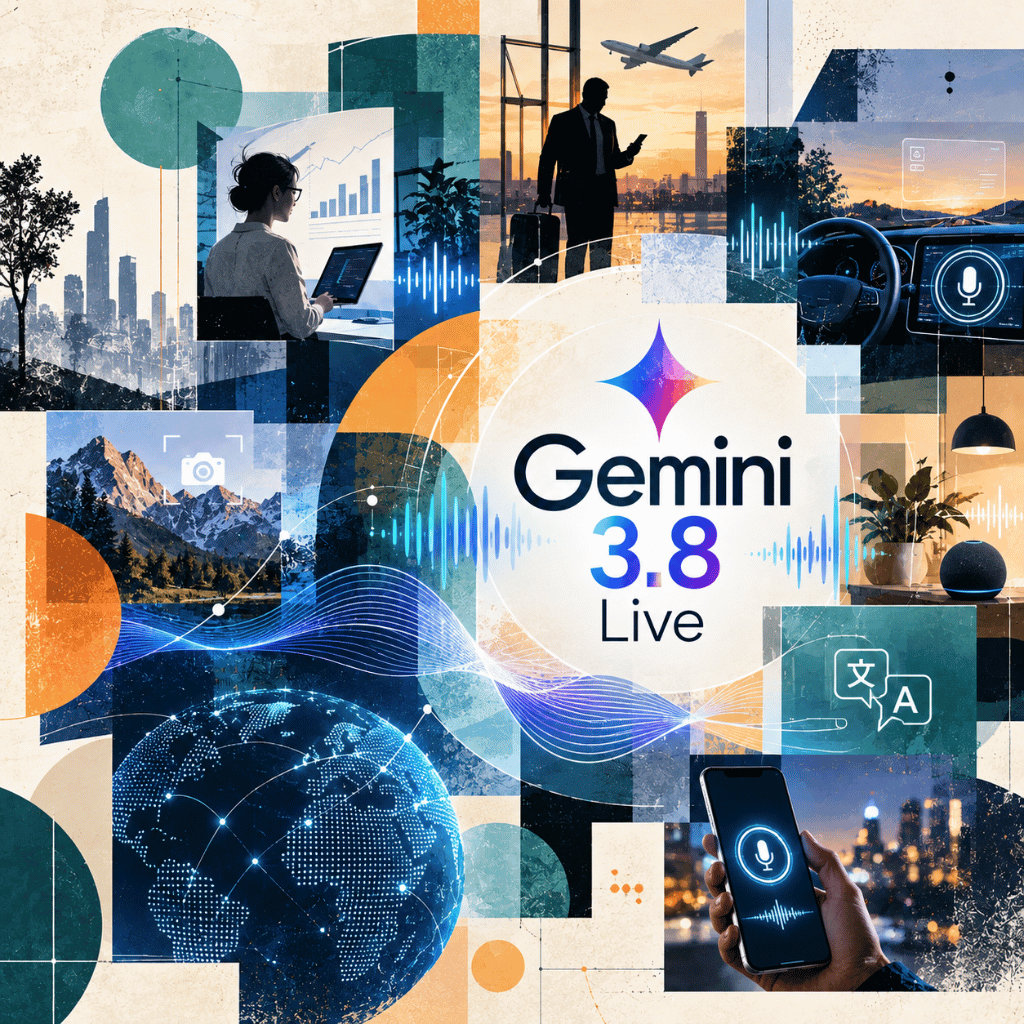
Unveiledby Google on September 15, 2026, Gemini 3.8 Live and Gemini 3.8 Live Extended Thinking evolve the voice assistant into an interface capable of following a conversation in real time, utilizing visual context, and executing tasks while the conversation continues. The published results indicate progress on several voice and agent-based evaluations, but they are not sufficient to guarantee reliability in all professional environments. The challenge lies less in achieving a more natural voice than in the ability to use voice commands to assign time-consuming tasks to a system connected to data and services.
Two models for two levels of complexity
Google offers two options. Gemini 3.8 Live is designed for low-latency interactions and large-scale deployments. Gemini 3.8 Live Extended Thinking adds deeper reasoning capabilities for complex queries and multi-step tasks. Both models are based on Gemini 3 Pro and accept audio streams, images, video, and text. Their announced context window is 128,000 tokens, with audio or text output of up to 64,000 tokens.[1]
The difference from a traditional voice assistant lies in the continuity of the interaction. A traditional system transcribes the request, searches for an answer, and then returns it. Gemini 3.8 Live is designed to maintain a multimodal session, handle interruptions, utilize a camera or screen, and call a function or API without requiring silence until the operation is complete. The model can thus confirm that an action is in progress, continue the conversation, and then announce the result.[2]
This capability does not mean that the system operates without infrastructure. The application must provide it with access to tools, define permissions, and process data streams in real time. The API documentation describes a stateful WebSocket connection. For direct connections from a client application, Google recommends using temporary tokens rather than permanent API keys to minimize the risk of exposure.[3]
What's Really Changing for the Voice Interface
The main contribution lies not only in the quality of the speech synthesis. It lies in the combination of four functions that were often separate: continuous dialogue, processing of visual context, multi-step reasoning, and the execution of tools. This combination brings the voice assistant closer to an agent-based interface—that is, a system capable of transforming a verbally expressed intention into a sequence of controlled actions.
Google also announced automatic detection and switching between 97 languages during a conversation. The general Live API documentation, meanwhile, lists 70 supported languages and more than 70 for live translation.[2][3] These figures do not describe exactly the same scope. Users are advised to verify, for each product and each language, the features that are actually available, the quality of accents, latency, and access requirements.
In a professional setting, an interaction might begin with a spoken question, continue with the analysis of a displayed document, trigger a search or a business function, and then culminate in a suggested action for the user. This continuity can make it easier to use complex software. It also increases the number of decisions made during a single session, which makes traceability and the ability to undo an action more important.


Master ChatGPT and Generative AI-
Demystify generative AI tools and unlock their potential in your field. A 100% hands-on approach, with no technical prerequisites.


Technology Framework
| Capacity or Constraint | What You Need to Know |
|---|---|
| Real-Time Dialogue | Continuous audio stream, the ability to interrupt the model, and low-latency voice responses. |
| Multimodality | Audio, image, video, and text inputs. Audio and text outputs as specified in the model specifications. |
| Context | Up to 128,000 tokens are available for both models, depending on the access channel and configuration. |
| Extended Reasoning | The Extended Thinking version is designed for complex, multi-step tasks and can provide verbal feedback on progress. |
| Tools and APIs | Background function and API calls during the conversation, subject to the permissions set by the app. |
| Deployment | Gemini API, AI Studio, Google products, and enterprise offerings, with availability varying by service and subscription. |
| Known Limitations | Hallucinations, attempts to bypass safeguards, slowdowns, or occasional crashes. Announced end date for the data: January 2025. |
Encouraging results—to be interpreted with caution
Google highlights several evaluations. Gemini 3.8 Live Extended Thinking scored 82.6 on Artificial Analysis’s Speech-to-Speech Quality Index, 68.6% on τ-Voice, 35.1% on Sierra τ-Voice-banking, and 97.7% on Big Bench Audio.[2] The methodology document specifies that the Artificial Analysis tests were conducted by that organization, that the ServiceNow evaluations were conducted by ServiceNow, and that the Gemini models were tested using pre-release IDs and, for several metrics, a high level of reasoning.[4]
| Evaluation | Published Results | Read Carefully |
|---|---|---|
| Speech-to-Speech Quality Index | 82,6 | Artificial Analysis Composite Index. It does not, on its own, measure an agent’s reliability in a specific profession. |
| τ-Voice | 68,6 % | Evaluates the performance of agentic tasks using voice commands within a given protocol. |
| Sierra τ-Voice-banking | 35,1 % | Results based on complex banking scenarios. The data also shows that a significant portion of the tasks are not completed. |
| Big Bench Audio | 97,7 % | Measuring reasoning abilities based on audio content, without replicating all the constraints of a real conversation. |
These metrics provide a more comprehensive assessment of speech and task performance than traditional text-based benchmarks. However, they remain sensitive to specific scenarios, reasoning frameworks, available tools, and success criteria. A natural conversation can mask a factual error or an incorrectly configured action. Conversely, an accurate but slow agent may be difficult to use during a call. Evaluation must therefore combine the quality of the interaction, the completion rate, the severity of errors, latency, and the ability to request confirmation.
Possible Applications in the Workplace and Services
Agent-based voice assistants can be useful when the user’s hands or eyes are occupied, when the user is not familiar with the interface, or when conversation is the most natural means of communication. Several use cases can be considered, provided they are tested in real-world environments.
- Technical support: guide an operator via a camera, consult documentation, and suggest the next step without interrupting the work.
- Customer Service: Categorize a request, query an information system, and prepare a response, transferring the call to an agent when the situation exceeds established guidelines.
- Research assignment: verbally summarize an email or document, search for information, and prepare a change request within authorized services.
- Education and accessibility: providing tailored explanations, describing a visual context, or enabling interaction that is less reliant on the keyboard and screen.
Not all of these scenarios grant the model the same degree of autonomy. Reading a procedure has fewer consequences than canceling an order, modifying a customer file, or sending a message. Organizations must therefore define levels of action: information, proposal, preparation, execution with confirmation, and automated execution. The more difficult an action is to correct, the more explicit human validation must be.
Voice technology raises the stakes when it comes to trust and data protection
A voice interface captures more than just a string of words. The audio stream can reveal the surrounding environment, habits, apparent emotions, information about third parties, and—depending on how the data is processed—characteristics that can be used to identify an individual. The CNIL recommends a “privacy by design” approach, clear disclosure, control over activation, and measures to limit accidental recordings.[5]
For an organization, deployment requires specifying the purposes, the data sent to the service, retention periods, recipients, any transfers, and individuals’ rights. In sensitive areas, access to files and tools must follow the principle of least privilege. Logs must make it possible to distinguish between what the user requested, what the model proposed, and what the system actually executed.
Synthetic voices also pose a risk of impersonation. Google states that audio content produced by its services incorporates SynthID, an imperceptible marker designed to facilitate their detection.[2] This measure is useful, but it does not guarantee that all players or platforms will check for this signal. In the European Union, Article 50 of the Artificial Intelligence Regulation has required, effective August 2, 2026, that users be informed when interacting directly with an AI system and that synthetic content be marked with a machine-readable label, with specific rules for hyper-manipulation.[6]
Security must also address malicious instructions transmitted via voice, images, or a referenced source. A connected agent may receive a hidden instruction in a document or be prompted to reveal information. The model’s datasheet mentions the general risks of hallucination and bypassing safeguards. It also states that Google does not consider these models to provide a material increase in capability compared to Gemini 3.7 Flash with respect to its boundary security framework.[1] This internal conclusion does not replace use-case-specific testing.
What the announcement does not yet show
- The published scores do not demonstrate consistent quality across all 97 languages listed or across all accents and acoustic environments.
- The smoothness of a demonstration does not reflect the rate of serious errors during lengthy or regulated actions.
- Availability varies across the API, Search Live, Gemini, Workspace, and enterprise offerings—sometimes as a private preview or depending on the subscription plan.
- The end date listed is January 2025. Therefore, recent information requires a reliable external source that has been properly cited.
- Google reports occasional slowdowns and timeouts. Actual performance also depends on the network, the app, and any third-party services being used.
Toward a Voice Assistant Capable of Acting Under Supervision
Gemini 3.8 Live marks a significant advancement in voice interfaces. Conversation becomes a way to control tools, access visual context, and follow a multi-step task. This change is important for accessibility and for situations where the screen slows down the action. However, it does not make speech a guarantee of reliability.
The value of these systems will depend on their control architecture: limited permissions, risk-based confirmations, logging, the ability to pause or cancel, clear disclosure of the artificial nature of the interlocutor, and accessible human intervention. The next step, therefore, will not simply be to make the voice sound more natural. It will involve determining what actions an assistant can actually perform, with what data, and under what level of accountability.
Learn more
To learn more about voice models, real-time translation, and the evolution of AI agents, be sure to check out these analyses on the aivancity blog.
Sources
[1] Google DeepMind. (September 15, 2026). Gemini 3.8 Audio (Live, Live Extended Thinking), Model Card. View the model card
[2] Google. (September 15, 2026, updated September 17). Introducing Gemini 3.8 Live and 3.8 Live Extended Thinking. View the announcement
[3] Google AI for Developers. (2026, updated September 15). Gemini Live API overview. View the documentation
[4] Google DeepMind. (2026). Gemini 3.8 Audio Model Evaluation: Approach, Methodology, and Results. View the report
[5] CNIL. (Accessed September 23, 2026). Voice assistants: advice for users and professionals. View the recommendations
[6] European Commission. (August 6, 2026). Guidelines on transparency obligations for providers and deployers of certain AI systems. View the guidelines