


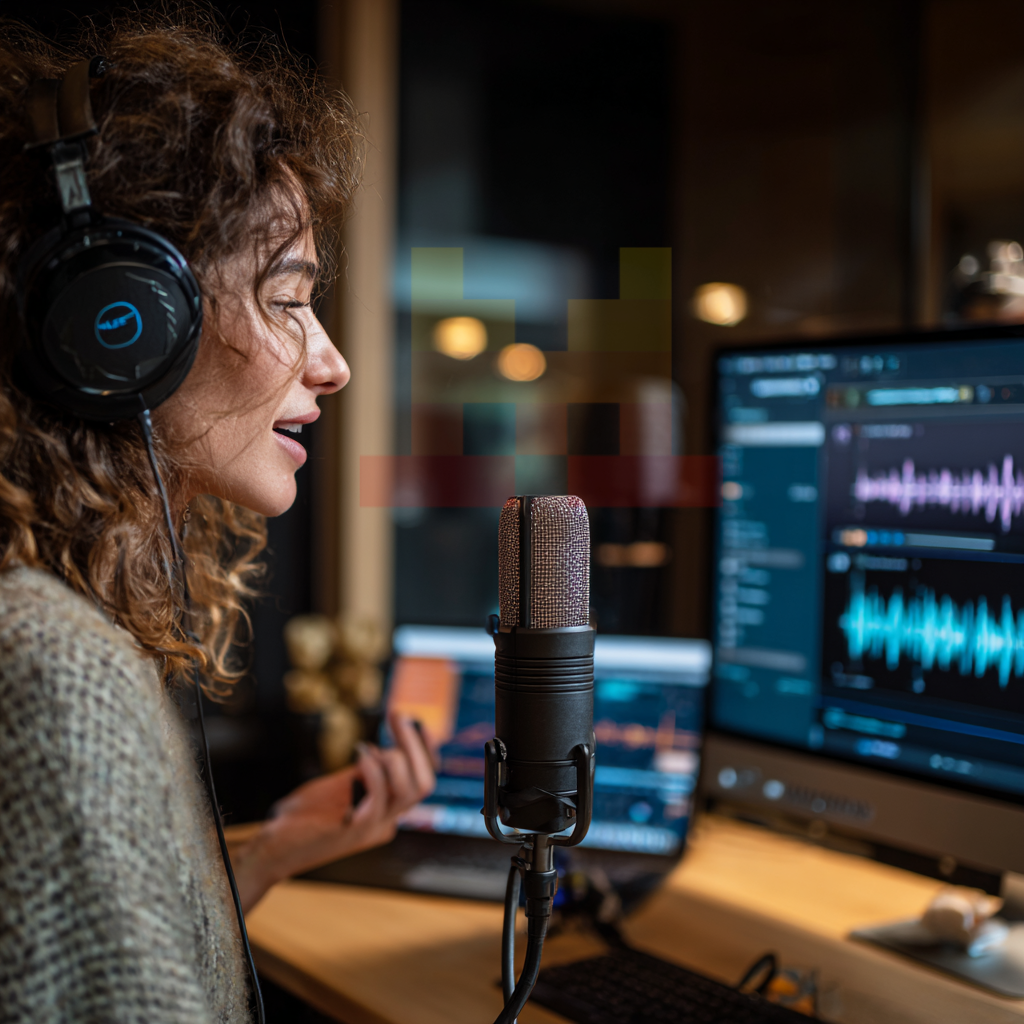
Speech and Artificial Intelligence: A New Technological Frontier
Artificial intelligence is no longer limited to vision or text. In recent years, speech has become a strategic area of research, where technical, commercial, and political issues intersect. While automatic transcription has made significant strides, the ability of machines to truly understand spoken language remains a more complex and multifaceted challenge.
In this rapidly evolving landscape, the French startup Mistral AI—already known for its open-source language models—has just reached a new milestone with the launch of Voxtral, its first family of AI models dedicated tospoken language understanding(SLU), released under the Apache 2.0 license1. With Voxtral, Mistral aims to lay the groundwork for an open voice ecosystem capable of competing with solutions from tech giants.
Understanding speech: much more than just transcribing
Automatic speech recognition(ASR) converts sound waves into text. Butspoken language understanding goes a step further: it involves interpreting the meaning of speech, extracting intentions, entities, and even emotional context.
This field is crucial for a wide range of applications, from voice assistants to summaries of phone conversations, as well as assistance systems in noisy or multilingual environments. Unlike text, speech carries contextual, prosodic, and often ambiguous information that AI must learn to model2.
Until now, most high-performance solutions have relied on proprietary models such as Whisper (OpenAI), AudioLM (Google DeepMind), or Meta Seamless. While these models deliver high performance, their limited openness restricts their use in sovereign, academic, or ethical contexts.
Voxtral: an open and strategic initiative
Announced in early July 2025, Voxtral is a family of pre-trained speech understanding models developed by Mistral AI. This marks the French company’s first public foray into the field of audio. In line with its strategy, Mistral is releasing Voxtral as open source under the Apache 2.0 license, allowing any organization to use, modify, and deploy the models without commercial restrictions.
According to information shared at the launch, Voxtral is based on an encoder-decoder architecture optimized for speech signal processing, trained on large multilingual corpora that combine public data (Common Voice, LibriSpeech, MLS) and anonymized proprietary corpora.
The models are available in several sizes, allowing them to be adapted to specific needs (on-premises, cloud, edge computing). Voxtral is designed to handle complex tasks such as:
- the segmentation and intelligent splitting of long audio sequences,
- automatic speaker identification,
- extracting intentions or named entities from spoken exchanges,
- conversational structure (who says what, when).
Initial use cases and performance
Mistral has announced that Voxtral is optimized to work in tandem with its in-house language models, notably Mixtral. This integration makes it possible, for example, to automatically analyze call recordings, produce a summary, or generate customer interaction reports in sectors such as customer service, healthcare, and education.
Although the quantitative results are still incomplete at this time, the initial benchmarks mentioned place Voxtral in a competitive position against Whisper and SeamlessM4T for tasks involving enriched transcription and contextual understanding3, particularly in French, English, and Spanish.
In addition, Mistral provides an API that enables quick integration into existing applications (via Python or REST) and offers a fine-tuning system for specialized corpora.
Open-source voice technology: a promise that needs to be managed
By releasing Voxtral under the Apache 2.0 license, Mistral is continuing its commitment to responsible, modular, and reproducible AI. This openness allows universities, public research labs, SMEs, and NGOs to adopt the tool, audit it, or adapt it to specific use cases, including in under-resourced languages.
However, the release of powerful voice models raises questions about governance and accountability: What data was used? Are the corpora representative? How can we prevent misuse (spying, voice deepfakes, automated harassment)?
To this end, Mistral plans to provide its model with a transparent documentation framework (model specifications, risk assessments, best practices for deployment), in line with European recommendations on trustworthy AI4.
A step toward European voice sovereignty?
Beyond its technical performance, Voxtral could become a landmark project in the development of a European alternative to proprietary voice models. By expanding into the audio domain, Mistral is rounding out its portfolio of open- s (text, audio), thereby solidifying its position as a leading player in the AI landscape.
This initiative could also encourage the creation of open-source voice resources for regional languages, educational settings, or public services, contributing to a more inclusive and locally rooted AI.
It also calls for a rethinking of audio interoperability standards in Europe, based on an ethical and collaborative approach, as opposed to technological centralization.
Learn more
To better understand Mistral AI’s overall strategy and its technological positioning, check out:
- VivaTech 2025: Mistral AI Unveils a Sovereign High-Performance Computing Infrastructure in Partnership with Nvidia
- Magistral: Mistral’s artificial intelligence that brings new meaning to automated reasoning
These two publications explore Mistral’s technological ambitions and its commitment to developing an open, high-performance, and sovereign European AI.
References
1. Mistral AI. (2025). Introduction to Voxtral.
https://www.mistral.ai/
2. Bapna, A. et al. (2023). Unified Speech Models. Google DeepMind.
https://arxiv.org/abs/2303.13035
3. Wang, A. et al. (2021). SUPERB: Speech Processing Universal PERformance Benchmark.
https://arxiv.org/abs/2105.01051
4. Common Voice Project. Mozilla.
https://commonvoice.mozilla.org/