


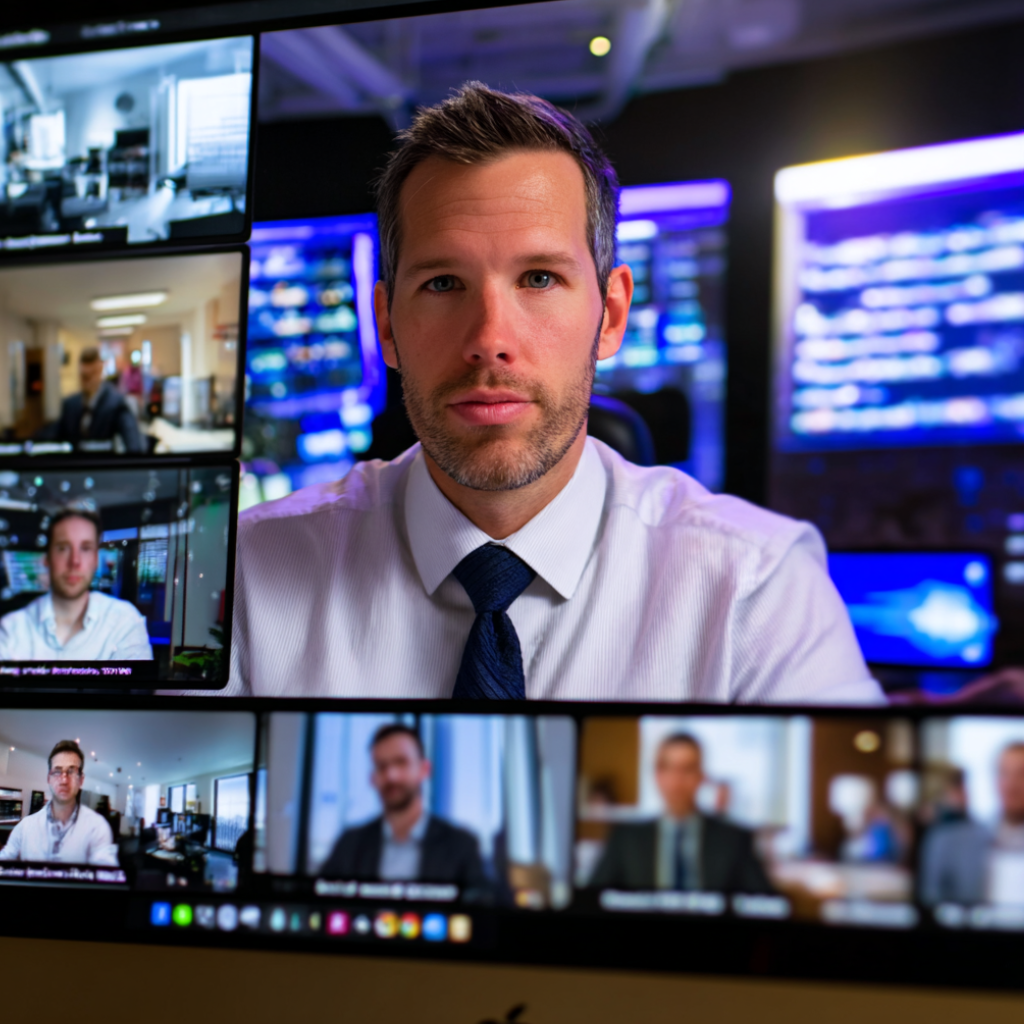
What if you could join a Zoom meeting without turning on your camera, while still maintaining a credible and expressive visual presence on screen? That’s exactly what Zoom is offering with its new feature currently in development: the ability to activate an AI-generated digital double that replaces your actual video feed with an animated version of yourself.
In practical terms, this innovation aims to create a photorealistic avatar capable of mimicking your facial expressions and head movements based on your voice captured in real time. No need to film yourself or stay perfectly framed: your digital “self” will take over visually, animating your reactions with a fluidity close to reality. The goal isn’t to make you disappear, but to offer you a form of controlled presence that’s more flexible, less intrusive, and (according to Zoom) more inclusive.
The feature was quietly unveiled at the Zoomtopia 2025 conference, during a session focused on personalization tools and digital fatigue. It is part of Zoom’s broader strategy to integrate generative AI models into video interactions, following in the footsteps of its recent writing, transcription, and meeting summary assistants.
Video conferencing without a camera: a solution to digital fatigue
Since the widespread adoption of remote work, video meetings have become the norm in many industries. But this norm comes at a cost: a 2023 survey conducted by Microsoft revealed that 68% of remote workers reported experiencing “visual cognitive overload” due to the need to stay in frame, remain expressive, and stay focused for several hours at a time1.
Another indicator: A Stanford study identified four specific forms of “Zoom fatigue”: cognitive overload, constant self-monitoring, reduced nonverbal cues, and stress related to the perceived proximity of faces on the screen2.
Zoom’s digital double aims to address these limitations by separating video capture from visual representation. You’re still there—speaking, listening, and interacting—but it’s no longer your live face that appears on screen. Instead, it’s a synthetic version of you, generated from data you’ve provided (photos, voice recordings, facial movements). This digital double reproduces your nods, smiles, and brief reactions in a believable way without actually exposing you.
Generative AI technology powered by synthetic video
Technically, this feature relies on video synthesis models combined with voice cloning and facial animation algorithms. Zoom has not specified whether this is a proprietary model or the result of a technology partnership, but several companies in the field (such as Synthesia, D-ID, and HeyGen) have already mastered this type of generation using photos and audio.
The digital double is first created using initial data: a short video clip or a series of photos taken from different angles, combined with a voice sample. Then, during the meeting, the model generates a facial animation synchronized with your voice in real time, mimicking the natural expressions of an attentive person, without requiring an actual video recording.
According to Zoom, users will be able to set their preferred level of animation: minimal (simple static presence), moderate (light animation), or dynamic (more lively expressions). This control over one’s personal image is part of a clear effort to tailor the tools to individual preferences and sensitivities.
A New Standard of Presence? Toward a Generalized Synthetic Representation
If this technology becomes widely adopted, it could fundamentally change the unwritten rules of remote meetings. Today, not turning on your camera is sometimes seen as a sign of disengagement. Conversely, using a digital avatar could offer an alternative: being seen without being filmed. This changes the game when it comes to visual presence.
But this also raises questions: What do we really see when we look at a synthetic face? Does it capture our attention in the same way as a real face? Are we at risk of seeing a standardization of nonverbal behaviors—calibrated smiles, artificial gazes, and movements “optimized” to please without distracting?
Social scientists are already warning about the disconnect between image and intention, which could affect the quality of interactions. If the person on screen is merely a simulated reflection, how much trust can we place in their emotional cues? Is this still authentic communication, or merely a simulated interface of presence?
A paradigm shift in our online self-image
Behind this innovation, a new relationship with digital identity is taking shape. Until now, video conferencing required us to show our true faces and manage our image in real time—with all its imperfections and signs of fatigue or stress. With the digital avatar, this exposure is mitigated, or even circumvented.
We choose what we want to convey—not just through words, but through facial expressions, style, and attitude. We curate our visual presence just as we would choose a profile picture, but in an interactive, real-time environment.
This is undeniably a technical breakthrough. But it also marks an anthropological turning point: a shift toward a form of communication in which one’s social image is generated by an algorithm rather than captured by a camera. This raises questions about our relationship to truth, spontaneity, and attention.
Between inclusive innovation and emotional standardization
For certain groups, this feature can be a real boon for accessibility: people with disabilities, employees in environments unsuitable for video, and those who are anxious or neurodivergent. Providing a way to participate visually without a camera can help break down significant barriers.
But for others, it could exacerbate a more troubling phenomenon: that of emotional standardization, where all faces end up looking alike, reacting in the same way, with the same perfect smile and the same carefully calibrated, attentive expression. If the diversity of human expressions fades away behind pre-programmed avatars, what becomes of the richness of our interactions?
What Zoom is really working on is an augmented presence
Zoom’s digital twin is neither a gimmick nor a clone. It symbolizes a subtle yet profound shift: a world where presence is negotiated between reality and simulation, between captured truth and controlled imagery. In this world, the camera becomes optional, visibility is customizable, and identity… programmable.
It remains to be seen whether this new form of presence will be perceived as a gain in freedom, or as yet another layer of interface between human beings.
Learn more
In the same vein, check out our article:
Voxtral: Mistral’s open-source response to large language models
An exploration of new voice generation models and their impact on human-machine interactions, at a time when voices and faces are becoming just as generated as text.
References
1. Microsoft. (2023). Hybrid Work Trends 2023 Report.
https://www.microsoft.com/work-trends-index
2. Bailenson, J. (2021). Nonverbal overload: A theoretical argument for the causes of Zoom fatigue. Technology, Mind, and Behavior.
https://doi.org/10.1037/tmb0000030