


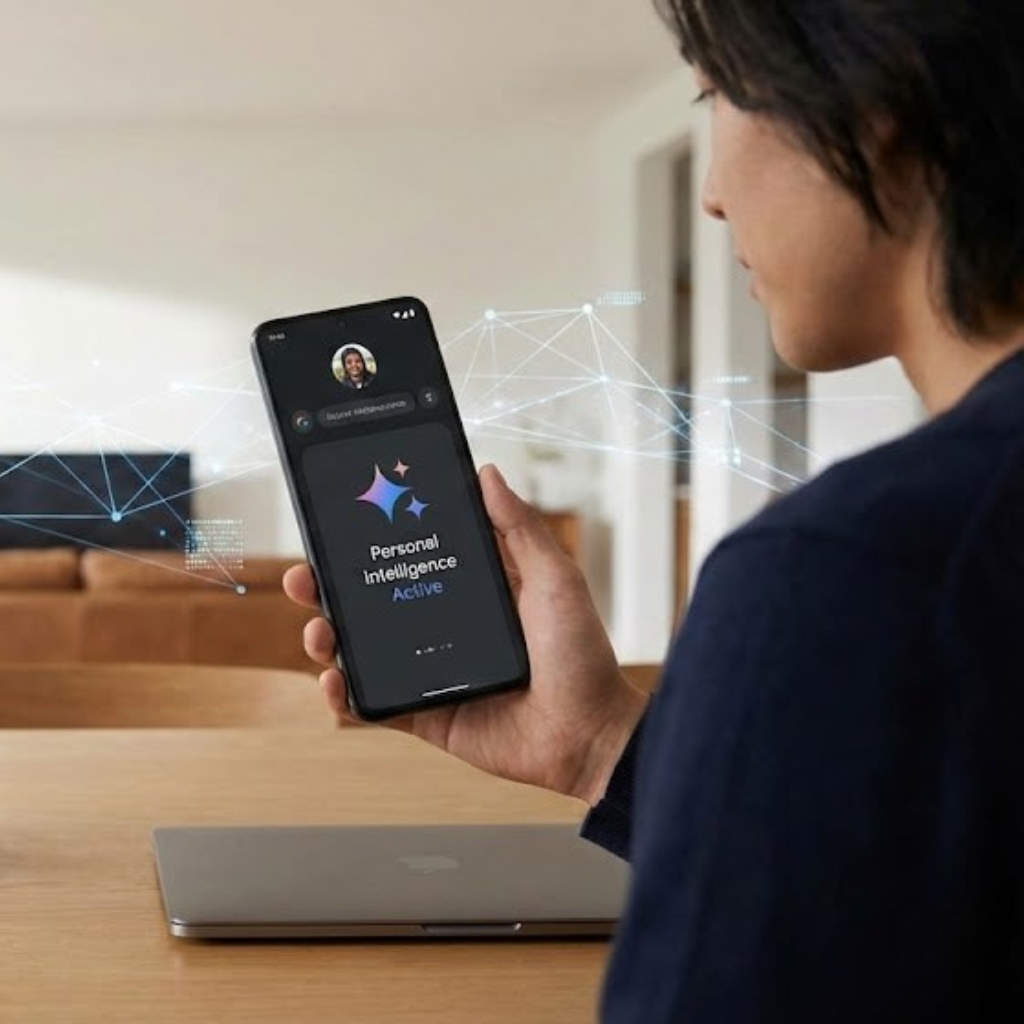
Artificial intelligence is entering a decisive phase: that of deep personalization. After years of assistants capable of providing effective but largely generic responses, Google is taking a new step forward with“Personal Intelligence,” a feature currently in beta in the United States as part of Gemini. The goal is clear: to transform AI into a truly personal assistant, capable of reasoning based on the user’s data—with their explicit permission—to provide contextualized, relevant, and proactive responses.
A U.S. beta for a more personalized AI
"Personal Intelligence" is currently being rolled out in beta in the United States, exclusively to Google AI Pro and AI Ultra subscribers with personal accounts. Google Workspace business accounts are not included at this time. The feature is available on Android, iOS, and the web, and is powered by Gemini 3 models. Google plans to gradually expand the feature to other countries and, eventually, to the free version of Gemini, though no specific timeline has been announced at thistime1.
Gain insights from your Google data
The key innovation introduced by “Personal Intelligence” lies in Gemini’s ability to reason simultaneously using multiple data sources, whereas previous assistants relied solely on isolated pieces of information. With the user’s consent, the AI can connect to a wide range of the Google ecosystem, including:
- Google Workspace (Gmail, Calendar, Drive),
- Google Photos (photos and videos),
- YouTube (watch history),
- Search services (Search, Shopping, News, Maps, Flights, Hotels).
Specifically, Gemini can cross-reference an email, a photo, and search history to provide a more accurate response. For example, it can recommend a travel itinerary by taking into account past conversations in Gmail, destinations previously visited identified in Google Photos, and interests observed on YouTube. According to Google, this ability to reason across multiple sources is one of the two strategic pillars of Personal Intelligence1.
Practical applications focused on recommendations and foresight
Gemini’s interface now features a “For You” tab on the home page, which offers personalized prompt suggestions. Users can also request recommendations for products, cultural content, or activities based on their habits identified by AI. This approach aligns with a documented trend, according to which more than 70% of users expect digital assistants to anticipate their needs rather than merely responding to explicit requests2. Personal Intelligence specifically aims to reduce cognitive friction by offering fewer generic responses and more directly actionable suggestions.

A clear difference from traditional AI assistants
Whereas traditional assistants function as response engines, “Personal Intelligence” introduces an active contextual memory. Gemini no longer starts from scratch with every interaction. It builds on past interactions to adjust the level of detail, tone, and nature of recommendations. This approach marks a strategic shift: AI is no longer merely conversational; it becomes relational, fostering continuity in interactions with the user.
Granular control and a commitment to privacy
Recognizing the challenges associated with the use of personal data, Google emphasizes giving users precise control. Personal Intelligence is turned off by default. To enable it, users must go to Gemini’s settings, select the feature, and choose exactly which apps to connect. Users can turn off personalization at any time, or start a conversation without “Personal Intelligence” for a one-time query.
Google also states that Gemini is not trained directly on content from Gmail, Google Photos, or YouTube. The data is used solely to generate context-aware responses and is not incorporated into the model training process, which relies on filtered and anonymized information3. This distinction aims to address a major concern, as nearly 80% of users say they are worried about the use of their personal data byAI systems4.
Limitations acknowledged in this first version
Google acknowledges that this beta version still has limitations. “Personal Intelligence” may produce inaccurate responses or over-personalize answers by drawing inappropriate connections between unrelated topics. These challenges include timing issues, misinterpretations of interests, and significant changes in users’ personal lives. Google therefore encourages users to provide direct feedback to Gemini to gradually improve the quality of its responses1.
Toward a New Standard in Smart Assistance
With "Personal Intelligence," Google anticipates a structural shift in the AI market. As models become comparable in terms of raw performance, differentiation will hinge on the ability to understand users over the long term. Analysts estimate that contextual personalization will be one of the key drivers of AI assistant adoption by 20275. By making Gemini an AI capable of learning habits, Google is setting a new standard: that of continuous, adaptive artificial intelligence deeply integrated into everyday life.
Learn more
This increased personalization of AI assistants raises significant questions regarding personal data and user control. On a related topic, check out our article “Temporary Conversations on Gemini: A Step Toward More Privacy-Respectful AI”, which analyzes how Google is attempting to balance personalization, performance, and privacy protection in the evolution of its smart assistants.
References
1. Google. (2026). Introducing Personal Intelligence in Gemini.
https://blog.google
2. McKinsey Global Institute. (2024). The Future of Personalized AI Assistants. https://www.mckinsey.com
3. Google. (2026). Gemini privacy and data usage.
https://support.google.com
4. Pew Research Center. (2024). Public attitudes toward AI and personal data.
https://www.pewresearch.org
5. Gartner. (2025). AI personalization as a key driver of adoption.
https://www.gartner.com