


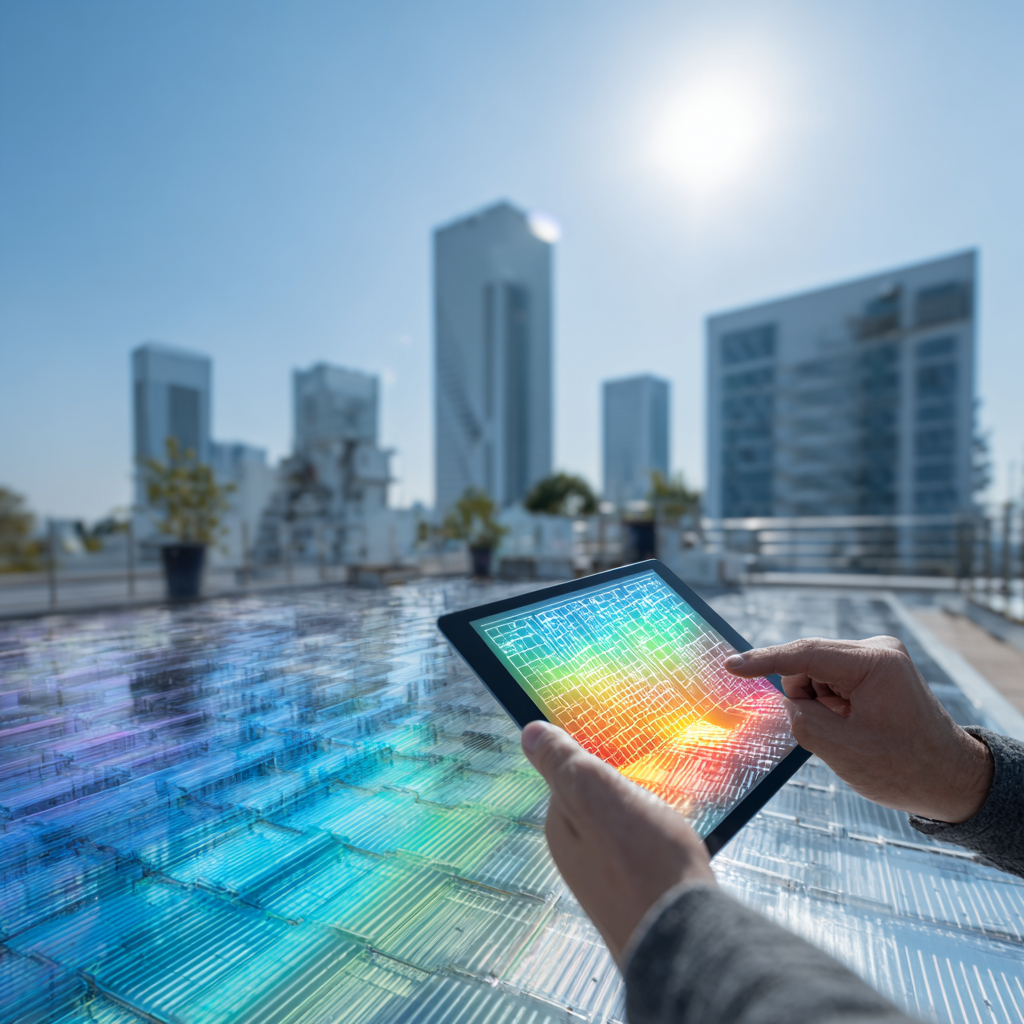
A growing climate challenge: the urban heat island
In the face of climate change, cities are particularly vulnerable to heat waves, which are exacerbated by the urban heat island effect. Traditional building materials (asphalt, concrete, glass) store heat and contribute to raising ambient temperatures by several degrees.1. Air conditioning, in turn, increases energy demand and exacerbates greenhouse gas emissions.
Against this backdrop, “thermoregulating” materials are emerging as a promising structural solution. Their rapid development today relies on an unexpected driver: artificial intelligence.
Intelligent materials for passive architecture
Thermoregulating materials are designed to reduce heat transfer between the exterior and interior of a building without consuming electricity. They are sometimes inspired by the natural properties of certain living organisms (bio-inspired design) or make use of complex physical phenomena (spectral reflectance, thermal emissivity).
Recent innovations include:
- paints that reflect up to 98% of the sun’s rays,
- adaptive coatings capable of changing their properties in response to temperature,
- nanocomposite structures that modulate heat conduction.
These materials are being tested on roofs, walls, and even roads. They are expected to reduce indoor temperatures by up to 5°C, which will have a significant impact on comfort and energy consumption.
The strategic role of artificial intelligence in their design
The development of these complex materials is greatly accelerated by artificial intelligence.2. Researchers are using machine learning to:
- predict the thermal properties of new material combinations,
- optimize nano- and micro-scale structures,
- model thermal behavior across several seasons or climatic zones,
- reduce prototyping time, thanks to inverse simulation and generative algorithms.
Databases containing thousands of configurations are analyzed by the AI, which identifies those that offer the best balance between solar reflection, durability, and architectural integration.
Impact on the city and the construction industry
The adoption of these materials could significantly lower urban temperatures, mitigating heat waves and reducing the need for air conditioning. It will also lead to a transformation of professional practices:
- Architects will need to incorporate dynamic thermal criteria right from the design stage.
- Materials engineers will work more closely with data scientists.
- Urban planners will need to develop passive cooling strategies at the neighborhood level.
AI is thus becoming an integral part of the construction industry’s value chain, creating a need for new hybrid skills.
Ethical, legal, and environmental issues
As with any technological development driven by AI, several precautions are necessary:
- Safety: Materials must meet standards for durability, fire resistance, and toxicity.
- Life cycle: sustainability and recyclability must be taken into account3.
- Legal framework: certifications and labels will need to evolve to include “AI-designed” materials.
We must also ensure that these innovations do not create new inequalities in access to energy efficiency.
Toward a new generation of self-regulating cities?
The combination of adaptive materials and artificial intelligence opens up promising prospects:
- buildings capable of adjusting their thermal response,
- neighborhoods whose materials interact with their surroundings,
- urban planning that incorporates AI simulation in the early stages of decision-making.
This trend heralds a new generation of cities that are more resilient, sustainable, and adaptable, where AI becomes an ally in promoting both energy efficiency and climate comfort.4.
References
1. Nature Communications. (2023). A passive cooling paint with superior solar reflectance.
https://www.nature.com/
2. MIT News. (2024). How AI is speeding up materials discovery.
https://news.mit.edu/
3. European Commission. (2024). Sustainable Construction and Energy Performance Regulation.
https://ec.europa.eu/
4. Science Advances. (2025). Thermal metamaterials for urban heat mitigation.
https://www.science.org//