


Open, lightweight robotic AI: a turning point for modern robotics?
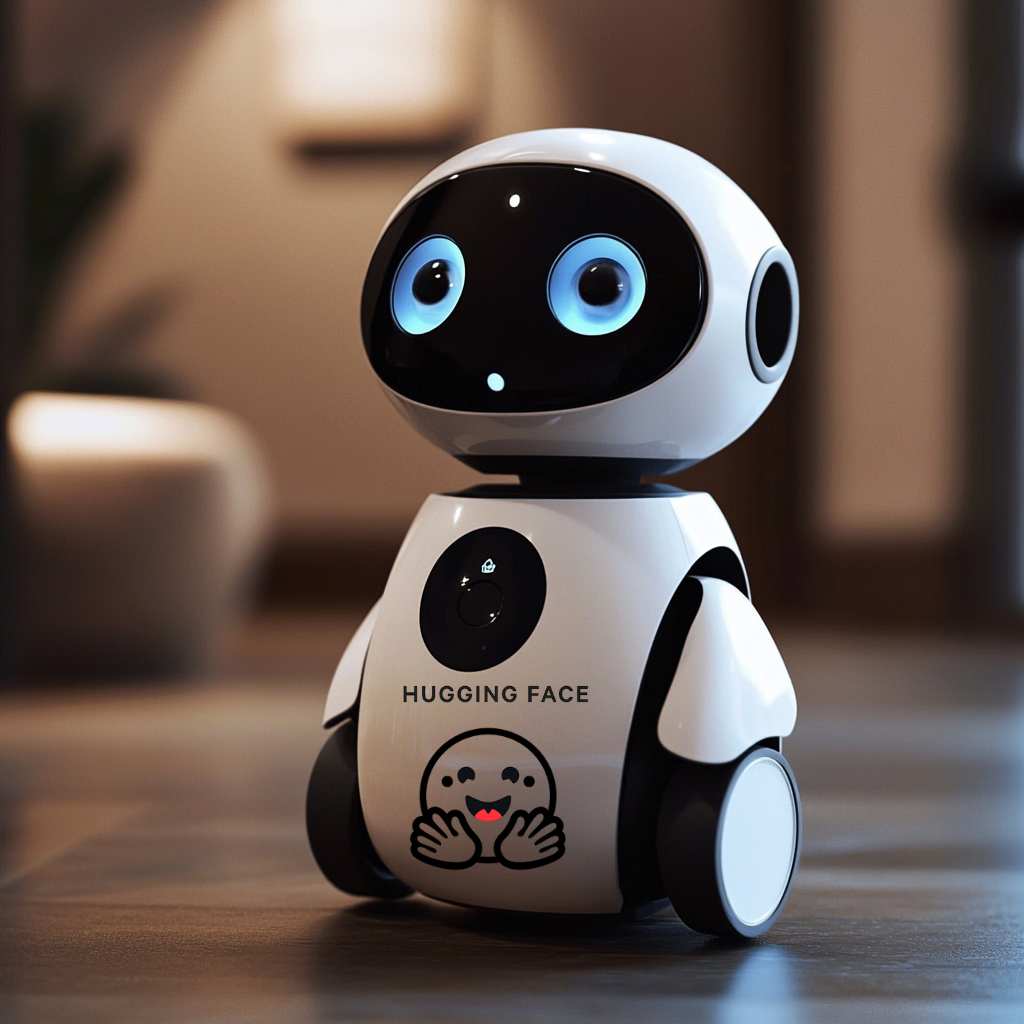
Hugging Face, a major player in open-source artificial intelligence, recently unveiled SmolVLA, a novel robotic model that combines lightness, performance, and accessibility. This project, developed in collaboration with the open-source community, illustrates a paradigm shift in the approach to artificial intelligence applied to robotics: favoring simple, adaptable, and cost-effective models over massive, expensive architectures.
Through this initiative, Hugging Face poses a strategic question: Could the future of intelligent robotics lie in the field of computational simplicity and frugality?
SmolVLA: a simple yet efficient robotic AI
SmolVLA (Small Vision-Language Action) stands out for its ability to understand natural language instructions, analyze images or videos, and generate appropriate robotic actions. Unlike large models that require significant infrastructure, SmolVLA can be deployed on compact robots or low-power embedded systems.
- Modest parameterization, proven effectiveness: SmolVLA operates with fewer than 200 million parameters, while maintaining competitive inference capabilities for simple visual and motor tasks.
- Integrated multimodality: the model is based on a vision-language-action architecture capable of simultaneously processing an image of the environment, a textual command, and the robot’s state.
- Open source and community-driven: the project is fully available on GitHub, along with fine-tuning tools, documentation, and demonstration videos of robots such as Unitree or Spot from Boston Dynamics.
This approach encourages widespread adoption by researchers, educators, makers, and startups seeking intelligent robotic solutions without the need for costly cloud infrastructure.
Use cases: accessible robots for specific applications
SmolVLA opens up new possibilities for practical applications in fields where robotics has previously been difficult to implement:
- Education and research: Many universities can now train multimodal robotic models without requiring extensive GPU resources, making it easier to teach cognitive robotics.
- Light logistics: Using low-cost robots, SmolVLA enables simple objects to be handled via visual or voice commands (e.g., “Put this object in the blue box”).
- Domestic or medical assistance: when combined with on-board visual sensors, the model enables robots to accompany a person in a wheelchair, detect a fallen object, or follow a remote command.
- Rapid prototyping in industrial robotics: SmolVLA facilitates the development of customized human-robot interfaces, even for small industrial facilities without advanced AI computing centers.
A new AI culture embodied in machines
The SmolVLA initiative is part of a broader movement to redefine priorities in artificial intelligence. Rather than seeking to produce ever larger and more energy-intensive models, Hugging Face advocates an approach focused on modularity, interpretability, and accessibility. This approach is gaining increasing acceptance in the scientific and industrial communities.
According to a Stanford HAI study published in 20241nearly 60% of all academic robotics projects now involve smaller models, optimized for edge deployment. At the same time, initiatives such as Open X-Embodiment or RT-Agents are moving in the same direction, integrating generative robotic capabilities at low computational cost2.
Toward the democratization of intelligent robots
Intelligent robotics has long been the domain of large corporations and well-funded laboratories. By making models more compact, open source, and compatible with inexpensive hardware, Hugging Face and its partners are ushering in a process of technological democratization. This trend could lead to a structural transformation of robotics value chains.
SmolVLA is not just another model: it embodies the political and technical commitment to bring artificial intelligence from the cloud to the field, from laboratories to workshops, and from research centers to classrooms.
References
1. Stanford HAI. (2024). AI Index Report 2024 – Robotics Section.
https://aiindex.stanford.edu/report/
2. Google DeepMind. (2023). RT-Agents: A New Standard for Multimodal Robotic Models.
https://www.deepmind.com/publications/rt-agents