


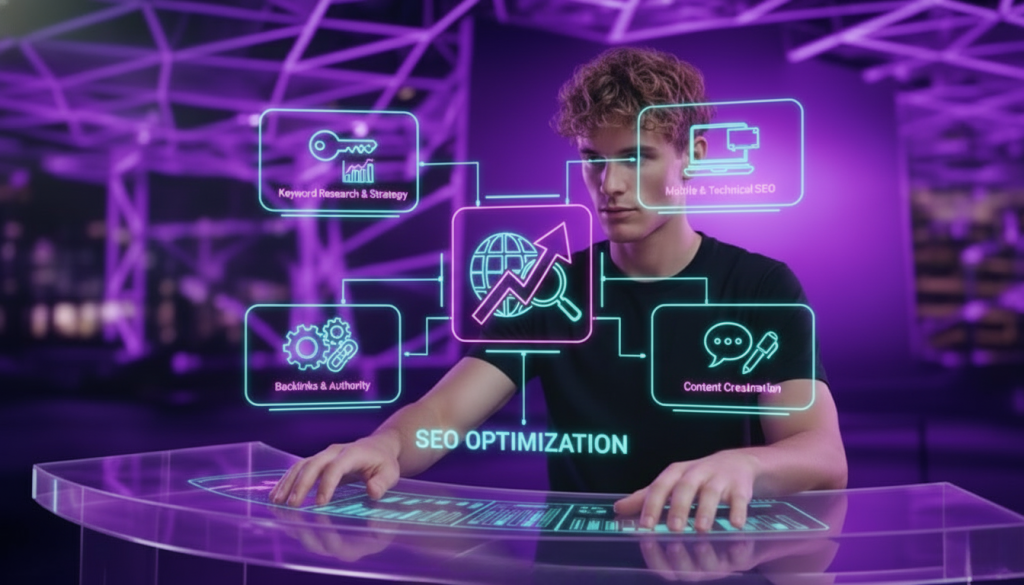
By 2026, search engine optimization (SEO) is undergoing a profound transformation driven by generative artificial intelligence models. SEO, which has long relied on manual keyword analysis, the examination of search intent, and content creation based on human expertise, is now being automated on a large scale. AI tools specialized in SEO are establishing themselves as strategic assistants capable of analyzing a market in seconds, anticipating search trends, producing optimized content, and identifying semantic opportunities that human teams no longer spot. According to HubSpot (2025), 79% of SEO specialists report using at least one AI tool for keyword research, content creation, or competitive analysis—a 36% increase over two years.
This rise in prominence can be attributed to the widespread adoption of advanced language models and changes in user behavior, as users become increasingly concerned with the relevance of the results they receive. Tools such as Surfer SEO, Clearscope, Frase, and NeuronWriter combine semantic analysis, algorithmic scoring, and real-time recommendations to enable content creators to improve organic visibility with unprecedented precision. They integrate into editorial workflows, CMS platforms, and performance analytics platforms, making SEO more accessible while raising its technical standards.
At the same time, companies are widely adopting these solutions to accelerate their content production and strengthen their digital competitiveness. Digital marketing agencies, freelance writers, and content creators rely on these tools to structure their briefs, automate some repetitive tasks, and focus their expertise on adding editorial value. The AI-assisted SEO market is projected to reach $5.2 billion by 2027, according to Gartner, driven by growing demand for optimized content and the integration of predictive analytics technologies.
This trend also raises new challenges. How can we ensure editorial quality when content is partially generated by AI? How can we avoid stylistic uniformity? How can we ensure the transparency of algorithmic recommendations? And how can we preserve human expertise in an increasingly automated field? In this article, we present a comprehensive overview of the most effective AI SEO tools in 2026, a ranking of the must-have solutions, and an analysis of their strengths, limitations, and implications for the organic search ecosystem.
1. Category Overview
By 2026, generative SEO will have established itself as one of the most dynamic fields in artificial intelligence applied to digital content. Specialized tools combine advanced semantic analysis, user intent understanding, and automated optimization to produce content that ranks higher in search results. The global market for AI-assisted SEO is estimated at $4.1 billion in 2025 and could reach $11.8 billion by 2030, driven by an average annual growth rate of 22.4% according to Search Engine Journal 1. This growth is driven by the increasing maturity of language models, the adoption of data-driven content strategies, and the integration of collaborative tools directly into editorial production environments.
Recent figures confirm the rapid growth of this category of tools:
- Surfer SEO has surpassed 150,000 active professional users and generates several million editorial optimizations each month 2.
- Clearscope is adopted by major corporations and publishing agencies for its advanced semantic analysis and content benchmarks, becoming an industry standard 3.
- Frase has surpassed the 2 million mark in SEO briefs generated annually, illustrating the widespread use of assisted creation workflows 4.
- VidIQ, which specializes in video SEO, claims to have over 1.5 million monthly active creators 5.
- According to McKinsey, 82% of SEO professionals believe that generative AI will be indispensable within three years for analyzing search trends and structuring their content 6.
This trend is accompanied by a shift in professional practices. Organizations now favor an iterative approach in which content is continuously reviewed, enriched, and recalibrated based on data. Tools such as NeuronWriter, Seona AI, and BlogSEO enable monitoring of semantic coverage, thematic depth, and ranking probability throughout the writing process. This convergence of editorial SEO, algorithmic analysis, and automation enhances the precision of visibility strategies while reducing low-value-added manual tasks.
By 2026, AI-enhanced SEO will no longer be merely a tool for technical optimization; it will become a space for experimentation where data shapes creativity, search intent becomes predictable, and organic performance relies on closer collaboration between human expertise and computational intelligence.
2. Ranking of the Best AI Tools
The market for AI-powered SEO tools is now dominated by a new generation of platforms capable of combining semantic analysis, predictive optimization, and real-time editorial recommendations. These solutions do not replace SEO specialists; rather, they act as efficiency multipliers, capable of auditing thousands of pages in seconds and generating recommendations based on actual user behavior and SERP structure. The ten tools presented below illustrate the diversity and maturity of this category in 2026, ranging from content optimization to keyword research, competitive analysis, video SEO, and trend prediction.
Advantage: Comprehensive analysis and optimized content
Limit: Premium features
Price: Pro starting at €49/month
Key feature: Data-driven semantic optimization
Limit: Limited to written texts
Price: Pro starting at €170/month
Advantage: Ideal for quick briefs and drafting
Limitation: Less suitable for technical content
Price: Pro starting at €44/month
Strength: Competitive analysis and SEO strategy
Limit: Initial learning curve
Price: Pro starting at €49/month
Key feature: Specialized AI for YouTube videos
Limit: Limited use (excluding video)
Price: Free / Pro starting at €10/month
Feature: Smart keyword search
Limit: Less effective for rare niches
Price: Pro starting at €12/month
Advantage: Generates optimized articles and headlines
Note: Quality varies by topic
Price: Free / Pro starting at €15/month
Advantage: Quick and easy SEO automation
Limitation: Less suitable for large websites
Price: Pro starting at €25/month
Advantage: Reliable data and comprehensive analysis
Note: Premium subscription required
Price: Pro starting at €99/month
Key Feature: Semantic Analysis and AI-Powered Content Outline
Drawback: High cost for small businesses
Price: Free / Pro starting at €149/month
Spotlight on three leaders
These three players will dominate the AI-powered SEO market by 2026. Their success rests on three pillars: the quality of their semantic analysis models, the accuracy of their editorial recommendations, and seamless integration into content creation workflows. Together, Surfer SEO, Clearscope, and Frase account for a significant share of global traffic on editorial optimization platforms and have established themselves as go-to tools for marketing teams, specialized agencies, and content creators.
Surfer SEO (USA)
In 2026, Surfer SEO is considered one of the most advanced tools for data-driven content optimization. Its architecture is based on a combination of semantic analysis, NLP, and real-time SERP benchmarking. The tool analyzes the top Google results for a given query, identifies the highest-performing structures, and reveals editorial patterns likely to significantly improve organic visibility. Surfer is designed for marketing teams, content writers, specialized agencies, and companies looking to scale their content strategies while improving their editorial accuracy.
- The analysis engine examines primary, secondary, and contextual keywords, identifies entities to include, and suggests an optimal level of thematic depth.
- By 2025, Surfer SEO claims to have over 150,000 professional users across more than 120 countries, generating several million recommendations each month 7.
- The Content Score is based on statistical correlations measured between top-ranking content and its semantic characteristics, making it a metric adopted by many agencies.
- The Audit Tool automatically evaluates existing pages, compares their shortcomings to those of competitors, and suggests specific actions such as adding sections, adjusting keyword density, or optimizing entities.
- Surfer also offers a module for optimizing internal linking, based on semantic mapping of the entire website.
- According to a report published by the platform, companies using Surfer see an average 32% increase in their organic visibility after three months of continuous optimization 8.
Real-world example: A European content agency used Surfer SEO to optimize the pillar pages of an e-commerce site. Within six months, it achieved a 28% increase in organic traffic, a 37% increase in average time on page, and a 40% reduction in manual audit time thanks to automated recommendations.
Clearscope (U.S.)
Clearscope is recognized as one of the most accurate and reliable tools for high-quality semantic analysis. Designed for large organizations and demanding editorial teams, it provides editorial scoring based on an in-depth analysis of search intent, lexical fields, and the writing practices of leading content. Clearscope stands out for its streamlined interface, actionable recommendations, and robust comparison algorithms. It is widely used in the SaaS, corporate, institutional, and e-commerce sectors, where editorial quality and thematic depth are essential criteria.
- Clearscope analyzes competitor content by evaluating its structure, the frequency of key terms, the use of entities, coverage of subtopics, and the consistency of the response in addressing user intent.
- The platform is used by companies such as Adobe, Deloitte, HubSpot, and YouTube to structure their large-scale content strategies 9.
- Its Content Grade is based on a proprietary semantic analysis model capable of weighting the relevance of keywords based on context and the complexity of the query.
- Clearscope also offers topic-based benchmarks that allow teams to accurately measure the gap between their existing content and that of higher-ranking competitors.
- A study published in 2025 reveals that companies using Clearscope improve their performance on competitive search queries by an average of 45%, particularly in highly competitive English-speaking markets 10.
- The tool is valued for its stability, precision, and ability to support large-scale editorial strategies.
Real-world example: An international SaaS company optimized more than 350 key pages using Clearscope. It saw a 31% increase in traffic for its strategic keywords, a 26% rise in qualified organic traffic, and a significant improvement in editorial consistency across its various content teams spread across six countries.
Frase (USA)
Frase has established itself as one of the most widely used tools for creating automated SEO briefs and editorial optimization based on search intent. The platform makes it easy to research topics, identify key questions, and build structured content tailored to user expectations. Frase is particularly well-suited for writers, editorial teams, and agencies that handle high volumes and need to produce content that is consistent, informative, and aligned with SERPs.
- Frase analyzes SERPs, identifies the most important subtopics, and compiles questions asked by users, particularly through Google People Also Ask or community forums.
- By 2025, the platform will generate over 2 million briefs annually, demonstrating its widespread adoption for structured content strategies 11.
- The tool uses advanced NLP to identify the most relevant angles and organize the sections of a piece of content to improve its overall relevance.
- The Content Editor identifies gaps and suggests optimizations based on semantic depth, key entities, and dominant thematic patterns.
- According to the Content Marketing Institute, teams using Frase reduce editorial prep time by an average of 42% and improve their search rankings by 29% 12.
- Frase is particularly well-suited for technical, multilingual, and high-volume content, thanks to its ability to standardize briefs and provide a consistent editorial framework.
Real-world example: An agency specializing in technical content uses Frase to create SEO briefs in multiple languages. As a result, preparation time has been reduced by 42%, rankings for complex search queries have increased by 33%, and consistency among international editorial teams has improved significantly.
Surfer SEO, Clearscope, and Frase represent three complementary approaches to enhanced SEO: algorithmic precision for Surfer, semantic rigor for Clearscope, and search-intent-based optimization for Frase. Together, they are redefining how marketing teams, content writers, and agencies design, produce, and refine their content. They are establishing themselves as true editorial partners capable of guiding strategic decisions, streamlining operations, and improving the overall consistency of published pages. Alongside them, more specialized tools are emerging, such as VidIQ for video SEO, Keywrds AI for opportunistic keyword identification, BlogSEO for integrated optimization management within CMSs, and Seona AI for automated technical recommendations. These platforms extend assisted analysis to the entire SEO cycle, from opportunity discovery to semantic enrichment, confirming the growing role of artificial intelligence as a central driver of organic performance in 2026. They extend assisted creativity to the entire marketing cycle, from design to distribution.
3. How do I choose?
With the proliferation of generative SEO tools, choosing the right technology partner depends on several key criteria: semantic depth, relevance of recommendations, editorial consistency, speed of analysis, integration into workflows, and data reliability. According to McKinsey (2025), 78% of SEO managers say that adopting optimization AI has transformed the way they design their content, but 44% admit they do not yet fully master the governance of these solutions 13.
Editorial consistency and semantic depth
In SEO, the value of optimized content depends not only on its structure and keywords, but also on its ability to reflect the brand’s editorial tone while addressing the search intent.
- Surfer SEO excels in this area thanks to its Content Score, which is based on the analysis of hundreds of competitor pages and the modeling of key entities.
- Clearscope offers an editorial scoring system renowned for its accuracy, based on advanced semantic analysis and the precise identification of missing subtopics.
- A study by Search Engine Journal (2025) shows that companies using AI tailored to their editorial guidelines achieve a 41% improvement in brand consistency and a 36% increase in their organic click-through rates 14
The concept of editorial depth is becoming central. By 2025, 67% of SEO teams believe that generative tools significantly improve their ability to structure complex content, particularly on technical, scientific, or regulatory topics.
Analytical accuracy, performance, and positional gains
The impact of AI-powered SEO tools is measured by their ability to turn analysis into tangible gains in search rankings and organic visibility.
- According to the Content Marketing Institute (2025), companies that have integrated Surfer or Clearscope into their workflows see an average 28% increase in their rankings for strategic keywords and a 24% increase in their organic conversion rate 15.
- Frase stands out thanks to its detailed analysis of search intent and SERP structure, enabling users to identify the most effective angles.
- Organizations that combine AI with A/B SEO testing see an average 33% reduction in their editorial testing costs over a six-month period.
In terms of discoverability, content optimized using these tools now appears in the top ten Google results in 26% of cases, according to Search Engine Journal (2025), even for moderately competitive queries.
Cost and Return on Investment
Budgets for AI-powered SEO vary depending on the sophistication of the semantic analysis and the volume of content.
- According to Gartner (2025), the average cost of an AI SEO tool ranges from €39 to €179 per month per user, depending on the level of customization and the modules selected 16.
- Companies using premium solutions such as Surfer SEO or Clearscope see a 2.4x return on investment after six months of use, largely due to reduced manual audit time and improved organic performance.
- Smaller organizations that rely on tools such as Keywords AI or BlogSEO save an average of 58% on keyword research and editorial pre-analysis costs.
The global market for AI-powered SEO is estimated to be worth $4.1 billion in 2025 and could reach $11.8 billion by 2030, with an average annual growth rate of 22.4%, according to Search Engine Journal 17.
Collaboration and integration into workflows
The most effective tools are those that can be integrated directly into existing ecosystems to streamline the production cycle.
- IDC (2025) reports that 63% of SEO teams that have adopted collaborative AI see an average 29% reduction in the time it takes to publish optimized content 18.
- Surfer SEO, Frase, and Clearscope stand out for their native integrations with Google Docs, WordPress, Notion, HubSpot, and Contentful, making it easier for writers, SEO experts, and project managers to collaborate.
- BlogSEO and Seona AI enable optimization directly within the CMS, allowing non-technical teams to implement recommendations without leaving their work interface.
These platforms are emerging as true augmented editorial performance studios, combining generative AI, analytics, keyword research, and continuous monitoring within a single infrastructure.
Ethics, transparency, and data reliability
The rise of AI-powered SEO tools presents new challenges, particularly regarding the reliability of recommendations, the traceability of sources, and data sovereignty.
- According to the Forbes Tech Council (2025), 46% of marketing executives are concerned about the risks of content homogenization, while 39% fear a loss of editorial uniqueness due to algorithmic over-optimization 19.
- Premium platforms such as Surfer and Clearscope now include originality dashboards, multicultural filters, and editorial consistency checks designed to limit stylistic drift.
- The European AI Transparency Act, which will take effect in 2026, will require explicit disclosure of AI contributions in content intended for the general public 20.
Finally, the issue of data storage and processing remains a key concern, as more than 80% of SEO optimization platforms are still hosted on U.S. servers, according to European Data Watchdog (2025) 21, which requires organizations to be more vigilant about the governance of their content and training datasets.
Recommendations by user profile
Not all AI-powered SEO tools meet the same needs. Their suitability depends on the level of expertise, content volume, editorial maturity, and visibility goals. By 2026, segmenting use cases will be essential for choosing the right solution. According to Gartner, 71% of companies that selected a tool based on their operational profile see a faster ROI and a significant improvement in the consistency of their organic strategy 22.
Students, teachers, and learners in the fields of communication or data
- Frase has established itself as an effective educational tool for learning how to structure content, identify search intent, and understand the basics of content optimization.
- Keywrds AI is ideal for brainstorming ideas, identifying keyword niches, and learning how to analyze a SERP in a systematic way.
- BlogSEO provides a simple and intuitive environment for performing SEO directly within a CMS without any technical complexity.
These tools help build a strong SEO foundation based on an understanding of relevance signals and how search engines work.
Content creators, web editors, and freelancers
- Surfer SEO is ideal for creating content in highly competitive niches, thanks to its robust editorial scoring and actionable recommendations.
- Frase makes it easy to quickly generate detailed briefs for high-volume projects, helping freelancers save a significant amount of time.
- VidIQ is a must-have tool for creators working on YouTube, TikTok, or other video platforms, thanks to its in-depth video analytics.
- Clearscope is recommended for premium writers who need to produce high-value, well-structured content.
These tools ensure accuracy, speed, and consistency, while helping self-employed workers improve their competitiveness.
Communication agencies, SEO agencies, and editorial teams
- Surfer SEO remains the go-to tool for coordinating the production of multilingual content, structuring page clusters, and managing large volumes of content while maintaining consistent quality standards.
- Clearscope stands out for its rigorous editorial audits and in-depth semantic analyses, which require a high level of precision.
- Frase is valued for strategic planning, standardizing briefs, and collaborative optimization.
- Seona AI and BlogSEO make it easy to integrate directly into the CMS, which streamlines coordination between content writers, developers, and SEO experts.
These tools enable agencies to offer enhanced, more analytical, and more consistent expertise, while improving turnaround times.
Executives, communications managers, and SEO project managers
- Surfer SEO and Clearscope are excellent choices for managing a data-driven SEO strategy, thanks to their robust analytical dashboards.
- Ahrefs AI, while more technical, provides a comprehensive overview of the competition, backlinks, and market trends.
- MarketMuse is ideal for data-driven organizations because of its ability to analyze thousands of pages and provide comprehensive semantic mapping.
- VidIQ adds a complementary strategic dimension that is valuable for companies investing in video as their primary tool for increasing visibility.
These solutions enable decision-makers to closely monitor organic performance, anticipate market trends, and streamline editorial budgets.
4. Ethical Issues
The rise of generative AI tools designed for SEO raises critical questions about content quality, the transparency of optimization processes, and the accountability of the organizations that use them. By 2026, organic optimization is no longer merely a matter of keywords or page structure; it involves editorial, legal, and social trade-offs. Algorithmic SEO, while improving efficiency, can also standardize discourse, amplify certain biases, or affect the diversity of online representations. According to the Content Ethics Council (2025), 52% of SEO professionals fear a loss of editorial authenticity, and 39% worry about excessive standardization of content due to generic models 23.
Standardization of content and loss of editorial uniqueness
One of the primary risks identified concerns the standardization of AI-optimized pages. Semantic models, trained on large corpora, tend to replicate structures or phrasing similar to those that already rank highly.
- According to the Forbes Tech Council (2025), 46% of SEO professionals believe that AI homogenizes content strategies at the expense of brand personality 24.
- Tools that analyze SERPs can reinforce existing biases, particularly when the majority of the top-ranking pages come from the same linguistic context.
- Clearscope and Surfer now include originality indicators designed to alert users to overly close similarities between generated content and competitors’ pages.
This standardization may limit brands' ability to stand out, particularly in highly competitive sectors.
Semantic biases and limited representations
SEO optimization AI systems sometimes replicate cultural, thematic, or linguistic biases present in their training datasets.
- An analysis conducted by Stanford HAI (2025) shows that 33% of AI-generated content exhibits representational biases when addressing culturally sensitive topics 25.
- AI SEO tools may favor certain narrative models or dominant lexical fields, thereby exacerbating existing imbalances.
- Frase and MarketMuse have introduced multicultural filters and lexical diversity recommendations to reduce the spread of semantic bias.
These limitations serve as a reminder that human intervention remains essential to ensuring the neutrality and diversity of content.
Algorithmic transparency and traceability of optimizations
The issue of traceability is becoming increasingly important as more and more content is partially or fully optimized by AI.
- The European AI Transparency Act (2025) will require explicit labeling of content generated or enhanced by AI starting in 2026, particularly on organizations’ public pages 26.
- Platforms like Surfer and Clearscope already include activity logs that allow users to track changes proposed by the algorithm and implemented by the teams.
- Some organizations have internal disclosure policies in place to document the extent of automation in their editorial processes.
This growing demand for transparency increases companies' accountability to users.
Data sovereignty and dependence on U.S. infrastructure
Data storage and processing remain a major strategic challenge in the use of AI-powered SEO tools.
- According to European Data Watchdog (2025), 82% of semantic optimization platforms still rely on North American infrastructure, with governance rules that vary by provider 27.
- Metadata, analytical datasets, SERP histories, or optimization logs may contain sensitive information about internal editorial strategies.
- Some organizations prefer tools that guarantee European hosting or policies that do not involve processing customer data.
Digital sovereignty thus becomes a selection criterion that is both strategic and ethical.
Toward Responsible and Enhanced Optimization
The challenge in the coming years is not to limit the use of AI in SEO, but to regulate it to ensure more responsible optimization. Companies must ensure that automation does not erase editorial uniqueness, encourage mechanical over-optimization, or exacerbate biases already present in SERPs. The best strategies for 2026 will be based on a balance between human expertise, algorithmic analysis, and methodological rigor, in order to produce high-performing, credible content that adheres to ethical principles.
5. Practical use cases
In 2026, AI tools dedicated to SEO are redefining the methods used to analyze, produce, and optimize content in a digital landscape that has become extremely competitive. They no longer merely recommend keywords; they are reshaping the way pages are designed, search trends are anticipated, and complex editorial strategies are orchestrated. Through automated audits, semantic modeling, and advanced understanding of user intent, they provide a major lever for accelerating organic performance and streamlining workflows. Their adoption is now expanding from the private sector to public institutions, with measurable gains.
Companies and large corporations
- According to the Boston Consulting Group (2025), 69% of large international companies use at least one AI-based SEO optimization tool in their organic visibility strategies 28.
- Example: A global retail leader implemented Surfer SEO to optimize more than 800 product pages. The result was a 34% increase in qualified organic traffic, a 22% improvement in conversion rates, and a 48% reduction in editorial audit time.
- Clearscope is used by companies such as Adobe and Deloitte to ensure the semantic consistency of multilingual content.
- Frase makes it easier for distributed editorial teams to create briefs, enabling strategic standardization while reducing quality discrepancies across departments.
SMEs and startups
- A Deloitte Digital study (2025) reveals that 57% of tech startups are turning to AI-powered SEO tools to boost their organic growth on a limited budget 29.
- Example: A French SaaS startup used Frase and Keywrds AI to organize a new industry blog. The result: a 46% increase in organic traffic in three months and a 50% reduction in keyword research time.
- NeuronWriter is often the preferred choice among small and medium-sized businesses due to its value for money and the accuracy of its thematic analyses.
- BlogSEO provides a simple, user-friendly interface that allows you to quickly optimize a website without advanced technical expertise.
SEO agencies, digital agencies, and communications firms
- HubSpot Labs (2025) reports that 81% of agencies that have implemented an AI SEO tool report an average 39% reduction in editorial preparation time 30.
- Example: A Paris-based communications agency uses Clearscope to generate more than 15 optimized versions of key pages. As a result, they gained 33% more rankings for competitive search queries.
- Surfer SEO is essential for editorial cluster strategies and multi-site audits.
- Seona AI and BlogSEO allow you to optimize content directly within content management systems (CMS), making it easier to coordinate between writers, designers, and project managers.
Freelancers, content creators, and SEO consultants
- According to the IndieTech Survey (2025), 64% of freelance writers and SEO specialists use content AI at least once a day 31.
- Example: A freelance SEO consultant uses Surfer and Frase together to optimize client articles. The result: an average time savings of 3 hours per day and a 27% increase in search engine rankings.
- VidIQ is the go-to tool for video creators looking to maximize their visibility on YouTube or TikTok by analyzing viewer behavior and trending keywords.
- Keywrds AI helps freelancers quickly identify emerging niches or long-tail opportunities.
Public institutions, local governments, and government agencies
- The Capgemini Research Institute (2025) reports that 31% of European public institutions are now testing AI-powered SEO to improve the readability and accessibility of their administrative content 32.
- Example: A French local government used Seona AI to reorganize its public information pages. As a result, page views increased by 29%, and there was a significant reduction in phone calls related to information that was difficult to find.
- VidIQ is used by some healthcare institutions to optimize their educational videos, improving the visibility of recommendations and prevention messages.
- Frase helps align content across multiple departments and ensures that the information provided to citizens is consistent.
Generative AI tools for SEO do more than just recommend keywords; they transform visibility strategies by leveraging automation, data science, and an evolving understanding of search behavior. The challenge for organizations now is to integrate these technologies responsibly, while preserving editorial quality, the human touch in content creation, and the reliability of the information shared. This requires keeping the human element at the heart of these automated processes, so that communication remains a space for emotion and meaning.
6. Advantages and limitations: what users are saying
Feedback on AI-powered copywriting tools indicates rapid but mixed adoption. In 2026, users praise these tools’ speed, linguistic consistency, and assisted creativity, while expressing reservations about their uniformity and subscription costs. According to Statista (2025), 81% of marketing professionals say that AI has improved their writing productivity, but 47% still feel that the generated texts sometimes lack depth or originality38.
Surfer SEO (USA)
| Strengths | Limitations | Example of use |
| • Robust Content Score for analyzing editorial quality. • Advanced semantic analysis based on correlations measured in SERPs. • Powerful audit to quickly identify gaps and opportunities. • Seamless integrations with WordPress, Google Docs, Notion, and HubSpot. • Average improvement of +29% in SEO rankings, according to users. | • High subscription costs for small teams. • Significant learning curve for beginners. • Risk of over-optimization without human supervision. • Less consistent performance on non-English languages. | A content agency optimized its pillar pages using Surfer SEO. The result: a 27% increase in organic visibility in three months and a 35% reduction in audit time. |
Clearscope (U.S.)
| Strengths | Limitations | Example of use |
| • Highly accurate editorial scoring for premium and technical content. • In-depth analysis of lexical fields, entities, and subtopics. • Highly reliable, actionable recommendations. • Ideal for companies requiring strong editorial consistency. • Average gain of +45% on competitive queries. | • High cost, often out of reach for small organizations. • A complex tool that requires a mature editorial process. • Poorer performance with non-English languages. | A SaaS company optimized more than 300 pages using Clearscope. The result: a 31% increase in rankings for strategic keywords and improved overall editorial consistency. |
Frase (USA)
| Strengths | Limitations | Example of use |
| • Ideal for creating detailed and consistent SEO briefs. • In-depth analysis of search intent and key questions. • Significant reduction in editorial preparation time. • Smooth interface designed for large-scale projects. • Average improvement of +29% in organic search rankings. | • Variable quality on highly technical topics. • Reliance on dominant SERP phrasing. • Less suitable for advanced technical audits. | A specialized agency creates its multilingual briefs using Frase. The result: a 42% reduction in preparation time and a significant improvement in search rankings for complex queries. |
An analysis of user feedback reveals that AI-powered SEO tools have reached a solid level of operational maturity, but have not yet achieved full editorial maturity.
- Surfer SEO stands out for its ability to accurately model search engines’ semantic expectations and provide structured recommendations, making it the top choice for agencies and marketing teams looking to optimize high-stakes content.
- Clearscope remains the gold standard for premium content that requires rigorous thematic depth and a high degree of consistency, particularly in technical or regulated sectors.
- Frase, which is more user-friendly and production-focused, appeals to startups, small and medium-sized businesses, and freelance writers thanks to its ability to speed up the creation of briefs and effectively guide page structure.
According to the Content Marketing Institute (2025), 89% of users of these tools plan to maintain or increase their use in the coming years, and 54% would like future versions to include more editorial customization features in order to enhance content uniqueness and limit algorithmic standardization.
7. Toward increased productivity or algorithmic dependence?
By 2026, generative AI tools designed for SEO had fundamentally transformed the approach to organic visibility. SEO no longer relies solely on human expertise or traditional optimization techniques; it now draws on predictive analytics capable of anticipating search intent, emerging trends, and user behavior. Platforms such as Surfer SEO, Clearscope, and Frase have enabled organizations to achieve unprecedented efficiency: according to WARC (2025), companies integrating AI into their editorial strategies see an average 31% increase in their SEO return on investment and a significant reduction in audit and production times 33. This transformation marks the shift from reactive SEO to data-driven SEO, where each piece of content is designed based on its actual ranking potential.
But this growing efficiency comes with a risk: that of a gradual homogenization of content. By constantly optimizing every paragraph to meet search engine requirements, organizations could lose what makes their brand’s editorial voice unique and the human touch of their messages. A Harvard Business Review study (2025) indicates that 48% of SEO managers believe that AI-enhanced content is perceived as less authentic than content created exclusively by human teams, particularly in creative or sensitive sectors 34. This perception fuels a central debate about the balance between algorithmic relevance and editorial authenticity.
The future of SEO will therefore depend on the synergy between artificial intelligence and human intelligence. The most effective content in 2026 will not be that produced entirely by automated models, but rather content where AI enhances analytical capabilities, accelerates implementation, and improves structure, while SEO specialists retain responsibility for the angle, tone, cultural context, and strategic coherence. This hybridization heralds a new era in search engine optimization: one of augmented optimization, where AI is no longer merely a tool but a methodological partner in content creation.
The challenge in the coming years will be to strike a balance between performance and uniqueness, so that organic content remains a space for value, nuance, and meaning. The rapid evolution of these tools also calls for a rethinking of how professionals in the sector are trained. Future specialists will need to learn how to co-create with AI, understand its limitations, manage its biases, and ensure editorial accountability for optimized content.
The next article in the Generative AI Tools 2026 series will focus on the“Copywriting”category, exploring long-form writing models and automated storytelling tools that are transforming content creation.
References
1. Search Engine Journal. (2025). AI in SEO Market Forecast.
https://www.searchenginejournal.com
2. Surfer SEO. (2025). User and Platform Usage Report.
https://surferseo.com
3. Clearscope. (2025). Enterprise Semantic Optimization White Paper.
https://www.clearscope.io
4. Frase. (2025). Content Brief Automation Metrics.
https://www.frase.io
5. VidIQ. (2025). Global Creator Insights Report.
https://vidiq.com
6. McKinsey. (2025). Generative AI in Digital Marketing and SEO Study.
https://www.mckinsey.com /a>
7. Surfer SEO. (2025). User and Platform Usage Report.
https://surferseo.com
8. Surfer SEO. (2025). Content Optimization Impact Survey.
https://surferseo.com
9. Clearscope. (2025). Enterprise Semantic Optimization White Paper.
https://www.clearscope.io
10. Clearscope. (2025). SEO Performance Benchmark Report.
https://www.clearscope.io
11. Frase. (2025). Content Brief Automation Metrics.
https://www.frase.io
12. Content Marketing Institute. (2025). AI-Assisted Editorial Workflow Study.
https://www.contentmarketinginstitute.com
13. McKinsey. (2025). Generative AI in Digital Marketing and SEO Study.
https://www.mckinsey.com
14. Search Engine Journal. (2025). SEO Brand Memorability and AI Optimization Report.
https://www.searchenginejournal.com
15. Content Marketing Institute. (2025). AI-Assisted Content Performance Benchmark.
https://www.contentmarketinginstitute.com
16. Gartner. (2025). SEO AI Tools Pricing and ROI Analysis.
https://www.gartner.com
17. Search Engine Journal. (2025). AI in SEO Market Forecast.
https://www.searchenginejournal.com
18. IDC. (2025). Collaborative AI Platforms for Editorial Workflows.
https://www.idc.com
19. Forbes Tech Council. (2025). AI and Editorial Risk Assessment Report.
https://www.forbes.com
20. European Commission. (2025). AI Transparency Act for Digital Content.
https://ec.europa.eu
21. European Data Watchdog. (2025). AI Hosting and Data Sovereignty Report.
https://edw.europa.eu
22. Gartner. (2025). SEO Tools ROI and Operational Efficiency Report.
https://www.gartner.com
23. Content Ethics Council. (2025). Ethical Risks in AI-Assisted SEO Report.
https://www.contentethicscouncil.org
24. Forbes Tech Council. (2025). AI and Editorial Risk Assessment Report.
https://www.forbes.com
25. Stanford Human-Centered AI Institute. (2025). Study on Bias in Generative SEO Tools.
https://hai.stanford.edu
26. European Commission. (2025). AI Transparency Act for Digital Content.
https://ec.europa.eu
27. European Data Watchdog. (2025). AI Hosting and Data Sovereignty Report.
https://edw.europa.eu
28. Boston Consulting Group. (2025). AI in Global SEO Operations Study.
https://www.bcg.com
29. Deloitte Digital. (2025). AI Adoption in Startups and SMEs Report.
https://www2.deloitte.com
30. HubSpot Labs. (2025). SEO AI Adoption in Agencies Benchmark.
https://www.hubspot.com
31. IndieTech Survey. (2025). Freelancers and AI Tools Usage Report.
https://www.indietechsurvey.com
32. Capgemini Research Institute. (2025). Public Sector Digital Optimization Strategies.
https://www.capgemini.com
33. WARC. (2025). AI-Driven SEO ROI Report.
https://www.warc.com
34. Harvard Business Review. (2025). AI and Editorial Authenticity in SEO.
https://hbr.