


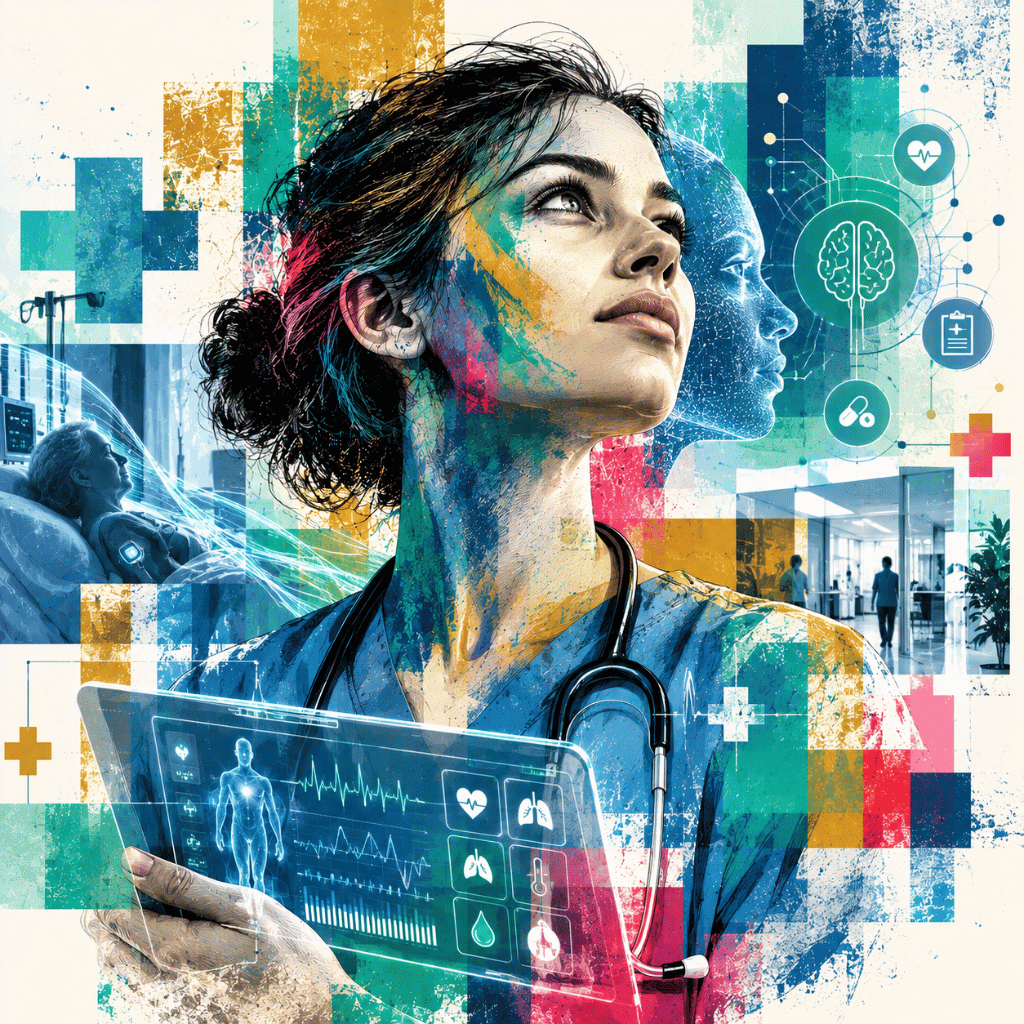
From early warning systems to documentation assistants, artificial intelligence is gradually making its way into healthcare settings. For nurses, the challenge is not to delegate clinical judgment to an algorithm, but to understand what these tools actually measure, what they can improve, and under what conditions their use remains safe, explainable, and beneficial to the patient.
From Traditional Patient Care to AI-Enhanced Care
The nursing profession relies on a combination of clinical, technical, interpersonal, and organizational skills. Monitoring health status, administering treatments, providing care, preventing complications, educating patients, and coordinating with other healthcare professionals are at the core of nursing practice. Electronic health records, monitors, and digital medical devices have been in use for several years, but they have not eliminated the need to observe patients, interpret readings in context, and exercise clinical judgment.
Artificial intelligence now adds a layer of analysis to this digital environment. In this article, the term refers in particular to models capable of identifying patterns in clinical data, generating a risk score, or—in the case of generative AI—generating text based on provided information. This distinction is important: a predictive system that calculates the risk of deterioration does not function like a generative assistant that summarizes a medical record, and their levels of evidence, risks, and uses are not the same.
One of the best-documented examples involves the early detection of deterioration in hospitalized patients. In 2025, a multicenter pragmatic trial published in *Nature Medicine* evaluated CONCERN, an early warning system based on machine learning and patterns derived from nursing documentation. The study included 60,893 hospitalizations across 74 clinical units in two healthcare systems. The intervention group showed a 35.6% reduction in the instantaneous risk of death compared to usual care, expressed as an adjusted hazard ratio of 0.64. This result should not be interpreted as an absolute 35.6% reduction in mortality: it is a relative measure of instantaneous risk within the specific context of this trial.[1]
The publication was subsequently corrected in April 2026. The authors revised the estimates regarding length of stay and 30-day readmission following a modeling error, without altering the statistical significance of the relevant results or the primary outcome regarding mortality. This correction illustrates a key rule for evaluating AI systems in healthcare: results should be interpreted based on their most recent version, along with their methodological limitations, and not as general evidence that a single tool will yield the same benefit in all hospitals.[2]
This transformation is taking place at a time when nurses constitute the largest healthcare professional group worldwide. The World Health Organization’s report *State of the World’s Nursing 2025* estimates the global nursing workforce at 29.8 million in 2023, up from 27.9 million in 2018, while still estimating the global shortage at 5.8 million professionals. The same report identifies digital technologies as one of the areas for which the profession must be prepared.[3]
These figures do not mean that AI is a direct solution to the staffing shortage. Technology can automate a task without resolving issues related to the field’s appeal, training, working conditions, or the geographic distribution of professionals. The challenge is therefore more specific: determining whether certain tools can improve the flow of information, risk detection, or documentation, without shifting the burden to new verification processes or compromising the patient-care relationship.
How AI Is Transforming Nursing Practices
AI does not transform all nursing activities in the same way. Some applications rely on predictive models integrated into patient records, others on sensors and remote monitoring systems, while generative AI is primarily used for text generation or synthesis. To understand their impact, it is important to distinguish between what the system actually automates and what remains a clinical interpretation.
Monitoring and Early Warning
Models can combine multiple signals—such as vital signs, laboratory results, or documentation—to generate a score or an alert. The potential benefit lies in identifying trends that go beyond simply exceeding a single threshold. The CONCERN example shows that such a system can be evaluated in a real-world trial, but its results cannot be generalized to all early-warning systems.[1]
Prioritizing Clinical Attention
A risk score can help a team identify patients who require prompt reevaluation. However, it does not constitute a clinical decision. The healthcare professional must assess the patient’s condition, look for other signs, and interpret the result in light of the clinical context.
Assisted Clinical Documentation
Large language models can be used to structure, rephrase, or summarize notes. A systematic review published in 2025 on the uses of LLMs in nursing identified applications in decision support, patient education, documentation generation, and workflow optimization, while highlighting risks related to confidentiality, misleading outputs, and ethical issues. The literature remains inconsistent and does not support considering generated documentation to be reliable without human validation.[4]
Remote Monitoring and Tracking
Connected devices can transmit measurements collected outside the hospital. Algorithms can then flag certain changes. Here again, the clinical value depends on the quality of the sensors, the population being monitored, the frequency of false alarms, and the system in place to handle alerts.
Information Research and Synthesis
Generative AI assistants can help retrieve information or generate a summary based on a file. The WHO notes, however, that large multimodal models can produce statements that are false, inaccurate, biased, or incomplete. Their integration into healthcare therefore requires validation procedures appropriate to the critical nature of the task.[5]
The real novelty, therefore, is not that nurses use digital tools. It lies in the fact that certain systems now generate scores, predictions, or content that can influence how information is interpreted and prioritized. This algorithmic mediation creates an additional need for verification, explainability, and traceability.
A New Role for Nurses
The integration of AI does not turn nurses into algorithm specialists. Instead, it reinforces several aspects that are already part of their profession: observing, interpreting, coordinating, alerting, and explaining. In a more data-rich environment, professional value shifts less toward the mechanical collection of information and more toward putting that information into context.
Interpreting Without Confusing the Score and the Diagnosis
A risk score may indicate that a patient warrants closer attention, but it does not necessarily describe the cause of the patient’s condition. The nurse must compare the system’s output with the clinical examination, reported symptoms, treatments, and medical history.
Monitor alerts in the workflow
A statistically valid tool can become counterproductive if it generates too many alerts or if it does not integrate well with the department’s practices. The professional then helps identify situations in which an alert is useful, redundant, or misleading.
Ensuring the quality of documentation
When a generative assistant prepares a handover or a summary, the nurse remains responsible for verifying that all essential elements are included, that nothing has been made up, and that the wording does not present a hypothesis as an established fact.
Help evaluate the tools
Their close contact with patients gives nurses practical knowledge that is difficult to replace with a purely technical assessment. Their involvement in the design, testing, and auditing of systems is particularly important when the tool alters monitoring or documentation practices. Recent studies on ambient recording devices in nursing specifically highlight the risks of misinterpretation, omission, and bias when nurses are not sufficiently involved in the development and oversight of these systems.[6]
Maintaining the therapeutic relationship
A system can process data, but it cannot physically be present, listen, or explain things to the patient. The more tools automate certain information-related tasks, the more important it becomes to ensure that there is sufficient time and the right conditions for human interaction.
The nurse’s new role is therefore not merely that of an operator of intelligent systems. It involves integrating these tools into clinical practice, where decisions remain context-specific, traceable, and commensurate with the level of risk.
What Skills Do Nurses Need in the Age of Generative AI?
The fundamentals of the profession remain a priority: clinical observation, pharmacology, monitoring, prevention, communication, coordination, and clinical reasoning. AI does not diminish the importance of these skills; rather, it creates new situations in which they must be applied.
Technical and digital skills
- Understanding the tool’s function: Nurses must be able to distinguish between a predictive model, a rule-based alert system, and a generative model. This distinction helps them understand what the output means and what it does not allow them to conclude.
- Interpret performance metrics with caution: sensitivity, specificity, predictive value, and false-positive rate do not all mean the same thing. An average performance may also mask differences among patient subgroups or across clinical settings.
- Verify the source and quality of the data: An alert can only be interpreted correctly if the data it is based on is reliable. A poorly positioned sensor, missing data, or outdated information can affect the system’s output.
- Using generative AI without blindly trusting it: a well-formulated response may still be incorrect. The user must verify clinical details, any citations, and information that might be included in the patient’s medical record.
Clinical, Analytical, and Decision-Making Skills
- Compare the alert with the patient’s actual condition: pain, confusion, behavioral changes, shortness of breath, or any other clinically concerning signs may require action even if a monitoring device has not triggered an alert.
- Recognizing uncertainty: An algorithmic result may be associated with a probability, a margin of error, or a specific scope of application. Understanding this uncertainty helps prevent an estimate from being mistaken for clinical certainty.
- Knowing when to step in: When an output is inconsistent or the potential consequences are significant, the proper use of AI may involve pausing the automation, verifying the source, and consulting the appropriate professional.
Ethical, Legal, and Organizational Skills
- Protecting health data: Clinical information is particularly sensitive. Its processing must comply with the applicable framework, including rules regarding data protection, access authorizations, and system security. The use of an external generative service must never result in the transmission of patient data outside an authorized framework.
- Understanding the framework of the AI Act without overemphasizing it: In the European Union, certain AI systems associated with regulated products—including medical devices that meet the conditions set forth in Article 6 of the regulation—may fall under the high-risk category. As of September 2026, the AI Act is still in a phased implementation phase: according to the European Commission, the rules governing high-risk systems are scheduled to take effect on December 2, 2027, and those concerning AI embedded in certain physical products—including medical devices—are scheduled to take effect on August 2, 2028. These deadlines should be distinguished from obligations that are already in effect and may still be subject to ongoing legislative changes.[7]
- Participating in governance: Frontline professionals must be able to report errors, document incidents, contribute to audits, and participate in decisions regarding whether to retain, modify, or discontinue a tool.
Can artificial intelligence make nursing more reliable?
The answer depends on what we mean by “reliable.” A system can improve the detection of an event in a given context without improving all aspects of the quality of care. Reliability must therefore be examined from several perspectives: measurement accuracy, predictive performance, quality of integration into the department, and the teams’ ability to act appropriately on the information generated.
What the evidence allows us to conclude
The CONCERN trial provides a stronger level of evidence than a simple technical demonstration, as it was conducted in real-world clinical settings and compared teams guided by the system to usual care. The adjusted results published in 2026 still show a statistically significant reduction in the instantaneous risk of death, a more modest reduction in length of stay, and a decrease in the instantaneous risk of sepsis. The study also observed an increase in the instantaneous risk of unanticipated transfer to the intensive care unit, a finding that may be consistent with earlier detection but must be interpreted within the context of the protocol.[1][2]
These results do not demonstrate that a standalone algorithm “saves lives.” The intervention involves a system integrated into patient records and team workflows, with an organizational chain of command for handling alerts. The observed benefit therefore depends on the combination of technology and organizational structure, and not solely on the model itself.
Limits to Watch For
- False positives and alert fatigue: An overly sensitive system can generate a flood of notifications and distract users. Performance must be evaluated based on the actual volume of alerts and the department’s ability to respond to them.
- False negatives: The absence of an alert does not guarantee the absence of risk. Clinical signs and the caregiver’s experience remain essential.
- Bias and generalizability: A model developed in a limited set of institutions or populations may not perform as well elsewhere. External validation and post-deployment monitoring are necessary.
- Hallucinations in generative AI: According to the literature, the main risk is not just grammatical errors but the inclusion of facts that aren’t true, the omission of important details, or the excessive rephrasing of uncertainties. The WHO recommends explicit governance of large multimodal models in healthcare and emphasizes the risks of false, biased, or incomplete content.5
- Trust automation: When a system frequently provides correct answers, the user may become less vigilant. Human supervision must therefore be organized as an active step, not as a general provision added to the protocol.
AI can thus improve certain monitoring and decision-support processes when it is properly evaluated, integrated, and supervised. It does not make care infallible. The relevant question is not simply “Is the model effective?” but “In what situations, for which patients, with what data, and within what organizational framework does this effectiveness actually improve care?”
What will the nursing profession look like in the future with AI?
It would be premature to describe a single model of “the nurse of the future.” Practices vary depending on departments, countries, digital infrastructure, and regulatory frameworks. Nevertheless, based on the tools currently being evaluated, several possible paths are plausible.
- More assisted monitoring: Alert systems will be able to analyze multiple data sources and flag unusual trends. The clinician will remain responsible for confirming clinical relevance and determining the appropriate escalation.
- More partially automated documentation: generative assistants and ambient tools can reduce certain data entry steps. However, the systematic review of AI-powered documentation systems concludes that quality and accuracy remain sufficiently variable to require rigorous evaluations before widespread adoption.8
- A more distributed approach to monitoring between the hospital and the patient’s home: remote monitoring can shift part of the monitoring to the patient’s home. This requires defining who receives alerts, within what timeframes, according to which protocols, and with what responsibilities.
- Greater involvement in digital projects: Nurses could be more involved in selecting tools, designing interfaces, defining relevant alerts, and assessing their impact on actual work.
- A heightened emphasis on AI literacy: The AI Act has already introduced provisions regarding AI literacy, which will take effect in February 2025. Beyond legal requirements, practical mastery of AI’s limitations, biases, and verification methods will become a key component of quality usage.7
We will also need to consider a less obvious effect: the impact of automation on learning the profession. As certain tasks—such as data collection, writing, or sorting—are gradually taken over by systems, organizations will need to ensure that professionals in training continue to acquire the skills necessary to understand the source of information and detect inconsistencies.
The future of the profession will therefore depend less on a scenario of replacement than on how healthcare facilities allocate responsibilities between professionals and systems. The more a task directly affects patient safety, the stricter the requirements for assessment, traceability, and supervision must be.
AI-Enhanced Care at the Heart of a Relationship That Remains Human
Artificial intelligence can analyze signals, generate a score, or prepare a summary. It does not share the nurse’s professional responsibility and does not experience the situation the patient is going through. This difference is not a mere philosophical detail: it determines how these systems should be integrated into patient care.
A useful tool is one with a clear purpose, whose performance is evaluated in a relevant context, whose errors can be identified, and whose use does not compromise clinical vigilance or patient autonomy. For several years, the WHO has emphasized the need to place ethics, human rights, transparency, and accountability at the heart of AI governance in healthcare.[9]
For nurses, the most significant transformation may therefore be less dramatic than the complete automation of care. It lies in the ability to work with more information while maintaining a clear hierarchy between data, alerts, interpretation, and decision-making. The system can flag issues. The professional must still observe, contextualize, explain, and take action.
Technology can make certain information visible sooner. It can also create new blind spots. The challenge of augmented care, therefore, is not to choose between artificial intelligence and nursing expertise, but to organize their integration in such a way that technology truly enhances the safety, continuity, and quality of the care relationship.
The question now is this: Will healthcare facilities use AI primarily to streamline workflows, or to give healthcare professionals the conditions they need to provide more attentive monitoring and be more available to patients?
Learn more
To further explore these topics— AI in healthcare, human oversight, and the evolution of skills— here are four additional posts from the aivancity blog.
Sources
[1] Rossetti, S. C., Dykes, P. C., Knaplund, C., et al. (2025). Real-time surveillance system for patient deterioration: a pragmatic cluster-randomized controlled trial. Nature Medicine, 31, 1895–1902. View the study
[2] Rossetti, S. C., Dykes, P. C., Knaplund, C., et al. (2026). Author Correction: Real-time surveillance system for patient deterioration: a pragmatic cluster-randomized controlled trial. Nature Medicine, 32, 1556. View the correction
[3] World Health Organization. (2025). State of the World’s Nursing Report 2025. View the report
[4] Song, J., Liu, W., Wang, Y., Hu, X., Chen, L., Wu, X., Zheng, C., & Gu, Q. (2025). Application and Challenges of Large Language Models in Clinical Nursing: A Systematic Review. Computers, Informatics, Nursing, 43(9), e01328. View the study
[5] World Health Organization. (2025). Ethics and Governance of Artificial Intelligence for Health: Guidance on Large Multi-Modal Models. View the report
[6] Topaz, M. (2025). Invisible Scribes: Can Nurses Trust Ambient AI for Clinical Documentation? Journal of Continuing Education in Nursing, 56(9), 358-359. View article
[7] European Commission. (2026). Navigating the AI Act. Visit the European Commission • European Union. Regulation (EU) 2024/1689, Article 6. View the regulation
[8] Bracken, A., Reilly, C., Feeley, A., Sheehan, E., Merghani, K., & Feeley, I. (2025). Artificial Intelligence (AI)-Powered Documentation Systems in Healthcare: A Systematic Review. Journal of Medical Systems, 49(1), 28. View the study
[9] World Health Organization. (2021). Ethics and Governance of Artificial Intelligence for Health. View the report