


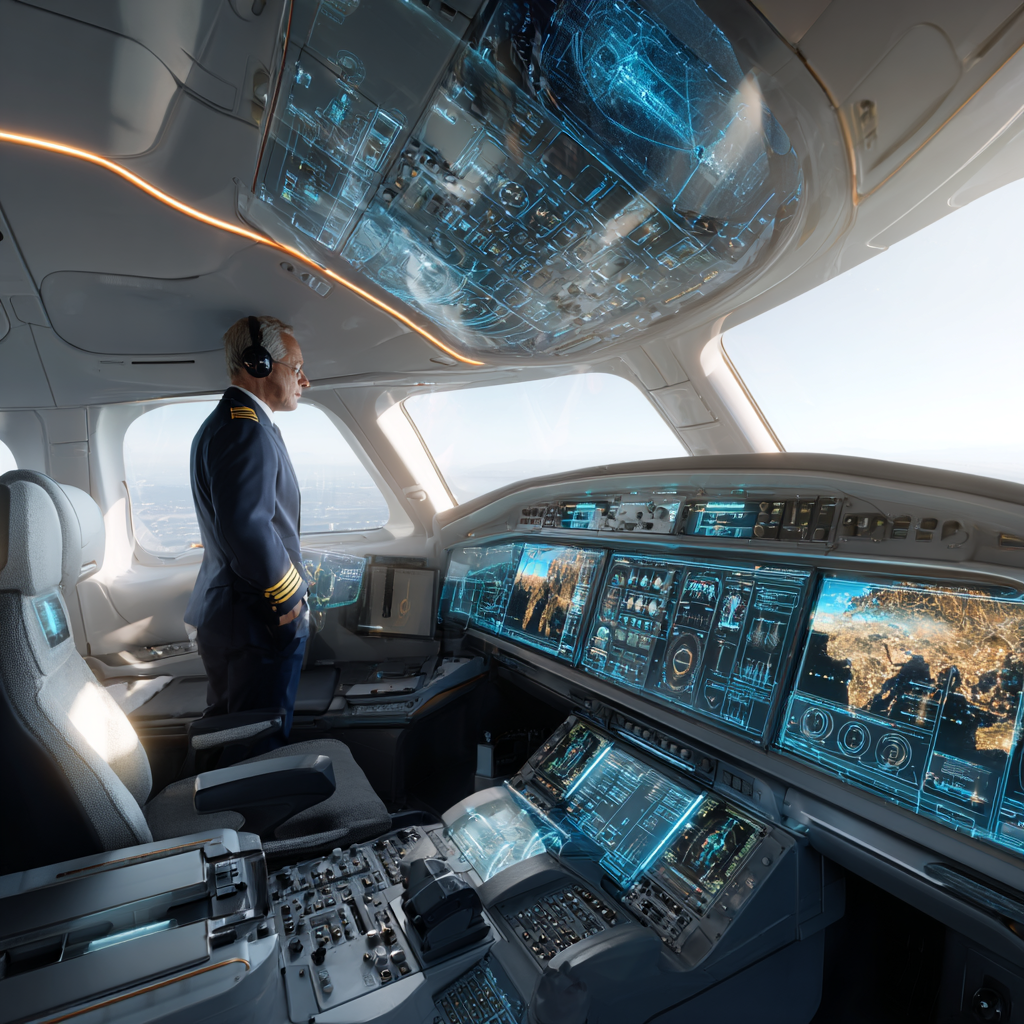
For decades, airline pilots have embodied technological mastery, responsibility, and composure. Yet, in the age of data and automation, this profession is undergoing an unprecedented transformation. Artificial intelligence, already ubiquitous in modern cockpits, is no longer limited to flight assistance: it is now establishing itself as a full-fledged decision-maker, capable of anticipating, analyzing, and adjusting flight paths in real time.
According tothe Airbus Global Market Forecast (2024), 95% of commercial flights use an autopilot system for more than 80% of flight time1. The global market for artificial intelligence systems applied to aviation is expected to reach $9.8 billion by 2030, with an average annual growth rate of 17.5%2. At the same time,the EASA (European Union Aviation Safety Agency) estimates that 70% of airlines plan to integrate predictive AI solutions into their operations by 20303.
These figures reflect a major shift: management is evolving into a discipline of augmented supervision, where data and algorithms enhance human decision-making rather than replace it.
How AI is being integrated into the cockpit and air traffic control
AI is being integrated into every stage of the flight, from takeoff to landing, including maintenance and training.
- Smart autopilots: New onboard systems use machine learning to analyze turbulence, automatically adjust flight paths, and reduce fuel consumption. In 2024, Boeing estimated that this optimization could lead to fuel savings of up to 12% on certain long-haul flights4.
- Predictive maintenance: By analyzing data from thousands of onboard sensors, AI detects anomalies before they become critical. Through its Skywise platform, Airbus collects more than 5 billion data points per day from its global fleet. This data helps reduce maintenance downtime by 30% 5.
- Real-time weather analysis: AI models can predict hazardous weather conditions (ice, thunderstorms, gusts) and adjust the flight plan accordingly. According to IATA (2024), this has led to a 15% reduction in weather-related incidents.
- AI-assisted training: Modern simulators, such as those developed by CAE, use generative systems to recreate dynamic scenarios based on real-world data, adjusting the difficulty level as the trainee pilot progresses.
A new role for the pilot
AI does not eliminate the pilot’s role; it redefines it. Today, the airline pilot acts as the conductor of an automated ecosystem, where supervision, validation, and coordination take precedence over manual control.
He must:
- monitor multiple standalone systems simultaneously,
- approve the decisions proposed by the AI,
- ensure safety in the event of a failure in the automated system.
In other words, the pilot becomes an expert in human-machine interaction, responsible for interpreting, explaining, and refining algorithmic decisions when necessary. This shift in role, already underway in the cockpits of the latest-generation aircraft (Airbus A350, Boeing 787), requires heightened cognitive vigilance and a deep understanding of how AI systems work.
What skills do pilots need in the age of AI?
The fundamental qualities of a pilot—discipline, stress management, and technical proficiency—remain essential. But new skills are now being added to the mix:
Technical and digital skills
- Understanding how predictive systems work.
- Interpret complex data dashboards.
- Identify potential biases in automated models.
Cognitive and decision-making skills
- Knowing how to quickly regain control in the event of an algorithmic error.
- Maintain active vigilance in a semi-autonomous environment.
- Develop critical thinking skills when evaluating system recommendations.
Ethical and Regulatory Competencies
- Understanding the standards of the European AI Act, which will classify aviation systems as “high-risk” applications.
- Ensure the traceability of decisions in the event of an incident.
- Maintaining passenger trust in an increasingly automated environment.
According to a study byEASA (2025), 70% of new pilot training programs will include modules on intelligent systems management, cybersecurity, and algorithmic ethics6.
Can artificial intelligence make aviation safer?
One of the main arguments in favor of AI in the aviation industry is its ability to reduce human error, which is the primary cause of 75% of aviation accidents, according to IATA (2023).
Specific examples:
- Automated incident detection systems have led to a 37% reduction in critical incidents related to pilot fatigue or disorientation7.
- Failure prediction models have reduced unplanned emergency interventions on long-haul flights by 25% (Airbus Safety Data, 2024).
- The integration of AI into air traffic management could help streamline flight paths and save more than 10 million tons of CO₂ per year by 20358.
But AI introduces new risks:
- algorithmic dependence (overreliance on systems),
- the risk of software failure,
- vulnerability to cyberattacks.
The ethical challenge is therefore clear: AI can enhance safety, but only if it remains under control, auditable, and understandable to the human pilot.
What will the job of a pilot look like in the future?
By 2035, pilots will be working in semi-autonomous, ultra-connected cockpits. Their role will focus more on supervision, strategy, and communication.
- Single-pilot cockpits are already being tested on certain cargo routes, with remote supervision by ground operators.
- Cognitive assistance systems will continuously analyze the pilot’s physiological signals (fatigue, stress) to tailor the assistance provided.
- AI co-pilots such as Airbus’s Project FlightDeck AI could assist with emergency management in real time.
But despite these advances, experts agree: human judgment will remain irreplaceable. In an increasingly automated aviation industry, it is the pilot’s ability to think, anticipate, and make decisions in uncertain situations that will make all the difference.
Toward an augmented aviation industry that remains human-centered
Artificial intelligence is revolutionizing aviation, but it does not replace the human hand on the controls. It provides pilots with enhanced situational awareness, more precise decision-making support, and increased safety. However, this evolution calls for a new level of vigilance: in terms of ethics, training, and shared responsibility.
The aviation of the future will be hybrid: a space where humans and machines coexist, interact, and complement one another. The pilot of tomorrow will no longer be merely a flight technician, but a strategist of intelligent systems, ensuring a balance between algorithmic performance and human judgment.
What if, in the end, the future of flying doesn’t lie in handing over control of the skies to machines, but in learning to fly alongside them—in a partnership where technology enhances our skills without ever replacing them?
Learn more
To better understand how artificial intelligence is taking a major step toward autonomous decision-making, read: ChatGPT Agent: OpenAI Introduces an AI Capable of Planning, Executing… and Learning.
This article puts the advancements in intelligent automation into perspective, drawing a direct parallel with onboard predictive flight control systems and AI co-pilots that are redefining the pilot’s responsibility.
References
1. Airbus. (2024). Global Market Forecast: The Future of Flight.
https://www.airbus.com
2. Allied Market Research. (2024). AI in Aviation Market Report.
https://www.alliedmarketresearch.com
3. EASA. (2025). Artificial Intelligence in Aviation: Training and Safety Report.
https://www.easa.europa.eu
4. Boeing. (2024). Sustainable Flight Efficiency Data.
https://www.boeing.com
5. Airbus. (2024). Skywise Predictive Maintenance Report.
https://www.airbus.com
6. EASA. (2025). AI Competencies in Pilot Training.
https://www.easa.europa.eu
7. IATA. (2023). Human Factors and Safety Annual Report.
https://www.iata.org
8. ICAO. (2024). Air Traffic Optimization and AI Integration Report.
https://www.icao.int