


With over 100 million active users, ChatGPT has established itself as the leading tool in generative artificial intelligence. Until now, its capabilities have been largely limited to one-off interactions, often disconnected from one another. But as the tool becomes more established in professional, academic, and creative contexts, a need has emerged: to organize, structure, and sustain interactions with AI.
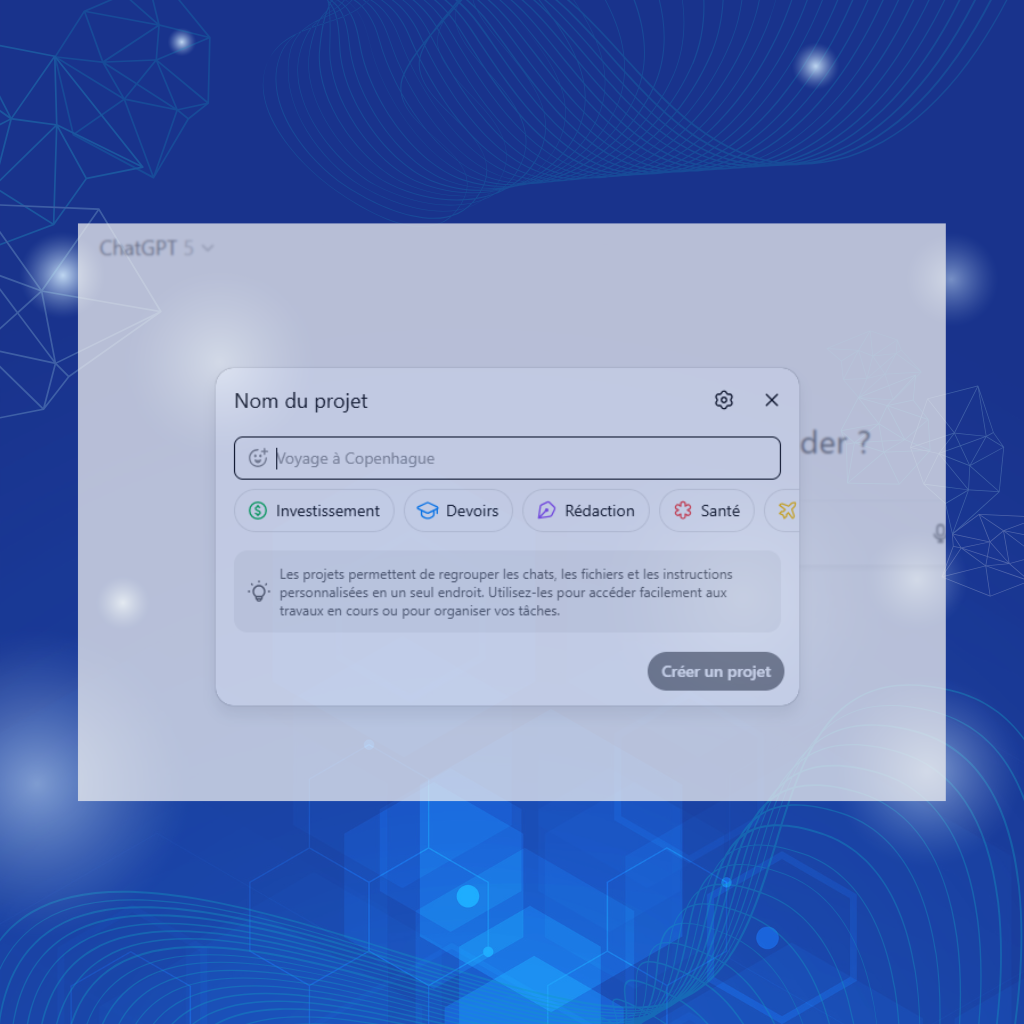
To meet this demand, OpenAI has decided to make a feature that was previously available only to paying subscribers available to all users: “Projects”1. Now available for free, this option allows users to centralize multiple discussions around a single goal, while preserving the context, files, and associated settings. This advancement brings ChatGPT closer to being a true work and creative assistant, designed to support processes over the long term.
With this in mind, OpenAI recently launched a new feature called [Name]. Available free of charge to all ChatGPT users, it now allows users to consolidate multiple conversations around a single goal while retaining the associated context, files, and settings. This marks another step toward AI that truly supports work and creative processes over the long term.
A growing need for continuity in interaction
Until now, each new conversation in ChatGPT operated as a silo: it was impossible to easily reuse the context of a previous exchange, unless you manually copied and pasted elements or switched between separate sessions.
This limitation was particularly restrictive for complex or iterative tasks, such as:
- write a document in several steps,
- conduct a research project,
- develop a lesson plan or curriculum,
- follow a communication strategy or a business plan.
With the launch of “Projects, ” OpenAI is addressing the need for organized contextual memory2, without, however, activating the chatbot’s global memory (which is still in the experimental phase for some users).
“Projects”: a dedicated space to organize your interactions with the AI
Specifically, the feature provides a workspace where users can:
- Create a themed project and name it according to your needs (e.g., “Thesis Outline,” “Marketing Strategy,” “Podcast Script”).
- Add multiple discussions, all related to this goal, with a shared history.
- Import and store files within the project, accessible from all associated chats.
- Provide specific instructions so that the AI adopts a particular tone, stance, or role in this context.
The interface is designed to be smooth and simple, featuring tabbed navigation, a sidebar for tracking, and a pop-up comment box. No paid version is required to use this feature, making it accessible to everyone.
A wide range of uses, from everyday life to specialized applications
The strength of this feature lies in its versatility. Here are a few examples of how it can be used:
- Students: thesis supervision, preparation for oral exams, and creating study guides.
- Professionals: preparing proposals, coordinating ideas within a team, product documentation.
- Teachers: preparing lesson plans, creating teaching materials, monitoring interactions between AI and teachers.
- Entrepreneurs: strategic planning, idea prototyping, and managing a pitch deck or business model.
- Content creators: structuring blog posts, writing chapters, creating video scripts.
In all these cases, “Projects” allows users to retrace their steps, build on previous iterations, and avoid having to start from scratch every time they open a new session.
A strategic move by OpenAI
The decision to offer “Projects” for free is no small matter. By doing so, OpenAI is enhancing the utility of its tool while familiarizing users with more sustainable and structured professional applications of ChatGPT. This signals a shift: moving from an intelligent chatbot to a true AI-powered work platform.
This initiative can also be seen as a response to competitors such as Google (with Gemini) and Anthropic (with Claude), which are also developing interfaces that are more focused on productivity.
Toward AI that is more persistent, more context-aware… and more sensitive to ethical considerations
By introducing the concepts of continuity and structured memory, “Projets” also explores our relationship with artificial intelligence:
- To what extent do we want AI to “remember” us?
- How can we ensure that these smart workspaces respect users' privacy, particularly in educational or professional settings?
- What happens to the data saved in “Projects”?
- How does AI adapt to consistent instructions without bias or drift?
These questions, which are still in the background, will need to be addressed thoroughly, especially since this type of functionality foreshadows the emergence of more autonomous AI agents capable of managing tasks over the long term and even interacting with one another in multi-user projects.
Rethinking the Organization of Work with AI
With “Projects,” OpenAI offers much more than just a user-friendly enhancement. It represents a paradigm shift in how AI is integrated into work, learning, and creative routines.
The conversational model is gradually giving way to a structured, persistent, and contextual framework for human-machine collaboration.
The question that now arises is this: what if AI were no longer content merely to provide answers, but instead became an active partner in managing, monitoring, and optimizing our most complex projects?
Learn more
On this blog, we’ve already analyzed other recent developments in ChatGPT that demonstrate OpenAI’s commitment to enhancing its AI assistant:“ChatGPT branches out: the ‘Create a Branch’ tool paves the way for smarter navigation”
References
1. The Information. (2025). OpenAI plans to launch AI-generated skill certificates.
https://www.theinformation.com
2. TechCrunch. (2024). ChatGPT adds “Create a Branch” button to improve conversational navigation.
https://techcrunch.com/chatgpt-branch-feature