



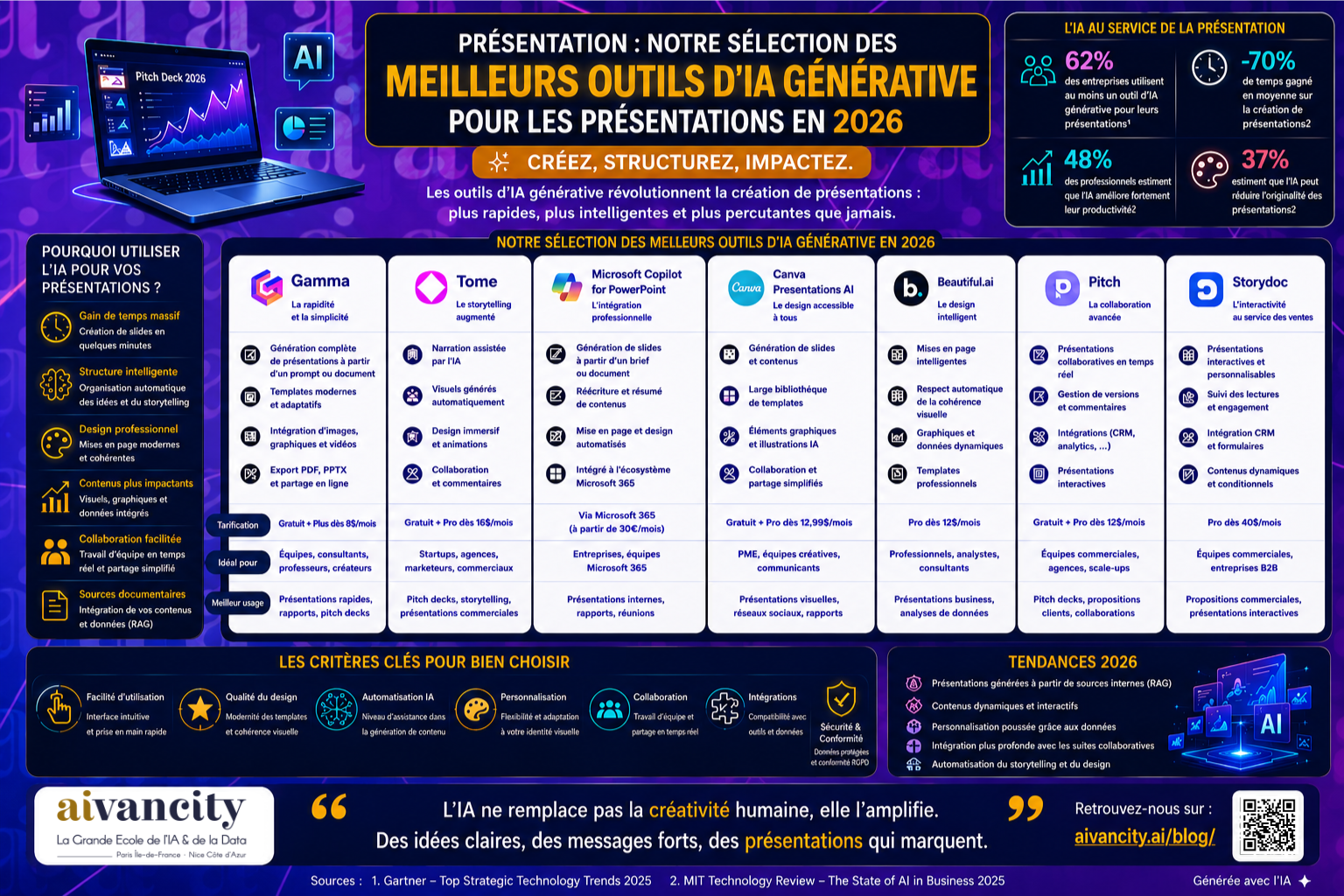
By 2026, generative AI tools designed for creating presentations will profoundly transform the way organizations produce, structure, and distribute their visual content. Long limited to layout software that required significant manual effort, presentations are now becoming intelligent tools capable of automatically generating slides, organizing a coherent visual narrative, and adapting the design to the professional context. This evolution is part of a broader trend toward the automation of visual communication, where generative models assist not only with graphic design but also with structuring the message and strategic storytelling. According to a Gartner study published in 2025, more than 62% of companies are already using at least one generative AI tool to produce presentations, pitch decks, or internal communication materials1.
This rise in popularity can be attributed to rapid advances in multimodal models, which are capable of understanding a text-based brief, generating a narrative structure, and automatically suggesting appropriate visuals, graphics, or layouts. Tools like Gamma, Tome, and Claude are no longer limited to automating slide creation; they now assist users in constructing a narrative, organizing ideas, and optimizing visual impact. As a result, presentations are produced more quickly, are more graphically consistent, and are more easily adaptable to different audiences. However, this growing automation also has its limitations: standardization of designs, loss of creative customization, and reliance on preconfigured templates. A study by MIT Technology Review published in 2025 indicates that 48% of professionals believe AI presentation tools significantly improve productivity, but 37% feel they sometimes reduce the originality of the materials produced2.
At the same time, a competitive ecosystem of specialized platforms has emerged, based on several complementary approaches. Some solutions, such as Copilot for PowerPoint or Canva Presentations AI, focus on integration into office suites that are already widely adopted in the corporate world. Others, such as Gamma, Tome, or Beautiful.ai, prioritize an approach centered on visual storytelling and the automatic generation of complete presentations. Finally, platforms like Pitch and Storydoc are positioning themselves more toward collaboration and business use cases, offering interactive presentations capable of integrating dynamic data and personalized content.
This shift is also changing organizations’ expectations regarding presentation materials. Companies are no longer looking merely for visually appealing slides, but for tools capable of speeding up production, improving brand consistency, and making content more engaging. In some cases, the most advanced platforms are beginning to incorporate features similar to RAG (Retrieval-Augmented Generation), enabling the generation of presentations from internal document databases, reports, or business data to automatically adapt content to the user’s context.
But this industrialization of visual communication also raises strategic and ethical issues. Dependence on proprietary models, the confidentiality of the data used to generate content, and the standardization of visual narratives are becoming increasingly important issues for marketing, communications, and innovation departments. The application of AI to presentations is not only changing creative tools; it is gradually redefining professional communication practices themselves.
In this context, this article offers a structured analysis of the main AI-powered presentation tools in 2026, categorized by their uses and specific features. Through a comparative analysis, the aim is to examine their functional benefits, operational limitations, and the strategic implications associated with the growing automation of visual communication.

1. Category Overview
Generative AI tools for presentations comprise a suite of solutions designed to automate, enhance, and structure the creation of professional visual materials. Their role is no longer limited to assisting with layout or producing visually appealing slides; they now play a key role in crafting narratives, organizing ideas, adapting designs to the context, and tailoring content to specific audiences. By 2026, AI presentation tools will no longer be mere office software enhanced with a few automated features; they will become communication assistants capable of transforming an intention or a text-based brief into a complete, coherent, and actionable presentation.


Master ChatGPT and Generative AI-
Demystify generative AI tools and unlock their potential in your field. A 100% hands-on approach, with no technical prerequisites.


The category is currently organized into three main functional categories. First, automated presentation generation platforms, such as Gamma, Tome, or Decktopus AI, which enable the rapid production of structured slides based on a simple prompt or a source document. These tools prioritize speed of creation, visual storytelling, and automated layout. Second, AI assistants integrated into office and collaborative suites, such as Microsoft Copilot for PowerPoint or Canva Presentations AI, which enhance environments already widely used in business. These solutions focus on seamless integration into professional workflows, real-time collaboration, and consistency with existing business tools. Third, platforms focused on interactive and sales-oriented presentations, such as Pitch, Storydoc, or Prezi AI, which prioritize visual engagement, interactivity, and applications related to sales, marketing, or investor pitches.
Market indicators confirm the rapid rise of this category. According to Stanford’s AI Index 2025 report, more than 58% of companies using visual communication tools have already integrated at least one generative AI solution into their presentation creation processes3. Furthermore, a Deloitte Digital study published in 2025 estimates that AI presentation tools can reduce the average time spent producing professional visual materials by 35 to 50%4. Finally, IDC notes that investments in AI-enhanced communication tools have been growing at an annual rate of over 22% since 2023, driven by the widespread adoption of collaborative and hybrid workflows5.
These developments reflect a shift in the role of presentations within organizations. The challenge is no longer simply about creating slides, but about the ability to quickly produce visual content that is consistent, personalized, and aligned with strategic communication objectives. AI tools thus help reduce friction in content creation, accelerate the dissemination of ideas, and standardize an organization’s visual guidelines.
At the same time, some platforms are beginning to incorporate features similar to RAG (Retrieval-Augmented Generation) architectures, enabling the generation of presentations based on internal data, reports, business documents, or knowledge bases. This trend is gradually transforming presentation tools into intelligent interfaces connected to corporate information systems, capable of automatically adapting content to the user’s context.
However, this growing automation also presents several challenges. The standardization of designs can lead to a homogenization of visual materials, reliance on preconfigured templates can limit creative originality, and the use of internal data to generate presentations raises questions of confidentiality and document governance. Furthermore, the ease of production can encourage an overabundance of visual content that is sometimes indistinguishable, where graphic effectiveness takes precedence over the depth of the message.
The category of AI presentation tools thus lies at the intersection of visual communication, enhanced productivity, and content governance. The central challenge in 2026 is no longer simply to produce slides quickly, but to design presentations capable of conveying a clear, engaging, and strategically relevant message, while maintaining creative consistency and human control over the narrative.


MSc in AI for Business
Lead AI projects with significant strategic impact. Seminars held every other weekend, compatible with a full-time job. RNCP Level 7 certification.
2. Ranking of the Best AI Tools
The market for generative AI tools designed for presentations is growing rapidly, driven by changing communication patterns, faster content production cycles, and the widespread adoption of hybrid work. These platforms are no longer limited to producing visually appealing slides; they now enable users to automatically organize ideas, build a coherent narrative, and tailor materials for professional, commercial, or educational use. The challenge is no longer simply to create a presentation quickly, but to convey a clear, engaging, and contextually relevant message through intelligent visual materials.
Advantage: Fast and modern presentations
Limitation: Limited advanced customization
Price: Free / ~€10/month
Strength: Very fluid visual storytelling
Limitation: Less suitable for complex slides
Price: Free / ~€16/month
Strength: Excellent research skills and storytelling
Limitation: Does not directly generate the final slide design
Price: Free / ~€20/month
Advantage: Simple and intuitive creation
Limit: Limited to advanced corporate use
Price: Free / ~€11/month
Advantage: Efficient automatic layout
Limit: Less creative freedom
Price: ~€12/month
Strength: Smooth teamwork
Limitation: AI capabilities are still limited
Price: Free / ~€20/month
Strength: Dynamic, immersive presentations
Drawback: More complicated to get started with
Price: ~€15/month
Feature: Generates slides from text
Drawback: Design can sometimes be generic
Price: Free / ~€8/month
Advantage: Automatically structures the slides
Limit: Limited graphics options
Price: Free / ~€14/month
Key feature: Native integration with Microsoft 365
Limit: Highly dependent on the Microsoft ecosystem
Price: ~€30/month
A closer look at three leading tools
These three tools represent the most tangible transformation in AI-enhanced presentations today. They are redefining the way professionals design their visual materials by combining automation, storytelling, and collaboration.
Gamma (USA)
- Gamma has established itself as one of the most innovative tools in the field of generative presentations. It allows users to automatically create presentations, documents, or microsites based on a simple text prompt.
- Its main strength lies in its ability to automatically organize content, create a seamless narrative, and produce modern designs without requiring advanced graphic design skills.
- The tool takes a conversational approach to content creation: the user describes their needs, and Gamma instantly generates a complete structure with headings, text, visuals, and content hierarchy.
- By 2026, Gamma is widely used in the consulting, marketing, and training sectors to quickly produce professional, consistent presentations.
- The platform also includes collaborative features and the ability to export content to various formats, making it easier to share and distribute content.
- Gamma is also beginning to incorporate RAG-like capabilities, enabling it to leverage internal documents or content to automatically customize certain presentations based on the user’s context.
- Example of use: A consulting firm uses Gamma to generate client recommendations based on internal briefs. The result is a significant reduction in production time and the standardization of visual guidelines.
Volume (USA)
- Tome stands out for its focus on visual and narrative storytelling. Unlike traditional presentation tools, it emphasizes a dynamic narrative structure rather than a simple sequence of slides.
- The tool allows you to generate presentations based on prompts, automatically incorporating text, images, videos, and interactive elements.
- Its main strength lies in its ability to produce visually smooth presentations, which are particularly well-suited for pitches, creative presentations, or marketing content.
- Tome also uses generative models capable of proposing narrative structures tailored to the subject matter, thereby improving the overall coherence of the content.
- In 2026, it is particularly popular among startups, creative agencies, and marketing teams looking to quickly produce visually striking presentations.
- The platform also facilitates real-time collaboration and the rapid adaptation of content to specific target audiences.
- Example of use: A startup uses Tome to create its investor pitch decks and sales presentations. The result is improved visual impact and faster preparation cycles.
Claude (USA)
- By 2026, Claude had established itself as one of the most effective AI assistants for preparing professional presentations. Although it was not originally designed as presentation software, its ability to organize information, summarize documents, and generate coherent narratives made it a widely used tool for designing presentation materials prior to formatting.
- His greatest strength lies in his in-depth understanding of complex documents. Claude can analyze reports, minutes, studies, or large bodies of documentation and propose a presentation structure that can be put to immediate use.
- Thanks to its Projects features and extended context management, the tool can leverage multiple internal sources simultaneously, using an approach similar to RAG (Retrieval-Augmented Generation), to produce highly contextualized content.
- Claude excels in creating strategic presentations, executive summaries, advisory reports, and training materials.
- By 2026, it will be widely adopted by consulting firms, executive teams, innovation teams, and communications professionals seeking to quickly produce high-value presentations.
- His approach emphasizes the quality of reasoning and storytelling rather than mere graphic design.
- Example of use: A consulting firm uses Claude to analyze several industry reports and generate the complete outline for a strategic presentation intended for an executive committee. The result is improved narrative quality and a significant reduction in preparation time.
These three players currently dominate the augmented presentation space, each with its own unique approach. Gamma focuses on intelligent automation and rapid production; Claude stands out for its ability to structure complex content and deliver high-quality storytelling; while Tome emphasizes narrative experience and visual impact. They coexist with other complementary solutions such as Canva Presentations AI for accessible and collaborative use, Beautiful.ai for automated layout, and Pitch and Storydoc for interactive sales presentations. Together, these tools are helping to transform presentations into dynamic, context-rich materials generated at high speed by artificial intelligence.
3. How do I choose?
With the proliferation of generative AI tools designed for presentations, choosing the right solution requires striking a balance between visual quality, production speed, customization capabilities, data security, and integration into collaborative environments. By 2026, both businesses and individual users will adopt a more strategic approach, favoring tools capable of producing consistent professional materials without compromising control over content or the quality of storytelling.
Ergonomics and integration into workflows
The effectiveness of an AI-powered presentation tool depends heavily on its ability to integrate with the tools teams already use, whether those are office suites, collaboration platforms, or cloud environments. According to IDC (2025), 76% of users prefer solutions that are directly integrated with their everyday work tools rather than a standalone platform6.
- Microsoft Copilot for PowerPoint is being adopted rapidly thanks to its native integration with Microsoft 365, making it easy to create presentations from Word, Excel, or Teams documents.
- Canva Presentations AI stands out for its ease of use and its collaborative environment, which is accessible even to users without technical expertise.
- Gamma prioritizes an intuitive, conversational approach that allows users to quickly create content without advanced design skills.
- Conversely, some more specialized tools, such as Storydoc or Prezi AI, offer advanced interactive features but require a more structured learning curve.
Content personalization and relevance
The quality of an AI-generated presentation no longer depends solely on its visual appeal, but on its ability to produce content that is coherent, contextually relevant, and tailored to the business objective.
- Tools like Gamma and Tome excel at narrative structuring and automated storytelling.
- Microsoft Copilot uses internal company data to generate context-aware presentations based on existing reports, meetings, or documents.
- Some platforms are beginning to incorporate mechanisms similar to RAG (Retrieval-Augmented Generation), which allow presentations to be linked to internal document databases in order to improve the relevance of the generated content.
- According to McKinsey (2025), organizations that use AI tools connected to their internal data see an average 38% improvement in the perceived relevance of their communications7.
Data Security and Governance
Professional presentations often contain sensitive information, such as financial data, internal strategies, business results, or confidential documents. Security is therefore a key selection criterion.
According to Gartner (2025), 57% of IT leaders view AI-powered document generation tools as critical to data governance8.
- Solutions integrated with major cloud ecosystems, such as Microsoft Copilot or Google Workspace, offer advanced access management and regulatory compliance features.
- Consumer-facing or freemium platforms may have privacy limitations, particularly when user-generated content is used to train models.
- The European AI Act is gradually requiring greater transparency regarding the processing of user-generated content and the use of user data.
- Large companies are increasingly favoring solutions that are compatible with their internal document governance policies.
Cost and accessibility
The cost of AI-powered presentation tools varies depending on their level of sophistication, collaborative features, and integration capabilities.
- Platforms like Canva Presentations AI and SlidesAI offer freemium templates tailored to freelancers and small teams.
- More advanced tools like Microsoft Copilot or Storydoc come with higher costs but offer more advanced automation and customization features.
- According to Deloitte Digital (2025), AI-powered presentation tools can reduce the time spent creating professional materials by 30 to 45%9.
- Return on investment depends heavily on the number of presentations produced and the desired level of standardization.
Performance and Creative Automation
The value of an AI-powered presentation tool lies in its ability to quickly transform ideas or data into actionable and engaging content.
- A study by Stanford HAI (2025) shows that generative tools used in presentations can reduce the initial design time for visual materials by up to 50%10.
- Gamma and Tome stand out for their speed of generation and their ability to produce coherent narrative structures.
- Beautiful.ai efficiently automates slide layout and ensures visual consistency.
- Pitch and Storydoc prioritize a more interactive approach focused on user engagement.
Ethics, transparency, and creative standardization
The automation of visual creation raises questions about the standardization of content and the role of human creativity.
- According to the Harvard Business Review (2025), 49% of communications professionals believe that AI tools tend to homogenize visual and narrative styles11.
- Generative models often prioritize optimized and reproducible structures, which can reduce the originality of the content.
- Organizations must maintain human oversight to ensure brand consistency, editorial quality, and strategic relevance.
- The value of a presentation lies not only in its design, but in its ability to convey a vision, a message, and a clear purpose.
Recommendations by user profile
- Freelancers, students, and small businesses
- Canva Presentations AI for its simplicity and ease of use
- SlidesAI for quickly turning text into structured presentations
- SMEs and project teams
- Gamma for automating the creation of professional and collaborative materials
- A tool for creating narrative presentations with a strong visual impact
- Marketing, Sales, and Communications Teams
- Storydoc for creating interactive, conversion-focused presentations
- Pitch to facilitate collaboration and the distribution of marketing content
- Large companies and management teams
- Claude to transform complex documents, reports, and databases into structured strategic presentations
- Solutions that combine generative AI, document governance, and advanced personalization to ensure security, brand consistency, and effective communication
The choice of an AI presentation tool therefore does not depend solely on its technical features. It hinges on its ability to integrate into existing workflows, comply with security requirements, and transform complex content into clear, engaging, and strategically relevant visual materials. By 2026, the value of these tools will lie less in their ability to generate slides than in their capacity to effectively structure communication and amplify the impact of ideas.
4. Ethical Issues
The rapid adoption of generative AI tools designed for presentations raises significant ethical issues at the intersection of professional communication, content governance, and creative responsibility. While these technologies enable the automation of visual creation and accelerate the production of materials, they also transform the way organizations structure their messages, standardize their narratives, and disseminate information. Between creative assistance and content standardization, increased productivity and reliance on generative models, AI presentation tools are gradually redefining visual communication practices.
- Creative standardization and homogenization of presentations: Platforms such as Gamma, Tome, and Beautiful.ai automate layout, storytelling, and content hierarchy. While this automation improves production speed and visual consistency, it can also lead to a homogenization of visual and narrative styles. According to Harvard Business Review (2025), 49% of communications professionals believe that generative tools are gradually reducing the creative differentiation of professional materials12. The risk is that presentations optimized for visual effectiveness will emerge, but with less identity, uniqueness, or strategic depth.
- Cognitive Dependency and Delegation of Discourse Structuring: AI presentation tools no longer merely generate slides; they also organize ideas, suggest narrative structures, and automatically rephrase messages. This assistance can lead to an increasing delegation of strategic thinking to the algorithm. According to a study by MIT Technology Review (2025), 46% of regular users of AI presentation tools report relying on the generated suggestions to structure their arguments13. This growing dependence could limit teams’ ability to develop original approaches or construct truly distinctive narratives.
- Confidentiality and Security of Business Content: AI-generated presentations often rely on sensitive internal data, such as financial reports, strategic documents, sales data, or HR information. The growing integration of mechanisms similar to RAG (Retrieval-Augmented Generation) exacerbates this issue, as certain platforms directly leverage internal document repositories to generate contextualized content. According to Gartner (2025), 58% of IT leaders view AI-powered document generation tools as critical data governance concerns14. Organizations must therefore balance the automation of communication with control over the strategic information used by the models.
- Algorithmic biases and oversimplification of messages: Generative models often favor optimized, consensus-driven narrative structures, which can lead to excessive oversimplification of complex messages. According to Stanford HAI (2025), nearly 32% of automatically generated content in professional contexts exhibits wording biases or contextual inaccuracies15. These biases can influence how a strategy, analysis, or decision is presented, by omitting certain nuances essential to overall understanding.
- Responsibility and authenticity of AI-generated content: The automation of presentation creation also raises the issue of editorial responsibility. Who is responsible for an error, a misleading visual, or an incorrect interpretation generated automatically? A study by Deloitte Digital (2025) reveals that 43% of professionals use AI-generated content in their presentations without fully verifying it16. In certain sensitive contexts, particularly financial, legal, or institutional ones, this reliance can pose a significant risk of disseminating inaccurate or poorly contextualized information.
- Toward Enhanced and Responsible Communication: AI-powered presentation tools are bringing about lasting change in visual and documentary communication, but their implementation must be accompanied by a clear framework that ensures transparency, human oversight, and content governance. The challenge is no longer simply to speed up slide production, but to preserve the quality of the message, strategic consistency, and the creative value of the materials produced.
The future of augmented presentations depends on striking a balance between intelligent automation and human creative direction. These tools offer significant gains in productivity, visual consistency, and accessibility, but their use must be guided by clear governance that ensures data protection, editorial control, and creative differentiation. The goal is not to replace human thought, but to amplify it by making communication more fluid, structured, and effective.
5. Practical use cases
In 2026, generative AI tools designed for presentations are transforming visual communication methods in an environment characterized by accelerating production cycles, a proliferation of distribution channels, and a growing demand for content personalization. They are no longer limited to assisting with layout or producing visually appealing slides; they are redefining how to structure a presentation, synthesize complex information, and deliver messages tailored to different audiences. By combining automated content generation, AI-assisted design, and dynamic storytelling, these tools offer a strategic lever for balancing productivity, brand consistency, and communication effectiveness. Their adoption is now spreading across all sectors, from consulting to marketing, education, sales, and public organizations.
Businesses and large organizations
- According to the Boston Consulting Group (2025), nearly 67% of large companies use at least one AI-powered presentation tool to speed up the creation of internal or sales materials17.
- Example: An international financial services group uses Claude to automatically analyze its internal reports and generate executive presentations. As a result, preparation time has been reduced and the quality of strategic summaries has improved.
- Gamma is used to quickly produce standardized internal presentations that are consistent with the company's visual identity.
- Some organizations use mechanisms similar to RAG to automatically generate presentations from internal document repositories or business data.
SMEs, startups, and project teams
- A Deloitte Digital study (2025) indicates that 63% of SMEs use AI-powered presentation tools to streamline their communication processes and improve the visual quality of their materials18.
- Example: A tech startup uses Tome to create its investor pitch decks and sales presentations. As a result, the visual impact has improved, and the time required to prepare for strategic meetings has been significantly reduced.
- Canva Presentations AI makes it easy for non-technical teams to quickly create collaborative materials.
- SlidesAI automatically converts text documents or meeting notes into structured, actionable presentations.
Marketing, Sales, and Communications Teams
- According to McKinsey (2025), companies that use AI tools to create their marketing materials see an average 28% increase in engagement during sales presentations19.
- Example: A marketing team uses Storydoc to create interactive presentations for prospects. As a result, engagement rates have increased and sales performance has improved.
- Pitch is used to centralize collaboration between marketing and sales teams around shared visual content.
- Beautiful.ai automates the visual consistency of slides to ensure a consistent brand identity across all produced materials.
Consultants, freelancers, and creators
- According to the IndieTech Survey (2025), 71% of freelancers use AI-powered presentation tools to automate certain document creation tasks and save time20.
- Example: A consultant uses Gamma to turn client notes into structured, professional presentations. The result is significant time savings in producing deliverables and an improvement in the perceived quality of the materials.
- Tome makes it easy to create visually striking narrative presentations for consulting projects or sales proposals.
• Canva Presentations AI lets you quickly create visual materials without advanced graphic design skills.
Public institutions, education, and organizations
- The Capgemini Research Institute (2025) reports that 39% of public institutions are experimenting with AI-powered presentation tools to improve information dissemination and the quality of educational materials21.
- Example: A university uses Microsoft Copilot for PowerPoint to transform educational content and academic documents into interactive presentations for students. As a result, content accessibility is improved and the time required to prepare course materials is reduced.
- Canva Presentations AI is widely used in educational settings to create collaborative and accessible content.
- AI-powered presentation tools also make it easier to create multilingual materials and quickly adapt content for different audiences.
AI-powered presentation tools no longer merely automate slide creation. They are transforming professional communication by introducing a more structured, collaborative, and performance-oriented approach. The challenge for organizations now is to integrate these technologies responsibly, while preserving the quality of the message, strategic coherence, and creative value of the content produced, so that presentations remain a space for communication, persuasion, and differentiation.
6. Advantages and limitations: what users are saying
Feedback on generative AI tools used for presentations in 2026 indicates widespread adoption, driven by productivity gains, the automation of visual creation, and improvements in the graphic quality of professional materials. Users praise the speed of production, the ability to automatically structure ideas, and the simplification of layout work. At the same time, certain limitations are regularly highlighted, particularly regarding the standardization of designs, the lack of creative customization, and the growing dependence on generative models. According to Statista (2025), 78% of professionals believe that AI tools improve efficiency in creating presentations, but 42% consider that the generated content still requires significant human intervention to ensure its originality and contextual relevance22.
Gamma (USA)
| Strengths | Limitations | Example of use |
|---|---|---|
|
|
A consulting firm uses Gamma to generate client presentations based on internal briefs. The result is a significant reduction in production time and improved visual consistency. |
Volume (USA)
| Strengths | Limitations | Example of use |
|---|---|---|
|
|
A startup uses Tome to create its investor pitch decks. As a result, the visual impact has improved and the preparation of sales presentations has been streamlined. |
Claude (USA)
| Strengths | Limitations | Example of use |
|---|---|---|
|
|
A consulting firm used Claude to transform several strategic reports into an executive presentation. As a result, the quality of the recommendations improved, and significant time was saved in preparing the deliverables. |
An analysis of user feedback shows that AI-powered presentation tools have reached a high level of operational maturity, particularly in terms of content structuring, automated layout, and accelerated document production. Gamma leads in generation speed and narrative flow, Microsoft Copilot stands out for its integration into professional workflows and its use of internal data, while Tome has established itself as a solution focused on storytelling and high-impact visual communication.
However, users point to persistent limitations in terms of creative originality, editorial control, and reliance on proprietary generative models. By 2026, AI applied to presentations is seen as a powerful catalyst for communication, but not as a substitute for strategic thinking, human creativity, and artistic direction. The value of presentations still rests on teams’ ability to craft a clear, distinctive message tailored to their audience.
7. Toward augmented communication or algorithmic dependence?
By 2026, generative AI tools applied to presentations will have profoundly shifted the balance between visual communication, content production, and the dissemination of ideas. The creation of professional materials no longer relies solely on graphic design skills or lengthy design cycles; it now draws on systems capable of automatically generating slides, structuring a presentation, and optimizing visual storytelling in a matter of seconds. Platforms such as Gamma, Tome, and Claude enable organizations to significantly accelerate content production while standardizing their graphic and editorial standards. According to WARC (2025), companies integrating AI tools into their visual communication processes see an average 31% improvement in their document productivity and a significant reduction in presentation preparation times23.
But this acceleration comes with a growing risk of algorithmic dependence. As tools offer optimized narrative structures, automated designs, and ready-to-use content suggestions, teams may be tempted to delegate some of their strategic and creative thinking to machines. A Harvard Business Review study (2025) indicates that 48% of communications professionals believe that the intensive use of generative tools tends to standardize presentations and reduce the differentiation of messages24. The risk lies not in the technology itself, but in the tendency to prioritize immediate efficiency at the expense of narrative uniqueness, context, and strategic intent.
The future of presentations will therefore depend on organizations’ ability to strike a balance between automation and human creativity. The most effective materials are not those produced entirely by algorithms, but those in which AI enhances teams’ ability to structure their ideas, clarify their messages, and tailor their content to different audiences. The human role remains central to defining the narrative, prioritizing information, and ensuring the strategic coherence of the materials produced. Presentation tools automate part of the design work, but defining the message, priorities, and argumentation remains largely dependent on human expertise.
The challenge in the coming years will be to maintain a sustainable balance between speed, quality, and authenticity. In an environment where presentations can be generated in a matter of minutes, differentiation will no longer rely solely on visual aesthetics, but on the relevance of the message, the quality of the argumentation, and the ability to produce content that is truly tailored to business needs. Organizations will need to learn how to use these tools without overly standardizing their communication or diminishing the strategic value of visual exchanges.
By 2027, AI-powered presentation tools are expected to reach a new milestone. Platforms will evolve into systems capable of automatically leveraging internal data, meeting minutes, and document databases through mechanisms similar to RAG (Retrieval-Augmented Generation). AI will no longer be limited to generating slides; it will contribute to the dynamic construction of professional narratives, automatically adapting content based on context, audience, and communication objectives. This evolution paves the way for truly intelligent presentations, where technology structures information while leaving humans to play the central role in creating meaning and making decisions.
The next article in the series Generative AI Tools 2026 will focus on the Logo Generator category. It will analyze how AI tools are transforming the design of visual materials by automating content structuring, optimizing storytelling, and enabling users to produce presentations that are clearer, more engaging, and tailored to professional contexts.
References
1. Gartner. (2025). AI and Enterprise Presentation Automation Report.
https://www.gartner.com/
2. MIT Technology Review. (2025). Generative AI and Visual Communication.
https://www.technologyreview.com/
3. Stanford University. (2025). AI Index Report 2025.
https://aiindex.stanford.edu/
4. Deloitte Digital. (2025). Generative AI and Business Communication.
https://www.deloitte.com/
5. IDC. (2025). AI-Powered Workplace Communication Forecast.
https://www.idc.com/
6. IDC. (2025). The Future of AI-Powered Workplace Applications.
https://www.idc.com/
7. McKinsey & Company. (2025). The State of Generative AI in Enterprise Communication.
https://www.mckinsey.com/
8. Gartner. (2025). AI Governance and Enterprise Content Security Report.
https://www.gartner.com/
9. Deloitte Digital. (2025). Generative AI and Business Communication Productivity.
https://www.deloitte.com/
10. Stanford HAI. (2025). Generative AI and Visual Productivity Study.
https://hai.stanford.edu/
11. Harvard Business Review. (2025). Creativity and Standardization in the Age of Generative AI.
https://hbr.org/
12. MIT Technology Review. (2025). Generative AI and Visual Communication Study.
https://www.technologyreview.com/
13. Stanford HAI. (2025). Bias and Reliability in Generative AI Communication Tools.
https://hai.stanford.edu/
14. Deloitte Digital. (2025). AI-Generated Business Content and Governance.
https://www.deloitte.com/
15. Boston Consulting Group. (2025). AI and Enterprise Communication Report.
https://www.bcg.com/
16. Deloitte Digital. (2025). Generative AI and Visual Productivity Study.
https://www.deloitte.com/
17. McKinsey & Company. (2025). Generative AI in Marketing and Sales Communication.
https://www.mckinsey.com/
18. IndieTech Survey. (2025). Independent Professionals and Generative AI Usage.
https://www.indietechsurvey.com/
19. Capgemini Research Institute. (2025). AI in Public Sector Communication.
https://www.capgemini.com/
20. Statista. (2025). AI Presentation Tools and Workplace Productivity Survey.
https://www.statista.com/
21. WARC. (2025). Generative AI and Business Communication Productivity Report.
https://www.warc.com/
22. Harvard Business Review. (2025). Creativity and Standardization in the Age of Generative AI.
https://hbr.org/