


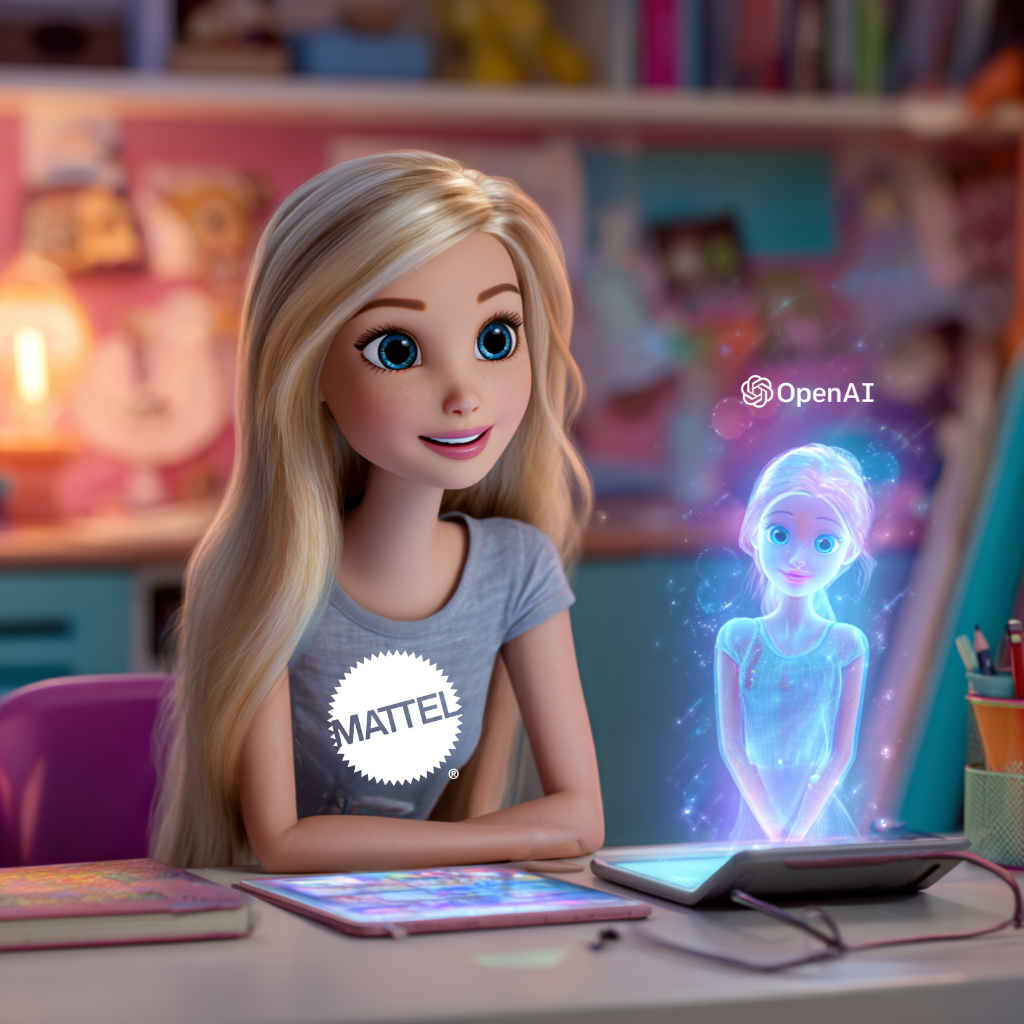
When conversational AI turns toys into interactive companions
Can the iconic toy of the 1960s become a conversational agent of the future? At the 2025 edition of VivaTech, Mattel announced a strategic partnership with OpenAI to equip its future toy lines—starting with Barbie—with conversational intelligence based on ChatGPT models. This initiative marks the beginning of a new era in the toy industry: the era of embodied AI.
This collaboration raises a number of questions: What kind of embedded intelligence will these toys offer? How will data security and interaction with young audiences be managed? And above all, what consequences could this shift have on the educational, emotional, and commercial uses of connected toys?
Toward a new generation of cognitive toys
Mattel’s announcement is not just a gimmick. It is part of a profound transformation in the toy industry, in which artificial intelligence is becoming a central pillar of product innovation.
According to a study by Juniper Research, the global market for smart toys is expected to exceed $35 billion by 2030, with an average annual growth rate of 12%.1. By providing a personalized version of GPT adapted to children’s language, OpenAI aims to transform playful interaction into genuine dialogue.
Barbie will be able to:
- Answer children’s questions in natural language, using an age-appropriate tone.
- Telling personalized, improvised stories based on a name or place chosen by the child.
- Encourage early learning (language, vocabulary, logic) in a fun environment.
- Save your preferences to maintain emotional continuity between gaming sessions.
New applications for generative AI in toys
This partnership opens up a wide range of possible applications, far beyond that of a simple "talking toy":
- Language learning: By responding to children in several languages, Barbie becomes a tool for multilingual learning.
- Emotional development: A Barbie who can ask questions, acknowledge emotions, or come up with imaginary stories encourages self-expression.
- Augmented role-playing: by adapting its voice and speech to different contexts (doctor, astronaut, veterinarian), AI enhances symbolic play.
- Social support: For isolated or disabled children, these interactive dolls could provide cognitive or emotional support.
AI designed for a sensitive audience
However, integrating artificial intelligence into a product designed for children raises critical issues. OpenAI and Mattel have announced several safeguards:
- Enhanced content filtering: The embedded version of GPT will have stricter filters than those available in conventional versions, blocking all inappropriate content.
- Partial offline mode: certain functions will work without an internet connection to limit data collection.
- Active parental consent: Each device must be activated by an adult using a dedicated app.
According to an MIT Media Lab study published in April 2025, 68% of American parents say they are open to AI-enabled toys, provided that strict parental controls are in place2.
From toys to personalized learning agents?
More broadly, this partnership could signal the arrival of hybrid toys that combine storytelling, learning, and personalized interaction. Several startups, such as Cognimates, Embodied, and Roybi AI, are already developing companion robots with adaptive cognitive capabilities. Barbie’s global popularity could accelerate the adoption of this new standard.
We are thus witnessing the emergence of a new techno-cultural object: the cognitive toy, which combines emotion, storytelling, and simulated intelligence. This convergence also raises questions of sovereignty and regulation: which AIs will be included? Where will the data be stored? Who will control the language models?
The convergence of AI and the cultural industry
This project also marks a strategic convergence between generative AI and the entertainment industry. Mattel is already considering other brands (Hot Wheels, Polly Pocket) that could benefit from AI voice interfaces. For its part, OpenAI is exploring a B2B business model for its customizable agents, which have already been tested using ChatGPT’s “GPTs” mode.
In a co-design approach, certain dialogues could be enriched with narrative elements from partner studios, similar to conversational storytelling co-written by AI and human authors. In this way, we move beyond mere gimmicks and toward an AI-enhanced transmedia approach.
A new frontier in toys… to be framed
Conversational artificial intelligence transforms Barbie into an interactive interface capable of fostering narratives, emotions, and learning. The challenge is to harness these new capabilities so that they serve as tools for empowerment, not alienation.
How can we teach children to distinguish between reality and fictional conversation? How can these technologies be integrated into educational settings? What technical and ethical standards should be imposed on the industry? These questions will be at the center of upcoming debates.
References
1. Juniper Research. (2024). Smart Toy Market Trends 2024–2030.
https://www.juniperresearch.com/researchstore/innovation-disruption/smart-toys
2. MIT Media Lab. (2025). Parental Attitudes toward AI-Enabled Toys.
https://www.media.mit.edu/publications/ai-toys-report-2025