


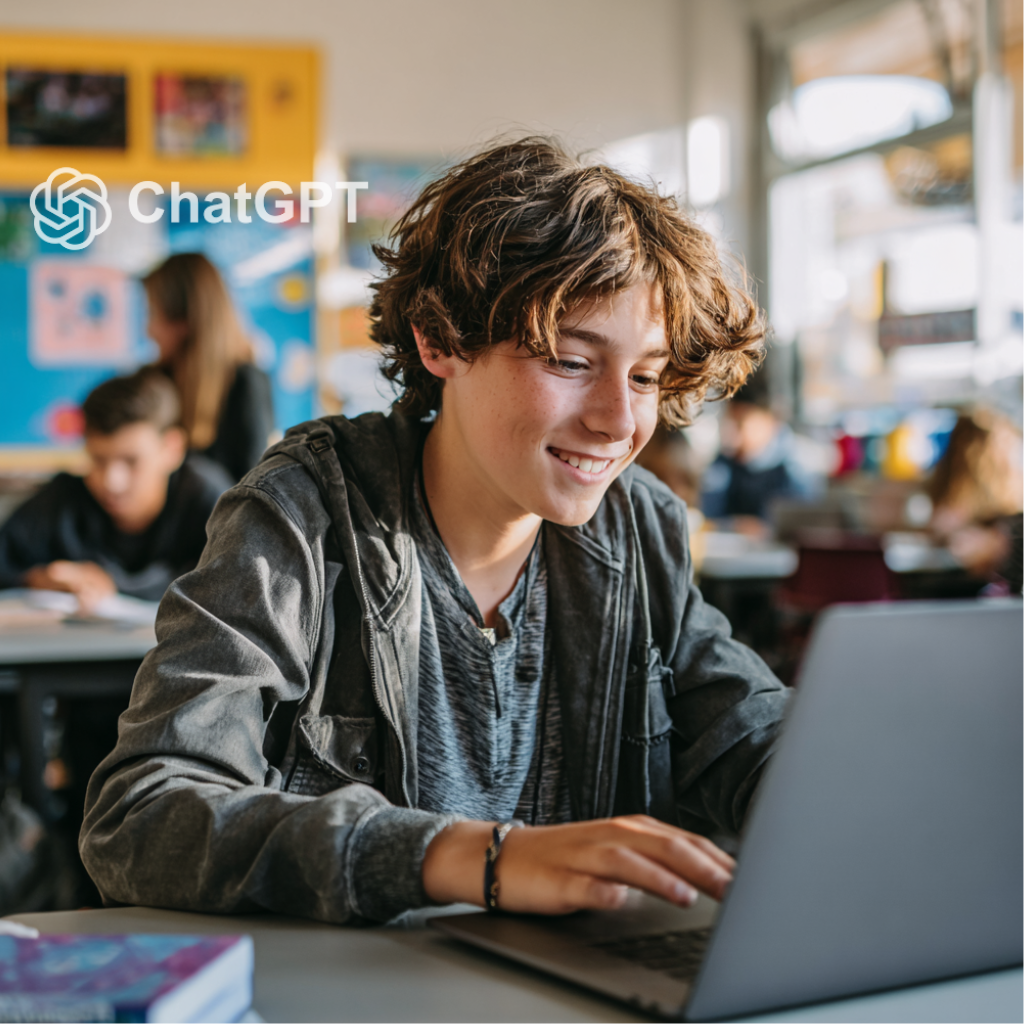
Since the launch of ChatGPT, the use of generative artificial intelligence has become widespread, including among age groups that were not initially targeted. Many middle schoolers, high schoolers, and even younger children are now using ChatGPT for their homework, presentations, or creative projects, often without their teachers’ or parents’ knowledge. In response to this widespread but unsupervised use, OpenAI has confirmed the development of a version of ChatGPT designed for teenagers, with safeguards tailored to this demographic.
Billed as free, educational, and compliant with child protection standards, this initiative could mark a new milestone in the democratization of AI. But it also raises fundamental questions: What kind of AI should be used for which educational purposes? What limits should be set, and what safeguards are in place?
Why a special version for teenagers?
Until now, the use of ChatGPT has been officially restricted to individuals over the age of 13, with parental consent required. In practice, however, many young people access it through family, school, or anonymous accounts. At the same time, many teachers recognize the value of AI that can simplify, rephrase, or organize information, while also pointing out the lack of clear educational guidelines.
By developing a version specifically for teenagers, OpenAI is seeking to address two key needs:
- Support the growing educational use of ChatGPT in middle and high schools in a more responsible and secure manner.
- Stay ahead of regulations regarding the protection of minors, particularly in the United States (COPPA) and Europe (GDPR, DSA, AI Act).
According to OpenAI, the project aims to provide an age-appropriate conversational environment with filtered content, a clear educational focus, and features designed to promote learning, without exposing users to inappropriate risks1.
What We Know About the Upcoming “ChatGPT Junior”
Few technical details have been made public yet, but several features are already taking shape:
- Enhanced content filtering: language, sensitive topics, and response types.
- Parental control settings: browsing history, time restrictions, and content filters.
- A simplified interface designed for educational and creative use.
- Integrated teaching guidelines designed to encourage students to ask questions, verify their sources, and think for themselves.
This version could also be interoperable with existing educational platforms or integrated into digital learning environments (DLEs), depending on the country.
Learning with AI: What Are the Practical Applications in Middle School?
When used thoughtfully, AI tools like ChatGPT can serve as educational aids. Here are a few examples of how they can be used effectively with teenagers:
- Help with understanding course material: rephrasing, examples, personalized explanations.
- Preparing presentations or assignments: outlining, brainstorming, proofreading written work.
- Development of transferable skills: critical thinking, analytical skills, creativity.
- Academic counseling: exploring academic tracks, careers, and educational paths.
- Civic and digital education: learning to recognize the limitations of AI, biases, and the ethical uses of digital technology.
When used properly, AI does not replace teachers, but acts as a responsive, personalized virtual tutor that complements human guidance.
AI for Minors: An Educational Opportunity or an Unmanaged Risk?
However, this project raises several ethical, technical, and legal issues:
- Data protection: interactions involving minors must be strictly regulated (data retention, traceability, parental consent)2.
- Reliability of responses: Like any generative AI, ChatGPT can produce inaccurate or misleading content.
- Content neutrality: Young audiences are more easily influenced; efforts to ensure transparency, moderation, and cultural diversity are essential.
- Risk of substitution: certain unregulated uses could lead to excessive reliance on AI (tasks done “by” AI, lack of independent thinking).
Finally, the issue of digital addiction cannot be ignored, especially since teenagers are already heavily exposed to hyperconnectivity.
An opportunity to rethink AI education
The upcoming launch of a ChatGPT designed for teenagers should be viewed not as a threat, but as an opportunity to establish a comprehensive AI education program starting in middle school. This involves:
- Thoughtful integration into school curricula, supported by teachers.
- Training for educational staff to help them understand the strengths and limitations of these tools.
- A discussion with families about usage guidelines and rules.
- Access to French-language and multicultural resources, to avoid a tool that is overly focused on Anglo-Saxon corpora.
More broadly, this project could help achieve the goal of fostering citizens who are tech-savvy and self-reliant from an early age3.
Toward educational AI… and responsible AI?
The plan for a "Junior" ChatGPT confirms a strong trend: artificial intelligence is entering the educational sphere, starting as early as middle school. It remains to be seen whether this development will take place within a collaborative framework (involving students, families, teachers, and institutions) or whether it will simply become the norm through widespread use.
By laying the groundwork for a supervised version tailored to teenagers, OpenAI is opening a new chapter: one in which AI is used for educational purposes, but which, more than ever, must demonstrate transparency, ethical standards, and restraint in its use.
Learn more
To explore the educational, ethical, and practical issues surrounding AI tools designed for young people, here are two particularly relevant posts from the aivancity blog:
- ChatGPT branches out: the “Create a Branch” tool paves the way for smarter navigation : explores conversation structuring features that can enhance the learning experience and control over conversational pathways.
- Google Launches Gemini for Kids: Educational AI for Children : explores how a version of AI designed for children can balance educational use with necessary safeguards.
References
1. OpenAI. (2025). ChatGPT for teens: building a safe and educational version.
https://openai.com/blog
2. CNIL. (2023). Children and Personal Data: Protecting the Youngest in the Digital World.
https://www.cnil.fr/
3. UNESCO. (2022). Guidance for policymakers on AI and education.
https://unesdoc.unesco.org