


OpenAI continues the rapid evolution of its artificial intelligence models with the launch of GPT-5.5 Instant, a new version designed to address a challenge that has become central to the industry: generating faster responses while reducing errors. For several years, the race for power has dominated the development of large language models. Now, the focus is gradually shifting to another criterion: reliability in real-world applications. With GPT-5.5 Instant, OpenAI appears to be seeking a balance between speed, stability, and operational efficiency.
This development comes at a time when the use of generative AI is growing rapidly in businesses, customer service, digital assistants, and productivity tools. In these environments, response speed is becoming essential, but it can no longer come at the expense of accuracy. Hallucinations, inconsistencies, and factual errors remain one of the main barriers to the widespread adoption of AI in critical contexts. GPT-5.5 Instant thus appears to be an attempt by OpenAI to make its models more practical for everyday use, rather than simply more technically impressive.

A new generation of models designed for real-world use
With GPT-5.5 Instant, OpenAI is part of a broader industry trend: the development of models optimized for real-time use. The goal is no longer simply to increase the size or complexity of models, but to reduce latency, improve response stability, and optimize usage costs. This approach is becoming particularly important in environments where AI must interact continuously with users, such as conversational assistants, support tools, or AI agents.
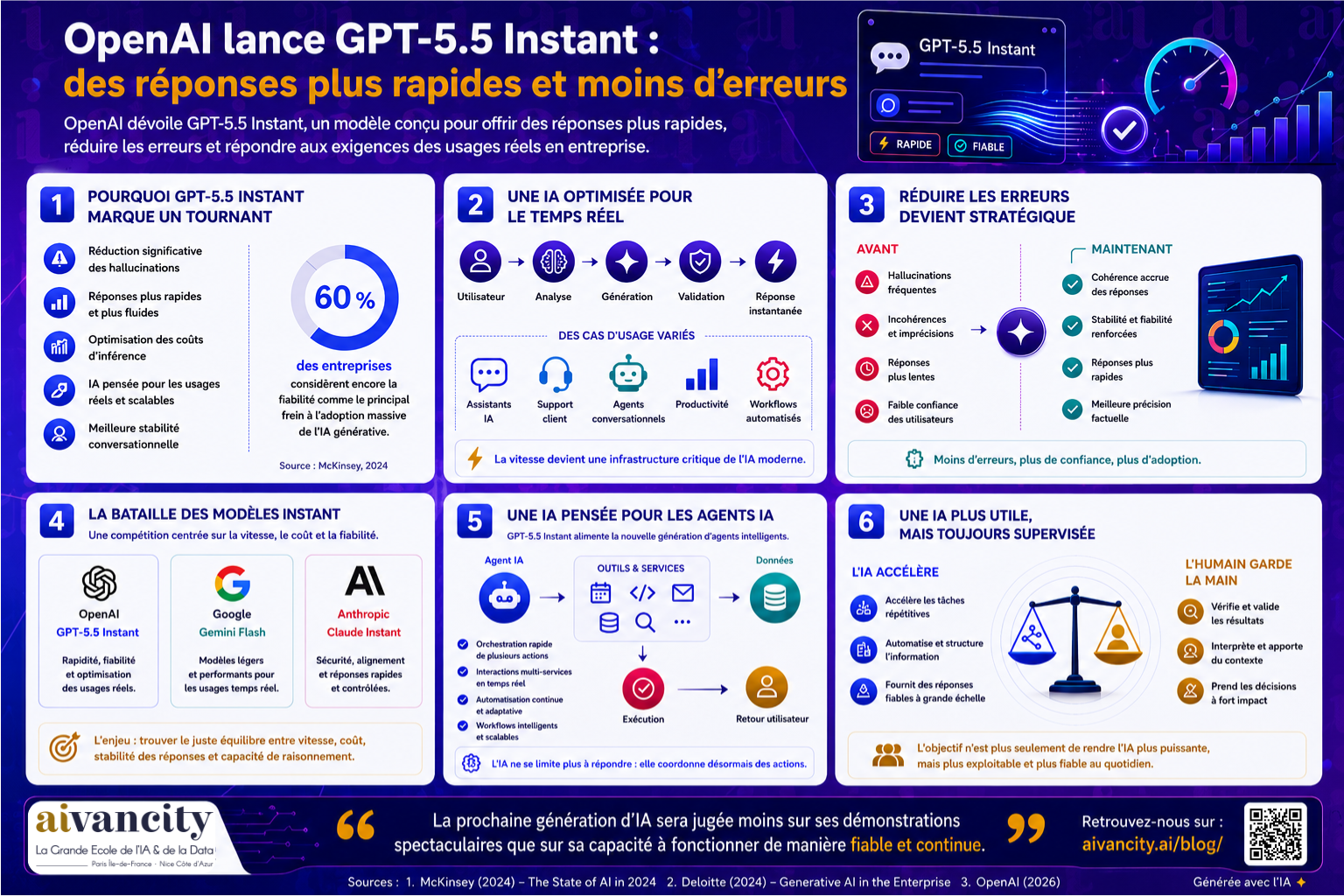
This approach also reflects economic realities. Companies are looking for models capable of operating at scale without driving up inference costs. According to several industry estimates, spending on AI computing could exceed $300 billion annually by 20301. In this context, “Instant” models represent an optimization strategy, producing fast, consistent, and sufficiently reliable responses for everyday use, while limiting resource consumption.
Reducing errors is becoming a strategic priority
One of the key selling points of GPT-5.5 Instant is its ability to reduce errors and hallucinations. Since the emergence of generative models, these issues have been a major limitation. Even the most advanced systems can produce incorrect responses that sound convincing, posing significant risks in sensitive fields such as healthcare, law, and finance.
According to several recent studies, nearly 60% of companies now view the reliability of responses as the main obstacle to the widespread adoption of generative AI2. In this context, improving consistency and reducing errors has become just as important as simply increasing the model’s capabilities. GPT-5.5 Instant appears to reflect this shift in priorities; OpenAI is less focused on impressing with spectacular demonstrations and more on producing an AI that is more stable and credible for professional use.
AI designed for speed and fluidity
Speed is the other key focus of this new version. Users now expect near-instantaneous interactions with AI systems, particularly in conversational or collaborative tools. High latency can degrade the user experience and limit the integration of AI into continuous business workflows.
Optimized models such as GPT-5.5 Instant meet this requirement by reducing generation time while maintaining a high level of quality. This approach is particularly important in applications involving AI agents, where multiple actions must be executed quickly and in a coordinated manner. OpenAI thus appears to be adapting its models to a new phase in the market, one in which AI must function as a seamless infrastructure rather than merely a technological demonstration.
A tech battle between OpenAI, Google, and Anthropic
The launch of GPT-5.5 Instant comes amid increasingly fierce competition among the major players in the artificial intelligence sector. Google is developing models like Gemini Flash, Anthropic is focusing on Claude Instant, while other companies are also seeking to offer faster and more resource-efficient AI systems.
This competition demonstrates that the industry is entering a phase of maturity. Raw performance remains important, but it is no longer sufficient on its own. Companies are now looking for models that can be easily integrated into business tools, offering high stability and controlled costs. In this context, fast models are becoming strategic, as they enable broader and more frequent adoption of AI in everyday use.
Faster models, but not necessarily “smarter”
However, this development raises an important question: can speed replace depth of reasoning? Models optimized for speed often excel at conversational or repetitive tasks, but they can reach their limits when dealing with complex problems that require lengthy or multi-step reasoning.
The development of “Instant” versions thus reflects a technological trade-off. OpenAI appears to be gradually distinguishing between several categories of models, some focused on reasoning power, others on speed and operational efficiency. This segmentation could become the industry standard, with AI systems specialized for specific use cases rather than a single model capable of doing everything.


Master ChatGPT and Generative AI-
Demystify generative AI tools and unlock their potential in your field. A 100% hands-on approach, with no technical prerequisites.


A development designed for AI agents
GPT-5.5 Instant also appears to be a model particularly well-suited to the rise of AI agents. These systems, which are capable of performing tasks semi-autonomously, require fast, consistent, and reliable responses to function effectively in complex environments.
In this context, speed is not merely a matter of user convenience; it has become an essential technical requirement. An AI agent that interacts with multiple services, processes requests, or manages workflows must be able to respond almost instantly. OpenAI therefore appears to be preparing its models for this new generation of applications, where AI is no longer limited to answering questions but acts as an operational intermediary between the user and digital tools.
Toward AI that is more integrated into everyday life
The launch of GPT-5.5 Instant reflects a more profound transformation in the artificial intelligence market. After a phase dominated by demonstrations of the spectacular capabilities of large language models, the industry now appears to be moving toward industrialization and practical integration.
The main challenge is no longer simply to generate impressive responses, but to build systems that are fast, reliable, and stable enough to be used continuously in both professional and personal settings. This development could accelerate the adoption of AI in everyday tools, provided that improvements in reliability keep pace with technical advancements.
AI that is more reliable, but still supervised by humans
Even with significant improvements, GPT-5.5 Instant does not eliminate the need for human oversight. AI models remain probabilistic; they can produce errors, biases, or approximations. Reducing hallucinations is a major step forward, but it does not guarantee absolute reliability.
From this perspective, AI appears less as a replacement for humans and more as an increasingly powerful tool. The user retains a central role in verifying, interpreting, and making decisions. GPT-5.5 Instant thus exemplifies a major industry trend: making artificial intelligence more useful, faster, and more integrated, without eliminating human responsibility.
How does GPT-5.5 Instant work?
GPT-5.5 Instant is built on a language model architecture optimized to reduce latency while improving the stability of responses. Unlike previous generations, which focused primarily on raw increases in reasoning capabilities, this version prioritizes a balance between speed, reliability, and inference cost. The goal is to produce near-instantaneous responses suitable for real-time applications such as conversational assistants, AI agents, or integrated productivity tools.
The model operates using advanced natural language processing mechanisms capable of analyzing a query, predicting the most relevant text sequences, and then generating an optimized response with minimal latency. GPT-5.5 Instant also incorporates adjustments designed to limit hallucinations and inconsistencies, notably through improved context management, internal verification mechanisms, and an optimized balance between reasoning depth and generation speed.
- Quick responses: significant reduction in conversational latency
- Enhanced reliability: fewer errors and false positives
- Real-time optimization: designed for AI assistants and continuous workflows
- Reduced inference cost: improved computational efficiency
- Agent-based integration: compatible with multi-action autonomous systems
- Limited complex reasoning: less suited to tasks requiring in-depth thought
- Context dependency: a quality related to the precision of prompts
- Hallucinations are still possible: a reduction, but not a complete elimination of errors
- Trade-off between performance and speed: optimization that may reduce certain core capabilities
- Infrastructure computing: significant demand for large-scale computing power
Learn more
The launch of GPT-5.5 Instant highlights the current race toward AI models that are faster, more reliable, and better suited for everyday use in both business and consumer applications. On a related topic, check out our article “Gemini 3.1 Pro: Google’s Response to the Most Advanced Models on the Market”, which analyzes how major AI players are seeking to simultaneously improve reasoning capabilities, execution speed, and user experience.
References
1. McKinsey. (2025). The Cost of AI Infrastructure.
https://www.mckinsey.com
2. Deloitte. (2025). Enterprise AI Adoption Report.
https://www.deloitte.com