


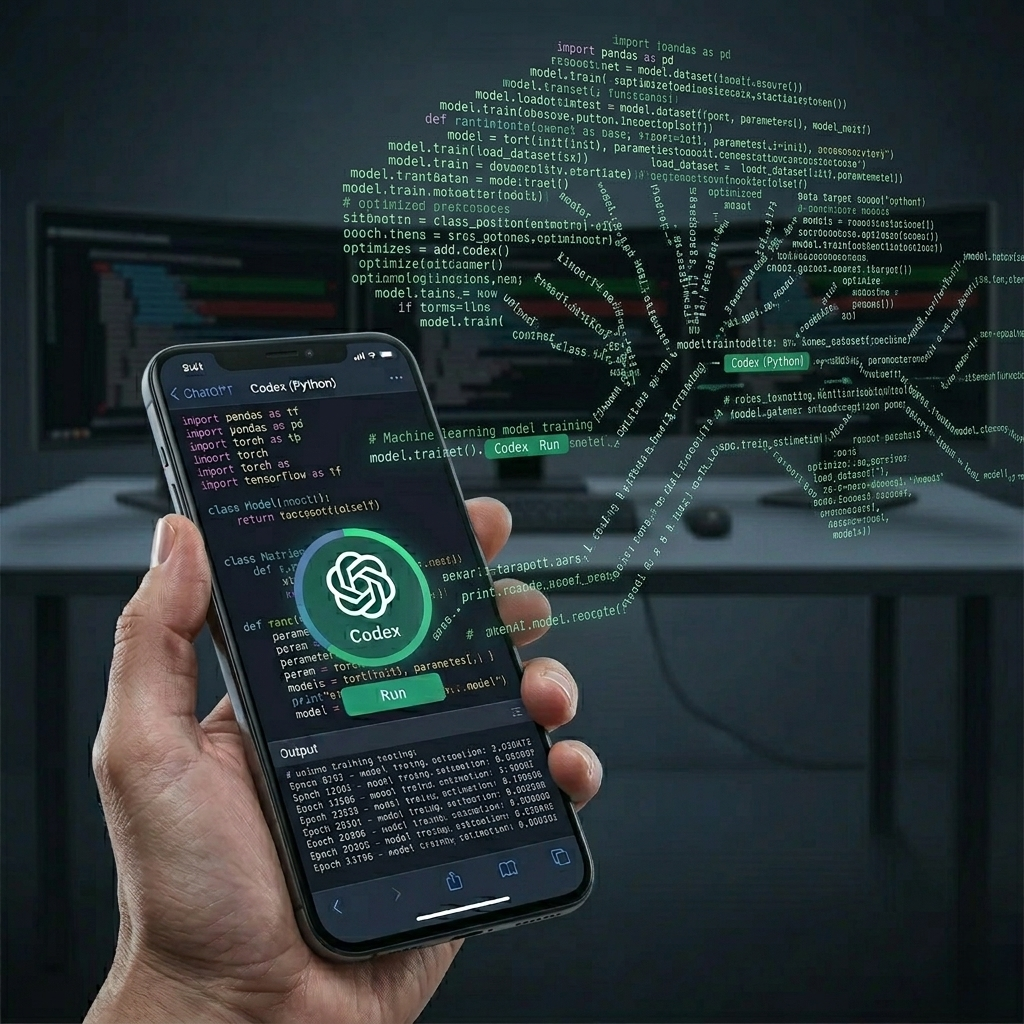
AI-assisted development is entering a new phase of mobility. OpenAI has just integrated Codex into the ChatGPT mobile app for iOS and Android, allowing developers to track and oversee their projects directly from a smartphone. The goal is not to turn the phone into a full-fledged programming environment, but to make the mobile device a control interface capable of managing AI agents working remotely on long and complex tasks.
This development reflects a deeper trend in the artificial intelligence ecosystem: the shift from one-off conversational tools to agent-based systems capable of operating continuously and autonomously. With Codex Mobile, the computer is no longer necessarily the sole focus of software development. Work can now be managed from any connected device.

The smartphone is becoming an AI monitoring interface
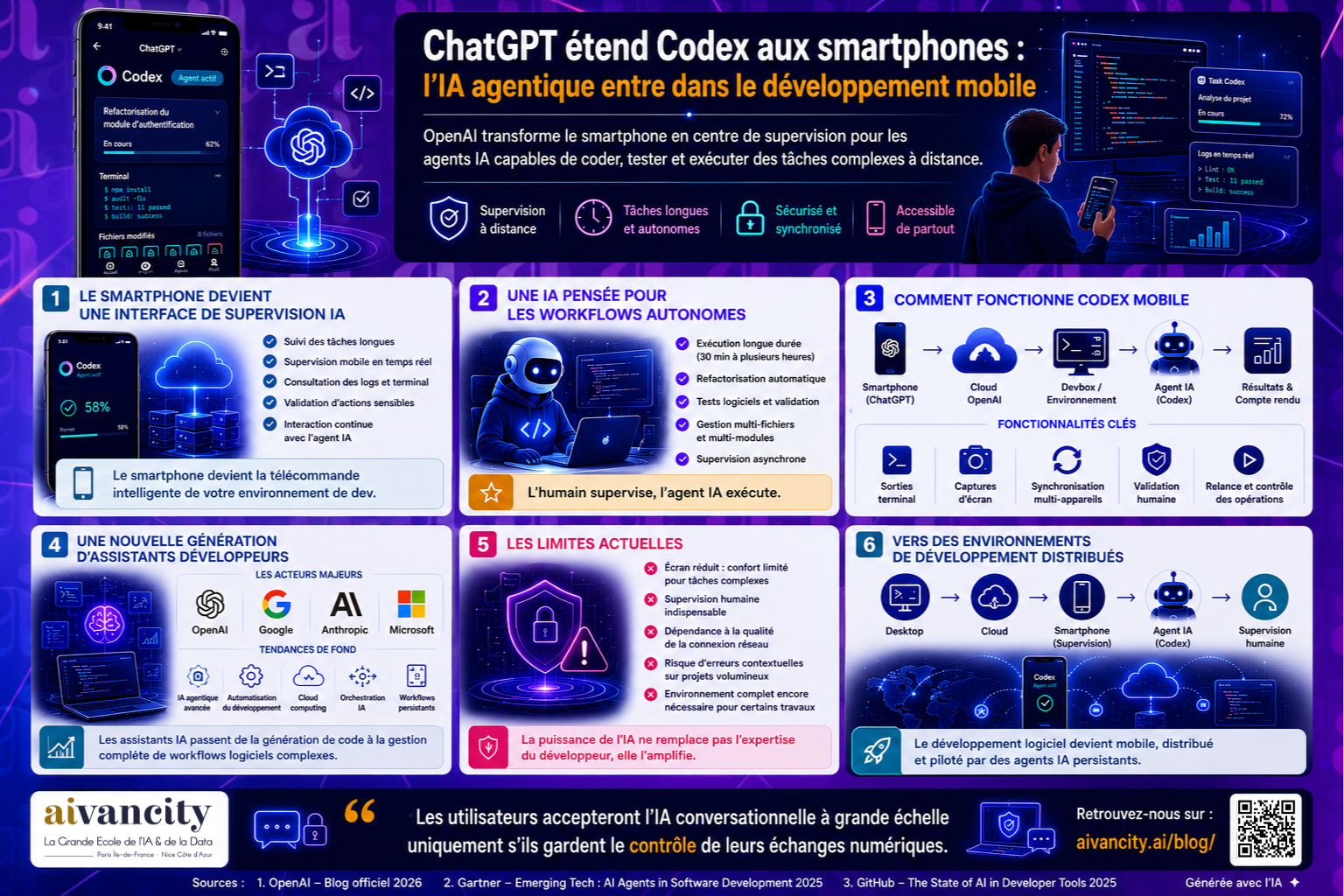
Here, OpenAI takes a different approach from traditional mobile tools. The idea isn’t to code entirely on a screen just a few inches wide, but to turn the phone into a smart remote control for the development environment.
In practical terms, Codex remains connected to the developer’s main machine, whether it is:
- a laptop,
- in a cloud environment,
- from a remote server,
- or a specialized development box.
The smartphone then allows you to:
- track the progress of tasks,
- view the terminal output,
- view test results,
- approve certain actions,
- or respond to requests from the AI agent.
This approach brings software development closer to an asynchronous supervision model, in which the agent continues to operate even when the user steps away from their main workstation.
AI designed for long, autonomous tasks
OpenAI explains that the use cases for AI agents are rapidly shifting toward much longer workflows. Some systems can now perform tasks for tens of minutes, or even several hours, without direct human intervention.
In this context, developers no longer need to sit in front of their screens all the time to monitor the execution of operations. The human role is gradually shifting toward:
- validation,
- arbitration,
- supervision,
- and strategic decision-making.
Codex Mobile is designed to address this exact need. Users can start a major refactoring project before leaving the office and then monitor its progress from their phone. They can also approve a significant change or provide additional context to the AI agent without having to reopen their entire development environment.
This development marks a significant milestone in the rise of agent-based AI in software development.
Operates much like a mobile control center
Codex’s mobile integration is gradually transforming ChatGPT into a centralized AI management platform. The mobile app is no longer just a tool for conversing with a model; it is becoming a management interface capable of coordinating multiple tasks executed remotely.
According to OpenAI, users can, among other things:
- view screenshots generated by the agent,
- monitor the execution logs,
- view modified files,
- resume certain operations,
- change the AI model,
- or pause a task that is currently in progress.
This approach positions AI assistants as true, continuously operational systems rather than mere conversational tools.
A logical next step after AI developers
The integration of Codex into the ChatGPT mobile app is part of a broader transformation in AI-assisted development. For several months now, OpenAI, Anthropic, Google, and Microsoft have been working to create agents capable of managing complete software workflows.
Code assistants are no longer limited to providing just a few lines of code. They can now:
- analyze entire projects,
- fix bugs,
- generate architectures,
- run tests,
- edit multiple files,
- and maintain long-term contexts.
The problem then becomes an organizational one. The longer agents work, the more they require flexible and ongoing supervision. The smartphone thus serves as a natural monitoring tool that keeps people in the loop without constantly tying the developer to their computer.
A new milestone for agent-based AI
Above all, this announcement highlights the rapid evolution of agent-based AI. Unlike traditional generative models, agent-based systems execute complex sequences of actions in a semi-autonomous manner.
With Codex Mobile, OpenAI is experimenting with a work structure in which:
- the AI agent generates,
- a human supervises,
- and the smartphone becomes the orchestration interface.
This approach could gradually be extended to other areas:
- cybersecurity,
- data analysis,
- office automation,
- cloud computing,
- or infrastructure management.
Computers remain important, but they are gradually ceasing to be the only gateway to digital work.




MasterAgent-Based AI
, with Claude Cowork
Move from conversational AI to operational AI. Automate your complex tasks in just two days—no technical skills required.
Availability and Access
OpenAI is gradually rolling out Codex for mobile via the ChatGPT app on:
- iOS,
- Android,
- and soon in other environments.
The feature is available on several ChatGPT subscription tiers, including certain free plans depending on region and rollout phase. OpenAI also notes that the integration will continue to evolve with new monitoring and orchestration capabilities.
This strategy aims to strengthen the ChatGPT ecosystem by enabling cross-device and persistent usage, where AI agents can operate continuously regardless of the device being used.
The Limits of Mobile App Development
Despite its promises, Codex Mobile obviously cannot replace a full-fledged development environment. Small screens, the complexity of projects, and certain technical operations naturally limit what can be done on a smartphone.
The role of mobile devices remains primarily focused on:
- supervision,
- quick approvals,
- task tracking,
- and certain one-off interactions.
Furthermore, AI agents still require close human supervision. An incorrect modification, a misinterpretation of context, or unexpected behavior can have significant consequences for a software project.
AI speeds up development, but it does not eliminate developers' responsibility.
A more profound transformation of digital work
Beyond simply adding a mobile feature, Codex in ChatGPT illustrates a more profound evolution in digital work environments. AI agents are gradually becoming persistent, capable of operating continuously and interacting with multiple devices simultaneously.
This transformation could permanently change the way developers work with artificial intelligence systems. The challenge will no longer be simply to produce code quickly, but to effectively manage autonomous agents capable of performing time-consuming tasks in complex environments.
The smartphone thus becomes less of a creative tool and more of a control center connected to AI systems that are constantly running in the background.
How does Codex work on mobile devices via ChatGPT?
The integration of Codex into the ChatGPT mobile app is based on an agent-based AI architecture connected to remote development environments. Unlike traditional coding assistants, which are limited to autocompletion or one-off code generation, Codex functions as an agent capable of tracking long-term tasks, analyzing software projects, and interacting with complex development workflows. The mobile app does not replace the developer’s computer; rather, it acts as a supervisory interface that allows users to control AI agents from a smartphone.
The system works by connecting the ChatGPT mobile app to a primary development environment, such as a computer, remote server, cloud, or devbox. Once connected, Codex can transmit test results, terminal output, file changes, or the progress of tasks performed by the AI agent in real time.
Users can then approve certain actions, provide additional instructions, or restart operations directly from their phones. This approach combines natural language processing, mobile supervision, and agent-based automation in software development.
- AI Task Monitoring: Real-Time Tracking of Development Operations
- Mobile Interaction: Controlling AI Agents from a Smartphone
- Software Project Analysis: Managing Complex, Multi-File Workflows
- Viewing terminal output: displaying logs and test results
- Approval of sensitive actions: approval of significant changes
- Multi-device synchronization: continuity across desktop, cloud, and mobile
- Development automation: assistance with time-consuming, hands-off tasks
- Semi-autonomous execution of development tasks by the AI agent
- Human validation of critical actions prior to implementation
- Real-time tracking of changes made by AI
- Monitoring of ongoing tasks, with the option to pause or resume them
- Synchronizing statuses across multiple devices and environments
- Keeping people in the loop despite advanced automation
- Compatibility with personal computers, remote servers, and cloud environments
- Can be connected to specialized devboxes and DevOps workflows
- Dependence on network connectivity and remote infrastructure
- Limited smartphone capabilities for complex development tasks
- Risk of errors or misinterpretations of context by AI
- High computational load for long-running agents
- Challenges in managing particularly large software projects
Learn more
The expansion of Codex to smartphones reflects a broader trend in development tools toward always-available solutions capable of supporting technical workflows beyond the traditional desktop environment. On a related topic, check out our article “Claude Code Voice: Anthropic Finally Lets You Control Your Code With Your Voice”, which analyzes how new conversational interfaces are gradually transforming programming practices and human-machine collaboration in software development.