


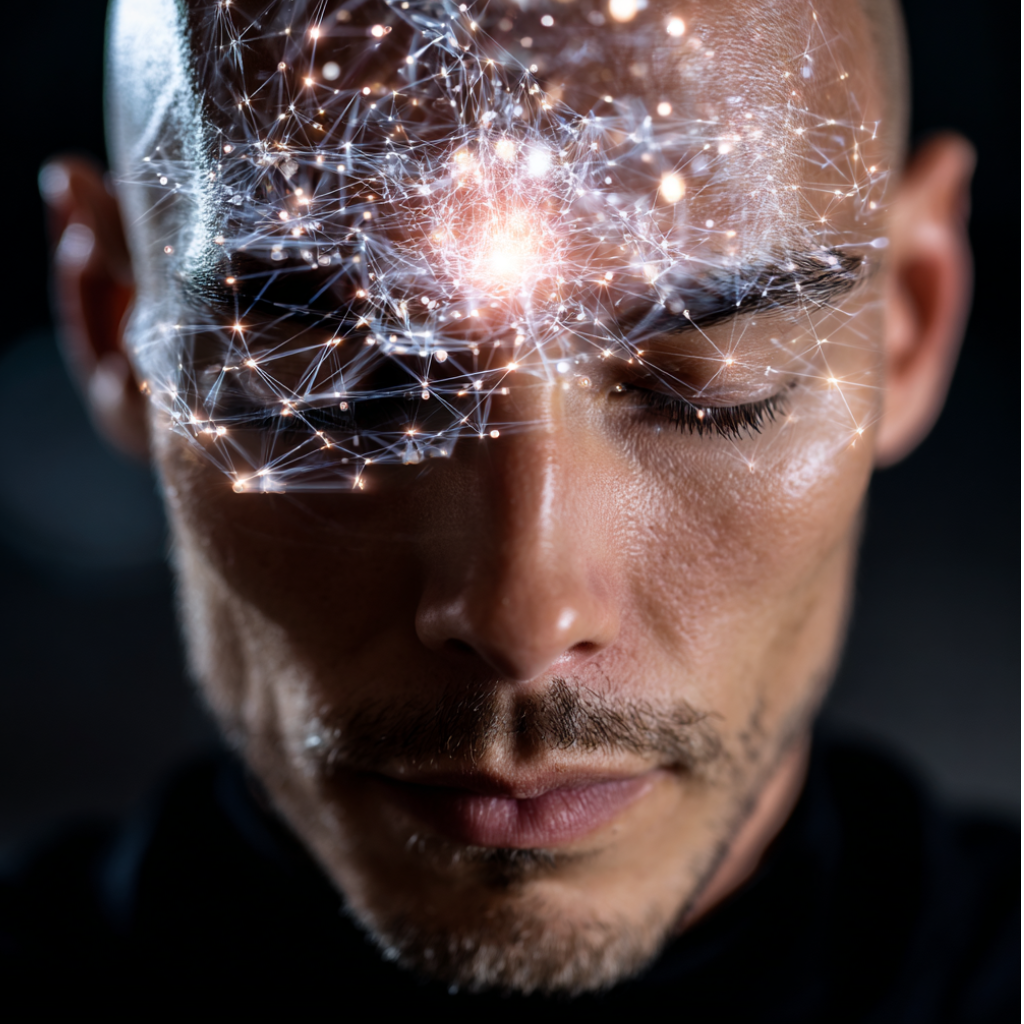
What if we could converse with artificial intelligence—not via a keyboard, screen, or voice, but directly through our thoughts? This scenario, long confined to science fiction, is taking on a more concrete form withElon Musk’s recent statements. As head of Neuralink, his startup specializing in brain-computer interfaces (BCI), the billionaire has announced a bold ambition: to enable direct communication between the human brain and conversational AI.
Following the promises of generative AI in text, visuals, and speech, this new phase raises fundamental questions—technological, ethical, and philosophical alike. Is this a groundbreaking innovation or just another provocation? An analysis of the Neuralink project and its progress allows us to assess the true scope of this ambition.
Neuralink: A Transhumanist Project Already in Action
Founded in 2016, Neuralink’s initial goal was to develop neural implants capable of restoring certain brain functions in people with neurological disorders (paralysis, blindness, ALS, etc.). In January 2024, the company announced that it had successfully performed its first human implantation1. The device, named Telepathy, would allow a patient to control a computer using only their thoughts.
Beyond this medical breakthrough, Musk has stated that, starting in 2025, he intends to expand the technology to cognitive applications for the general public, particularly for communicating with conversational AIs such as ChatGPT or Claude. The goal is no longer merely to repair, but to enhance human capabilities by creating a continuous, direct, and invisible link between the brain and artificial intelligence.
Toward Direct Communication with Artificial Intelligence?
Neuralink’s stated goal is to make AI a brain-based interface. This involves capturing not only motor signals (such as cursor movement), but also intentions, thoughts, and even linguistic representations.
Such an interface could enable:
- To ask an AI a question without speaking or writing,
- Receiving a response through an internal channel, which feels like a form of assisted thinking,
- To interact with AI models on an ongoing basis, in multitasking or cognitively complex contexts.
Technically, this would involve a combination of neural networks that decode brain activity and multimodal language models capable of interpreting and then formulating responses tailored to the user’s mental context.
Major scientific and technological challenges
This view remains highly speculative today. Current neuroscience still struggles to accurately decipher the language of thought. Neural activity is noisy, variable, and highly individualized. Even the most advanced systems struggle to arrive at a stable and generalizable interpretation of mental signals.
On the AI side, conversational models are not designed to interpret raw data streams from the human brain. We would need to develop bioinformatics alignment models capable of linking neural activity to semantic representations, which would require advances in bioelectronics, self-supervised learning, and neurosymbolism.
Finally, reliability, latency, and the ability to adapt to emotions or the ambiguity of natural language still pose significant technical challenges.
Ethical and societal issues
While Neuralink’s advances are fascinating, they are also cause for concern. Who owns brain data? Who can access, process, or exploit an individual’s mental activity? How much autonomy do we retain if we delegate certain cognitive functions to an AI system?
Bioethicists are urging caution: the line between assistance and cognitive intrusion is a fine one. The risks of mental manipulation, cognitive addiction, or neural hacking cannot be ruled out. Debates are also emerging regarding the need for specific regulations governing neurotechnologies integrated with AI2.
The idea of AI that “thinks alongside you” challenges fundamental assumptions about identity, privacy, and the very nature of human consciousness.
A technological strategy… but also an economic and media strategy
Beyond innovation, the Neuralink project is part of a broader strategy to integrate the technologies controlled by Elon Musk: Tesla, SpaceX, xAI, and Twitter (X). All of them could one day benefit from seamless interaction between humans and machines, facilitated by neural interfaces.
This announcement also allows Neuralink to capture the markets’ attention at a time when AI investments are on the rise, but truly groundbreaking projects remain scarce. By introducing a new field (neuro-AI), Musk is shaping the narrative of AI enhanced by humans—rather than the other way around—a promise that is as enticing as it is thought-provoking.
Between transhumanist fantasy and cognitive dissonance
The idea of communicating with AI through thought highlights the tensions surrounding transhumanism. Should we view Neuralink as a future brain-based companion, or simply as an extension of voice-activated or mind-controlled navigation tools for people with disabilities?
Companies like Synchron and Blackrock Neurotech are working on less invasive implants, but with similar goals. So this race isn’t just about media attention—it’s also technological, medical, and philosophical.
Neuralink could pave the way for extremely useful applications (rehabilitation, assisted communication, learning), but also for consumer uses that are still difficult to regulate.
At the intersection of thought and code: What does the future hold for brain-based AI?
With Neuralink, Musk isn’t just proposing a new technology. He is outlining a radically new model of interaction, in which artificial intelligence is no longer merely a tool but becomes an intimate companion. This vision raises questions that remain largely unanswered: to what extent do we actually want humans and machines to merge? And should this merger be driven by innovation… or by ethics?
Learn more
To explore the cognitive, ethical, and technological issues raised by brain-AI interface projects, here are two particularly relevant posts from the aivancity blog:
References
1. Neuralink. (2024). First human implanted with a brain-computer interface.
https://www.inserm.fr/
2. UNESCO. (2023). Ethical issues of neurotechnology.
https://unesdoc.unesco.org/ark:/48223/pf0000386241