


Since the emergence of generative AI, one question has been repeatedly raised: Which jobs will be replaced by artificial intelligence? The answers offered so far have often been based on theoretical reasoning. If an AI is capable of performing a task, then the associated job is potentially at risk. But this approach has a major limitation: there is sometimes a considerable gap between what a technology can do and what is actually used in businesses.
It was precisely this observation that led Anthropic to publish a new study on the impacts of artificial intelligence on the labor market.1 The company behind Claude employs an original methodology that relies not only on the theoretical capabilities of AI models, but also on the analysis of millions of real-world use cases observed through Claude and its API.
The findings challenge several common assumptions. Some occupations often portrayed as being at high risk actually appear to be less vulnerable in practice, while other professions—though less frequently mentioned in public debates—are already making extensive use of artificial intelligence.
Why Employment Forecasts Are Often Misleading
Most studies published in recent years assess the automation potential of jobs based on a simple principle: if artificial intelligence is capable of performing a human task, then that task is considered automatable.
On paper, this approach seems logical. However, it overlooks many factors that slow down or prevent the actual adoption of AI.
As Anthropic points out, certain tasks that are theoretically feasible for artificial intelligence are not necessarily used in real-world conditions due to regulatory constraints, human validation procedures, security requirements, or technical limitations of existing software.1
In other words, technological capability alone is not enough to predict how work will actually change.
That is why Anthropic has developed a new metric that combines two dimensions:
- the theoretical ability of AI to perform a task;
- the actual usage observed in Claude products.
This approach provides a more accurate picture of how artificial intelligence is transforming the workplace today.
What the Anthropic Study Really Reveals
One of the most striking findings of the study concerns the gap between the theoretical capabilities of AI and its actual use.

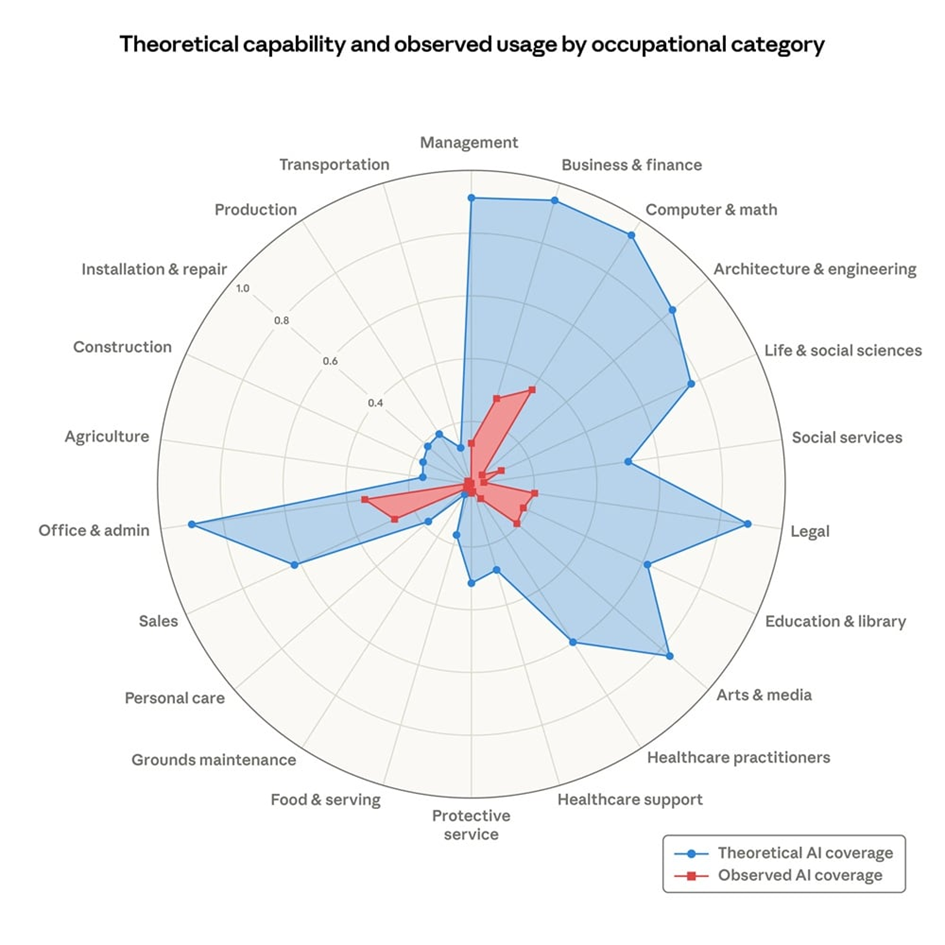
The chart shows that many occupational categories already have a high potential for automation based on the current capabilities of the models.
This is particularly true in the following cases:
- management careers;
- finance;
- computer science;
- legal matters;
- the sciences;
- the media.
However, the actual usage observed remains significantly lower than this theoretical potential.
This finding suggests that the adoption of AI depends less on technical performance than on the specific conditions for its integration into organizations.
The study also reveals that certain sectors that are, in theory, highly exposed—such as administrative services or legal functions—are still only utilizing a fraction of the possibilities offered by artificial intelligence models.
The Jobs Currently Most Vulnerable to AI
Anthropic has also published a list of the occupations that currently have the highest observed level of exposure.
Among the occupations most at risk are:
| Occupation | Observed exposure |
|---|---|
| Computer Programmers | 74.5% |
| Customer Service Representatives | 70.1% |
| Data Entry Operators | 67.1% |
| Medical Records Specialists | 66.7% |
| Marketing and Market Research Analysts | 64.8% |
| B2B Sales Representatives | 62.8% |
| Financial Analysts | 57.2% |
| Software Testers | 51.9% |
| Cybersecurity Analysts | 48.6% |
| IT Support | 46.8% |
These findings are particularly interesting because they primarily concern knowledge-based professions that rely on information processing, document analysis, or the production of digital content.
Contrary to popular belief, the professions most at risk are not necessarily the least skilled jobs. On the contrary, several highly specialized professions are among those most affected.
Those Left Behind in Alarmist Scenarios
Anthropic's study also identifies a significant group of occupations that are not very exposed to AI.
According to the company, nearly 30% of workers are in occupations whose tasks rarely appear in Claude’s observed usage.1
These include, in particular:
- the cooks;
- the mechanics;
- bartenders;
- the rescuers;
- skilled workers;
- agricultural occupations;
- field-based professions that require a strong physical presence.
These activities rely on motor skills, direct human interactions, or interventions in complex environments that are difficult to automate using current models.
This observation serves as a reminder that generative AI is primarily transforming digital and intellectual work, while many physical activities remain relatively unaffected.
Does AI replace or increase the amount of work?
One of the key takeaways from Anthropic’s previous research is that AI acts more as a tool for augmentation than as a complete substitute for human labor.2
In many cases, users rely on Claude to:
- write faster;
- analyze data;
- summarize documents;
- generate code;
- produce summaries;
- prepare presentations.
Nevertheless, humans remain responsible for validation, interpretation, and decision-making.
This reality contrasts with the scenarios of mass replacement often cited in public debate. The data show that artificial intelligence changes tasks before transforming the jobs themselves.
What This Study Means for Businesses and Employees
The approach developed by Anthropic is of particular interest to policymakers.
By looking at actual usage rather than just technical capabilities, it becomes possible to identify more precisely the sectors where AI adoption is actually progressing.
This approach can help organizations:
- anticipate AI training needs;
- adapt digital transformation strategies;
- identify emerging skills;
- prepare for changes in the workplace.
For employees, the main challenge seems to be less about replacement and more about adaptation. Skills related to data, data engineering, data analysis, generative AI, and agent-based AI are expected to continue to grow in importance across many sectors.
The Ethical Implications of a Gradual Transformation of Work
Anthropic's study sheds a more nuanced light on the impacts of artificial intelligence, but it does not eliminate the ethical questions.
The first concerns the pace at which skills are changing. Even though full automation remains rare, certain tasks are evolving rapidly, which requires significant training and support efforts.
The second issue concerns inequalities in access to AI. Workers with the skills needed to use these tools effectively could benefit from significant productivity gains, while others may be more vulnerable to market changes.
Finally, the evaluation methodologies themselves will need to continue to evolve. As Anthropic acknowledges, no study today can capture the full range of indirect effects that artificial intelligence could have on the economy and employment.1
A study that encourages us to move beyond simplistic scenarios
The findings published by Anthropic serve as a reminder of a reality that is often overlooked: the impact of artificial intelligence on work does not depend solely on its technical performance.
There are many factors at play between what models are capable of and what companies actually choose to use. Regulations, trust, work organization, corporate culture, and the availability of skills all have a significant impact on the pace of transformation in various industries.
Far from the most alarmist predictions, this study suggests that the future of work will likely be marked by an increasing coexistence between human intelligence and artificial intelligence. This will be a gradual, complex evolution—and, above all, one that is far more nuanced than the most extreme arguments would have us believe.




Executive Training
AI & Data Science
s for Managers
Integrate AI into your business strategy. A 360° approach—Technology, Business, and Ethics—designed for decision-makers. Prerequisites: 5 years of managerial experience.
Learn more
Anthropic’s study challenges certain common assumptions about the impact of artificial intelligence on work. Rather than simply replacing jobs, it highlights a gradual transformation of tasks, skills, and ways of collaborating between humans and machines. On a related topic, check out our article “The Impact of AI on Employment: Decoding the Numbers and Trends”, which analyzes the latest data on the effects of AI on the labor market and the changes currently underway in many industries.
References
1. Anthropic. (2026). Labor Market Impacts of AI.
https://www.anthropic.com/research/labor-market-impacts
2. Anthropic. (2025). The Anthropic Economic Index.
https://www.anthropic.com/economic-index