


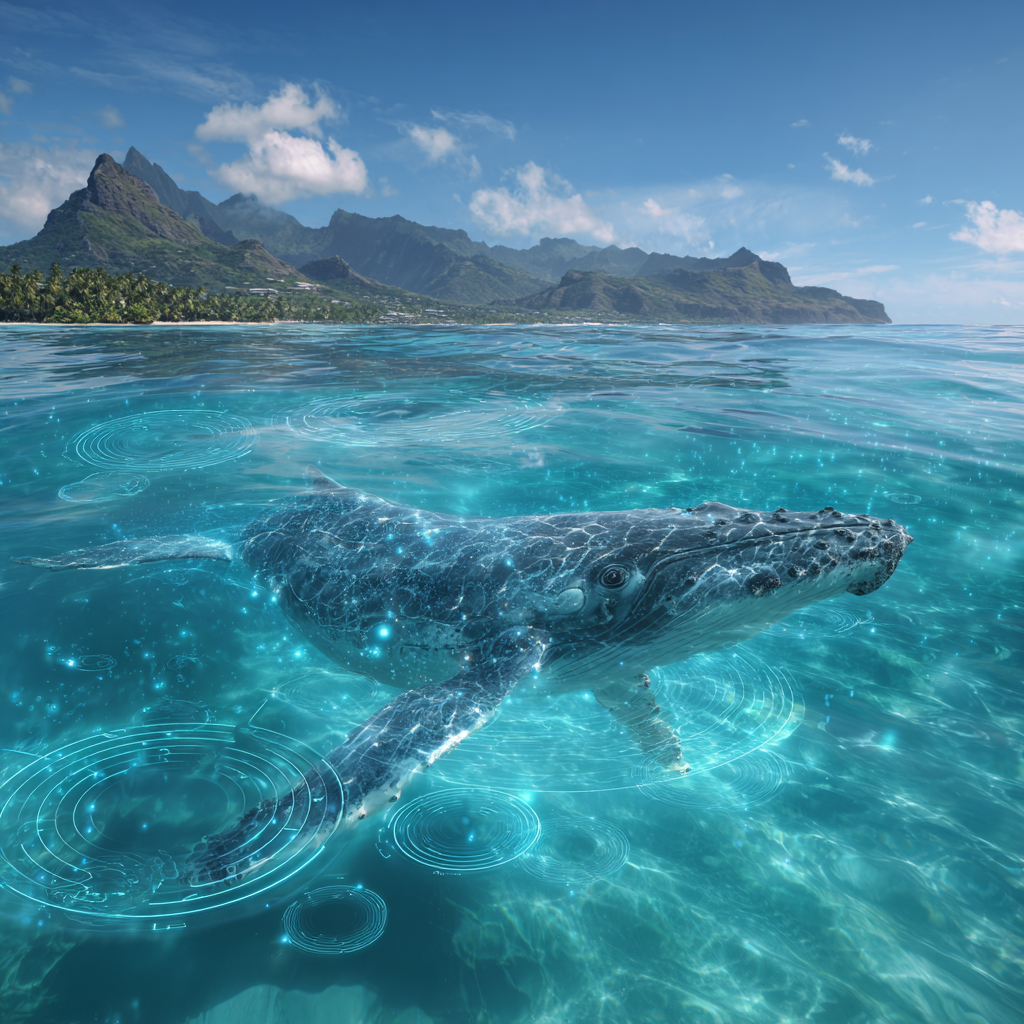
At the intersection of science and the ocean: a new era for marine conservation
Protecting marine biodiversity is now a global challenge, one that is particularly acute in the fragile ecosystems of the oceans. In French Polynesia, humpback whales, iconic migratory species, face growing pressures: maritime traffic, noise pollution, warming waters, and disruption of their breeding grounds. In light of these challenges, Artificial Intelligence (AI) is emerging as a strategic tool for cetacean conservation.
The Ocean AI project, a collaboration among researchers, engineers, and marine biologists, illustrates this convergence between data science and ecology. Through the analysis of acoustic recordings, the modeling of migratory behaviors, and the automated detection of biological signals, AI helps improve monitoring, anticipate risks, and support decision-making regarding species conservation.
This article offers an in-depth analysis of the practical contributions of artificial intelligence to whale conservation in Polynesia. Drawing on recent case studies, scientific data, and ethical considerations, it highlights the promise (but also the limitations) of a technological approach to protecting wildlife.
An ecosystem under pressure from multiple threats
French Polynesia is one of the last remaining natural sanctuaries for humpback whales in the Southern Hemisphere. Every year, between July and November, these whales leave the cold waters of Antarctica to breed and give birth in the lagoons of French Polynesia. However, this fragile balance is now threatened by a combination of human and climate-related factors.
Marine traffic is one of the major threats to these species. The growing number of pleasure boats, cargo ships, and cruise ships in areas frequented by cetaceans increases the risk of collisions, which can sometimes be fatal1. Noise pollution, meanwhile, disrupts the acoustic communications of whales, which are essential for their reproduction and navigation2. Added to this are disturbances caused by unregulated tourism, chemical pollutants, and the effects of warming waters on food chains.
In the face of these multiple threats, traditional monitoring and survey methods (visual observations, satellite tagging, manual recording) struggle to effectively cover marine areas as vast as those of the Polynesian archipelago. There is an urgent need for more powerful analytical tools capable of processing large volumes of data in real time.
Ocean IA: Sensors, Data, and Algorithms at the Service of Cetaceans
The Ocean IA project is the result of a partnership between oceanographic institutions, artificial intelligence laboratories, and local environmental NGOs. Its goal is to develop an intelligent marine acoustic monitoring system capable of detecting, identifying, and tracking cetaceans in a non-intrusive manner.
Networks of hydrophones (underwater microphones) installed in areas where whales frequently pass through continuously record ambient sounds. This massive and complex data is then processed by machine learning models capable of distinguishing whale songs from background noise, attributing them to specific species, and predicting their likely trajectories3.
This approach makes it possible to build a dynamic, evolving database of cetacean sightings, behaviors, and movements, which is essential for guiding conservation policies, alerting ships, and raising public awareness.
AI in Action: Predicting, Protecting, Preventing
Several recent use cases illustrate the effectiveness of AI in this context:
- Real-time detection: By analyzing acoustic signals picked up at sea, the system can detect the presence of whales within a radius of several kilometers. These detections are automatically transmitted to maritime authorities, who can then recommend changes in course or speed to approaching vessels.
- Dynamic mapping: Aggregated data is used to generate up-to-date maps of areas with high cetacean activity, which are then used to temporarily adjust shipping routes or prohibit certain water-based activities during critical periods4.
- Migration forecasting: Using predictive models based on historical and environmental data (water temperature, salinity, seasons), it is possible to anticipate when and where whales are likely to be present in greater numbers and to implement preventive measures.
Technological potential that must be handled with care
The integration of AI into marine conservation strategies offers numerous benefits: processing large volumes of data, rapid and accurate detection, reducing the human cost of offshore monitoring, and improving operational responsiveness. It also helps avoid approaches that are intrusive or stressful for the animals.
However, these technologies are not without limitations. Their effectiveness depends heavily on the quality and quantity of the data collected. The models can also produce classification errors or false positives, particularly when confronted with unknown marine noise. Furthermore, interpreting the results requires the combined expertise of data scientists and biologists, underscoring the need for an interdisciplinary approach5.
Governance, Transparency, and Sovereignty: The Ethical Challenges of Environmental AI
The use of AI in the marine environment also raises ethical and regulatory issues. The collection of marine data—even passive data—can conflict with local rights, particularly regarding maritime sovereignty or respect for Indigenous territories.
Furthermore, delegating certain decisions to automated systems (detection, alerts, zone closures) raises the question of accountability: who is responsible for the consequences in the event of an error or inaction? Finally, like any algorithmic system, the tools used must undergo regular audits to prevent bias and ensure transparency.
What if AI became a cornerstone of maritime diplomacy?
Whale conservation in Polynesia is now part of a close dialogue between biology, computer science, and ethics. Artificial intelligence, far from being a miracle solution, is emerging as a powerful tool in the service of a renewed vision of marine conservation. In the coming decades, could it become a pillar of international environmental diplomacy, based on shared knowledge of the oceans and the species that inhabit them?
Learn more
To broaden the discussion on AI for environmental protection, discover TerraMind: Artificial Intelligence and Earth Observation, a blog post from aivancity that explores how AI, through the analysis of geospatial satellite data, helps monitor ecosystems, track pollution, and anticipate natural hazards
References
1. UK launches £225m Isambard-AI supercomputer in Bristol – BBC News, July 15, 2025
https://doi.org/10.1002/fee.2040
2. Dunlop, R.A. (2016). The effect of vessel noise on humpback whale communication. Ecology and Evolution, 6(9), 2956–2970.
https://doi.org/10.1002/ece3.2060
3. Gillespie, D. et al. (2020). AI-based detection and classification of cetacean sounds. Journal of the Acoustical Society of America.
https://doi.org/10.1121/10.0001172
4. Comtet, T. et al. (2023). Oceans and AI: Toward Dynamic Management of Marine Biodiversity. IFREMER Report.
https://wwz.ifremer.fr/
5. CLavorel, S. & Villeneuve, B. (2022). Digital Ecology and Environmental Data Governance. Natures Sciences Sociétés Journal.
https://doi.org/10.1051/nss/2022010