


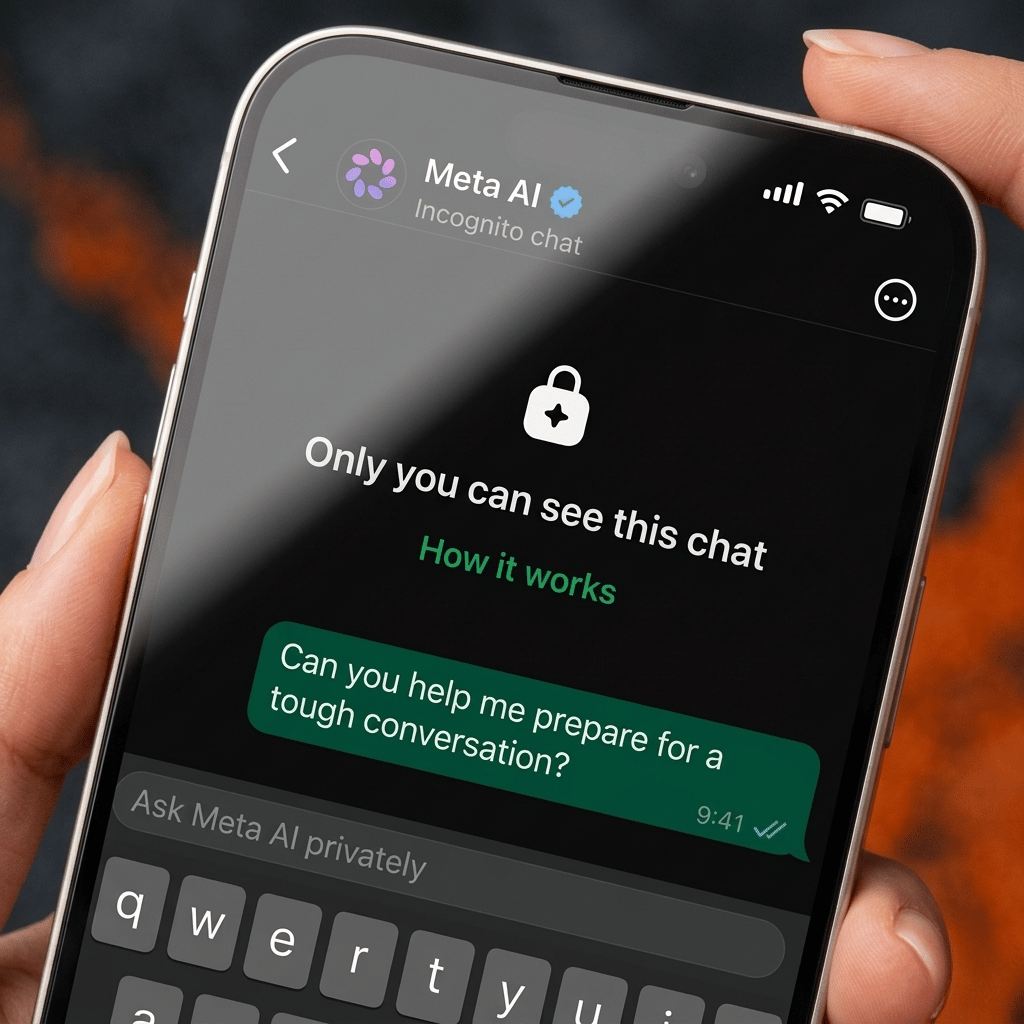
Conversational artificial intelligence is gradually becoming an everyday tool. After integrating Meta AI into WhatsApp, Instagram, and Facebook, Meta is now seeking to address a concern that has become a major priority for users: the privacy of conversations with AI assistants. To that end, the company is gradually rolling out a new feature called Incognito Chat, designed to enable temporary conversations with Meta AI without saving a persistent chat history.
This development reflects a significant strategic shift in the generative AI ecosystem. Users want to take advantage of the conversational capabilities of AI assistants, but without feeling like they are constantly being watched or that their conversations are being repurposed for advertising or model training. Meta is therefore attempting to make its conversational agents more socially acceptable by introducing greater control and discretion around interactions.

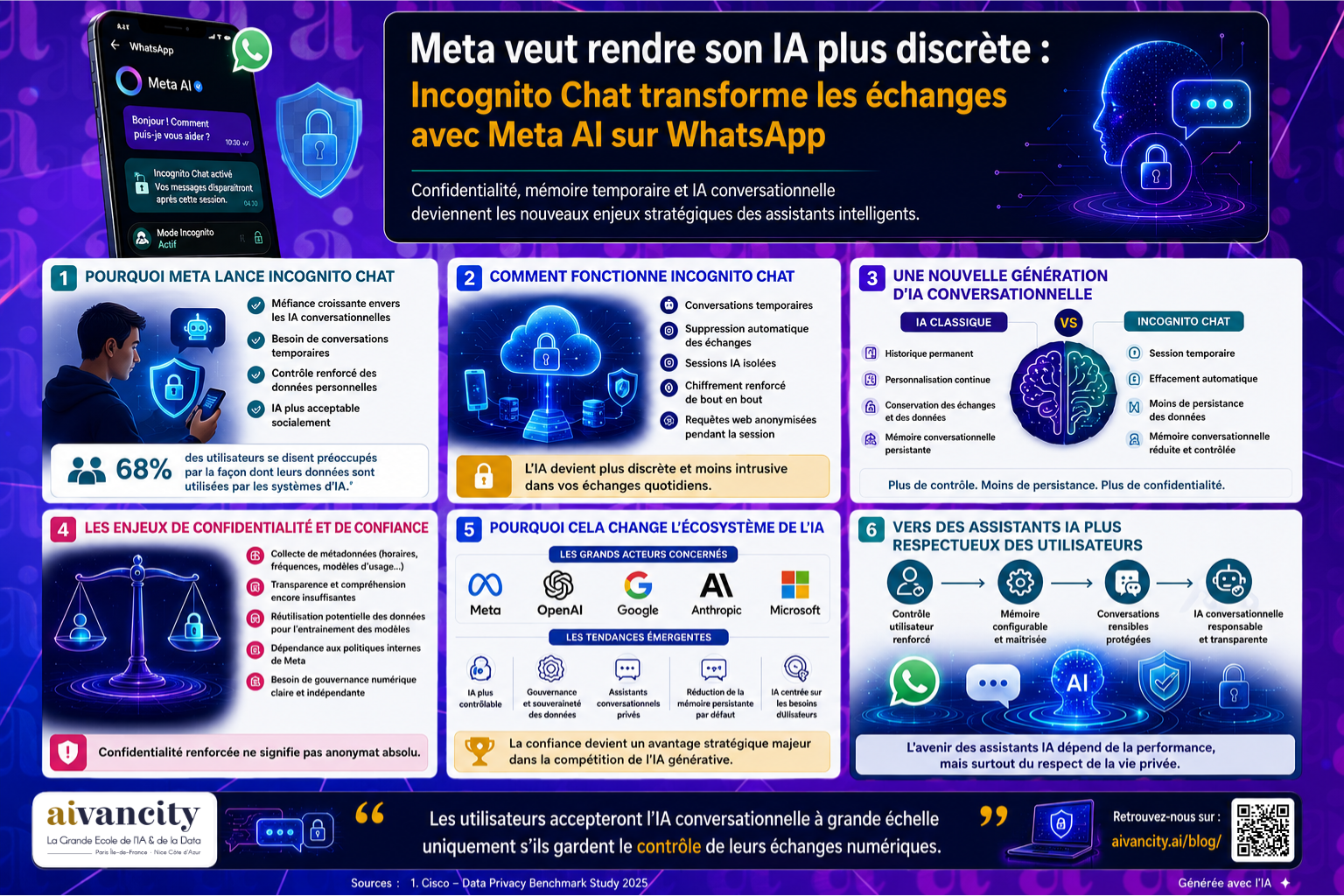
A conversational AI designed to be more unobtrusive
With Incognito Chat, WhatsApp is introducing a temporary chat mode designed specifically for Meta AI. The goal is to create a space where users can interact with the assistant without their conversations being permanently saved in their chat history. According to Meta, conversations in this mode automatically disappear after the chat is closed, do not appear in the standard chat history, and are not used to personalize ads.
This approach is similar to the private browsing modes already available in some browsers and messaging apps, but this time applied to interactions with conversational artificial intelligence. Meta’s main goal is to reduce the feeling of constant surveillance that still holds some users back when they chat with AI systems.
A response to concerns about personal data
The launch of Incognito Chat comes at a time when concerns about personal data are skyrocketing. As conversational AI becomes more prevalent in everyday life, users are entrusting it with information that is sometimes sensitive—related to work, health, finances, or their private lives.
This trend naturally heightens expectations regarding privacy. According to a Cisco study published in 2025, more than 68% of users say they are concerned about how their data is used by artificial intelligence systems1. Meta is therefore seeking to address an issue that has become strategic in the competition surrounding AI assistants: user trust.
The company wants to transform WhatsApp into an everyday conversational assistant, but without giving the impression that it is a platform that collects and stores all personal conversations. Incognito Chat thus appears to be an attempt to make AI more discreet and less intrusive.
How does Incognito Chat work?
Technically, WhatsApp relies on its end-to-end encryption infrastructure to enhance the privacy of communications with Meta AI. The company explains that conversations in Incognito Chat are processed in secure environments designed to restrict access to conversation data.
The system relies on temporary sessions. Once the conversation ends, messages disappear automatically and are not linked to the user’s account. Meta also notes that certain web searches conducted during these conversations would be anonymized to limit direct links to the user’s identity.
The goal is to create an experience that feels more like a fleeting conversation with an AI, rather than an assistant that permanently stores all interactions. This approach reflects a broader trend in conversational assistants, where memory becomes configurable and partially controllable by the user.
Meta is trying to rebuild trust in its AI
The issue remains particularly sensitive for Meta. Despite its massive investments in artificial intelligence, the company continues to grapple with a complicated reputation regarding the handling of personal data. The integration of Meta AI into WhatsApp had already raised numerous questions about the potential use of conversations to train models or fuel targeted advertising.
With Incognito Chat, Meta is therefore seeking to reassure users without slowing down the rollout of its AI assistants. This development shows that the battle over artificial intelligence is no longer fought solely on the technological power of the models, but also on the ability of platforms to build trust.
Major players in the industry, such as OpenAI, Google, Anthropic, and Meta, are now all working on mechanisms to control conversational memory in order to make their assistants more suitable for sensitive personal or professional use.
AI that’s becoming increasingly personal
The development of Incognito Chat also reflects a more profound shift in digital habits. Chatbots are gradually becoming highly personal tools. Some users are already turning to AI for professional advice, writing assistance, financial recommendations, or emotional support.
The more sensitive interactions become, the more important the issue of conversational memory becomes. Many users are willing to use AI as long as they can retain some control over their interactions and how long information is retained.
This trend is prompting technology companies to develop private modes, temporary storage, or ephemeral conversations designed to limit the retention of personal data in AI systems.


Master ChatGPT and Generative AI-
Demystify generative AI tools and unlock their potential in your field. A 100% hands-on approach, with no technical prerequisites.


True privacy, but not absolute
Although Meta emphasizes the private nature of Incognito Chat, several experts point out that no digital system can guarantee absolute privacy. Certain technical metadata may still be retained, including information related to connections, infrastructure security, or the operation of the service.
Furthermore, there is a significant difference between message encryption, the AI’s conversational memory, and the potential use of data to improve the systems. Communication regarding Incognito Chat must therefore remain particularly clear to avoid any confusion between enhanced privacy and complete anonymity.
A new milestone in the governance of AI assistants
With Incognito Chat, Meta demonstrates that the future of conversational artificial intelligence will depend as much on trust as on technological performance. Models are becoming more powerful, more integrated, and more personalized, but this increased intimacy also raises expectations regarding data protection and governance.
Platforms that can offer useful assistants while giving users more control could gain a major strategic advantage in the coming years. Conversational AI will only be widely adopted if users feel they retain control over their digital interactions.
How does Incognito Chat work on WhatsApp?
Incognito Chat is built on a secure messaging architecture combined with conversational AI that operates in a temporary, isolated environment. Unlike traditional AI assistants, which often retain a conversation history to improve responses or personalize the user experience, Incognito Chat is designed to limit the persistence of exchanges with Meta AI. The goal is to enable more private conversations that are less tied to the system’s permanent memory.
The system operates across several layers of technology. First, WhatsApp uses its end-to-end encryption infrastructure to protect messages. Next, Meta AI operates within a temporary session capable of processing messages without permanently storing them in the user’s chat history. Once the conversation ends or is closed, the messages are automatically deleted from the Incognito Chat interface.
This approach combines natural language processing, session isolation, and temporary management of conversational data. Meta AI can interpret queries, generate responses, and maintain context during the active session, without permanently storing the exchanges after the conversation ends.
- Temporary conversations: automatic deletion of messages after the conversation ends
- Isolating AI sessions: separating Incognito chats from the rest of WhatsApp
- Enhanced encryption: message protection via WhatsApp’s secure infrastructure
- Reduced conversational memory: limiting persistent history
- Interaction with Meta AI: conversational assistance built directly into WhatsApp
- Anonymized web requests: limiting direct links to user identity
- Enhanced privacy: greater control over sensitive communications
- Context is retained only during the active session
- Voluntary limitation of the AI's persistent memory
- Reducing the retention period for personal data
- Reduced risks associated with conversation history
- Reducing the reuse of web traffic data for advertising purposes
- Reducing the feeling of constant surveillance associated with AI assistants
- Interaction with Meta AI's conversational capabilities
- Connection to certain integrated web services and WhatsApp's native features
- Using Meta's cloud infrastructure for request processing
- Certain technical metadata related to security may be retained
- Reliance on Meta's internal policies regarding data management
- Limited customization capabilities due to the lack of persistent storage
- The need to maintain safety and abuse prevention measures
- Potential difference between visible deletion and complete deletion of system data
Learn more
The addition of an “Incognito Chat” mode to WhatsApp highlights the growing importance of privacy and data control in chatbots. On a related topic, check out our article “Temporary Chats on Gemini: A Step Toward More Privacy-Respectful AI”, which analyzes how major AI platforms are seeking to balance personalized interactions with the protection of user privacy.
References
1. Cisco. (2025). Consumer Privacy Survey.
https://www.cisco.com