



Meta is continuing its push into artificial intelligence with the launch of Forum, a new community platform heavily inspired by Reddit but enhanced with a significant layer of AI. Behind this app—which is discreetly integrated into the Facebook ecosystem—lies a much more strategic ambition: to transform community discussions into AI-assisted spaces.
For several years now, Meta has been seeking to revitalize social engagement on its legacy platforms. Facebook is gradually suffering from saturation in the main feed, which has become a mix of ads, viral content, Reels, and algorithmic recommendations. In this context, Facebook groups remain one of the last spaces where users still interact in a relatively authentic way around shared interests.
With Forum, Meta is therefore attempting to rebuild a community experience that is clearer, more structured, and more conversational. But this time, artificial intelligence is becoming the true driving force behind the user experience.

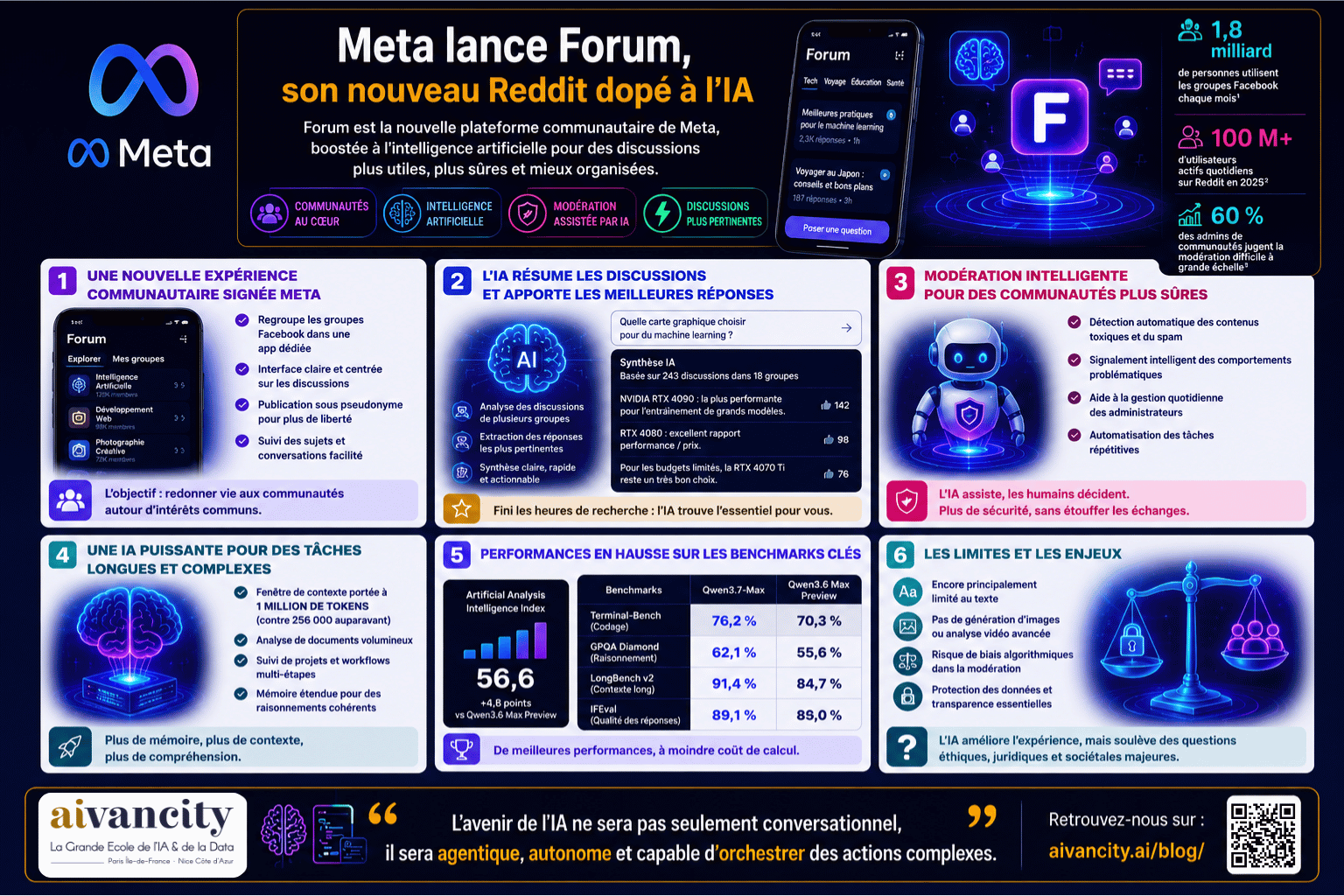
Meta wants to put communities back at the center of conversations
The concept behind Forum is based on a relatively simple idea. The app brings together Facebook groups in a standalone interface designed specifically for community discussions. Users can post under a pseudonym, find their conversations more easily, and follow specific topics without getting lost in Facebook’s main feed.
This approach is very similar to Reddit, whose popularity continues to grow. In 2025, Reddit surpassed 100 million daily active users1, thanks in particular to the diversity of its specialized communities and the quality of certain technical or topic-specific discussions.
Meta is clearly seeking to recapture some of that community momentum. According to the company, more than 1.8 billion people use Facebook Groups every month2. This represents a massive user base that the company is now trying to restructure around a more modern and conversational experience.
The goal is also to respond to a significant shift in digital habits. Many internet users today are looking for spaces that are more specialized and more human than traditional social media platforms, which are often saturated with short-form content and recommendation algorithms.
Artificial intelligence is becoming the heart of Forum
The real innovation behind Forum, however, lies in its extensive integration of artificial intelligence. Meta no longer wants to simply host communities; it wants to use AI to organize, summarize, and streamline conversations.
One of the most prominently featured functions is an AI-powered question-and-answer system. When a user asks a question, the app analyzes discussions from various groups to generate a summary of the responses it deems relevant.
This approach helps avoid lengthy searches through hundreds of comments or endless debates where important information gets lost in the middle of the discussion. The way it works is reminiscent of a mix between Reddit, ChatGPT, and a community-driven conversational search engine.
Above all, this trend shows that social platforms are now seeking to transform human conversations into knowledge bases that can be leveraged by AI. Discussions are gradually becoming structured data capable of powering intelligent conversational systems.
AI-powered moderation for community management
Meta also includes an AI assistant designed for group administrators. It helps manage content, detect certain problematic behaviors, and automate some moderation tasks.
This issue becomes particularly important as large online communities grow. According to Statista, more than 60% of community managers report having difficulty maintaining effective moderation on large-scale social media platforms3.
Artificial intelligence therefore makes it possible to:
- detect certain harmful content,
- identify spam,
- report problematic posts,
- or automate certain repetitive community management tasks.
But this automation also raises sensitive issues. The more AI systems are involved in moderation, the more important the debates surrounding algorithmic bias, filtering errors, and transparency become.
The question is no longer just how to moderate a community, but also to what extent artificial intelligence can intervene in human interactions.


Master ChatGPT and Generative AI-
Demystify generative AI tools and unlock their potential in your field. A 100% hands-on approach, with no technical prerequisites.


Meta is gradually transforming its social media platforms into AI platforms
Forum is not a standalone project. For several months now, Meta has been rolling out a growing number of products that systematically incorporate a layer of artificial intelligence.
The company has already launched:
- Meta AI in WhatsApp and Messenger,
- generative tools for Instagram,
- chatbots,
- automated creative features,
- or experimental apps like Instants and Meta Edits.
This strategy shows that Meta now views AI as the primary interface of the future for its digital platforms. The company no longer wants to simply connect users; it also wants to organize their interactions using intelligent systems capable of understanding, summarizing, and personalizing those exchanges.
Mark Zuckerberg is fully committed to this direction. According to the Wall Street Journal, Meta believes that the productivity gains brought about by AI now make it possible to develop new digital products much more quickly4.
Social media platforms are becoming AI-driven environments
Forum illustrates a more profound transformation of the social web. For a long time, community platforms relied primarily on human organization, user votes, moderators, and direct interactions between members.
With the advent of generative AI, platforms are now beginning to automatically summarize discussions, recommend certain responses, steer conversations, and even filter content without direct human intervention. In some cases, artificial intelligence can even generate certain interactions on its own to keep conversations flowing or maintain user engagement.
This development could significantly improve the user experience. Discussions become more accessible, responses are faster, and content is easier to use.
But it also strengthens the power of algorithms in shaping digital conversations. The more AI becomes involved in social interactions, the more platforms are able to influence what users read, discover, or consider relevant.
A New Milestone in Social AI
With Forum, Meta is making it clear that the next generation of social networks will be deeply intertwined with artificial intelligence. Platforms are no longer simply seeking to host human conversations; they now aim to organize, interpret, and sometimes automatically enhance them using AI.
This trend could bring about a lasting transformation in how online communities function. Forums and social networks are gradually becoming hybrid environments where humans and intelligent systems are jointly shaping an increasing portion of digital interactions.
Social AI is now entering a new phase in which platforms are no longer content merely to connect people; they are actively shaping the way conversations are structured and circulate on the Internet.
How does the Meta Forum work?
Forum is built on a community network architecture enhanced by a layer of conversational artificial intelligence. Unlike traditional forums or Facebook groups, where conversations are primarily organized chronologically and manually, Forum uses AI to analyze, structure, and summarize discussions in order to make communities more accessible and interactive.
The system operates in several stages. When a user posts a question or participates in a discussion, the AI analyzes the content of conversations in various groups to identify relevant answers, recurring themes, and useful information. It can then generate conversational summaries, recommend specific content, or direct the user to similar discussions.
This approach is based on a combination of natural language processing, semantic analysis, recommendation systems, and generative AI. The goal is to transform community discussions into an intelligent conversational environment capable of assisting users in finding and organizing information.
- Centralized Community Discussions: Bringing Facebook Groups Together in a Dedicated Interface
- AI-Assisted Synthesis: Generating Summaries from Existing Discussions
- Conversational search: the ability to ask questions in natural language
- Smart Recommendations: Highlighting Relevant Answers and Content
- AI-Assisted Moderation: Detecting Problematic Content and Assisting Administrators
- Posting under a pseudonym: more flexible community interactions
- Meta Integration: Connecting with the Facebook and Meta AI Ecosystem
- Risk of Bias in Algorithmic Recommendations
- Reliance on the quality of community discussions
- Possibility of errors in AI-generated summaries
- Privacy Issues Related to Conversation Analysis
- Difficulty in automatically moderating certain complex content
- Risk of over-personalization of interactions and algorithmic lock-in
Learn more
Meta’s launch of Forum illustrates the desire of major platforms to rethink community spaces through artificial intelligence, encompassing personalized interactions, automated moderation, and new forms of social interaction. On a related topic, check out our article “Moltbook Envisions an AI Society with a Human-Free Social Network”, which explores how AI-powered social networks could profoundly transform community dynamics and digital habits.Footnotes
References
1. Reddit Investor Relations. (2025). Reddit user metrics.
https://investor.redditinc.com
2. Meta. (2025). Facebook Communities and Groups Statistics.
https://about.fb.com
3. Statista. (2025). Challenges in online community moderation.
https://www.statista.com
4. Wall Street Journal. (2026). Meta expands AI-driven product strategy.
https://www.wsj.com