


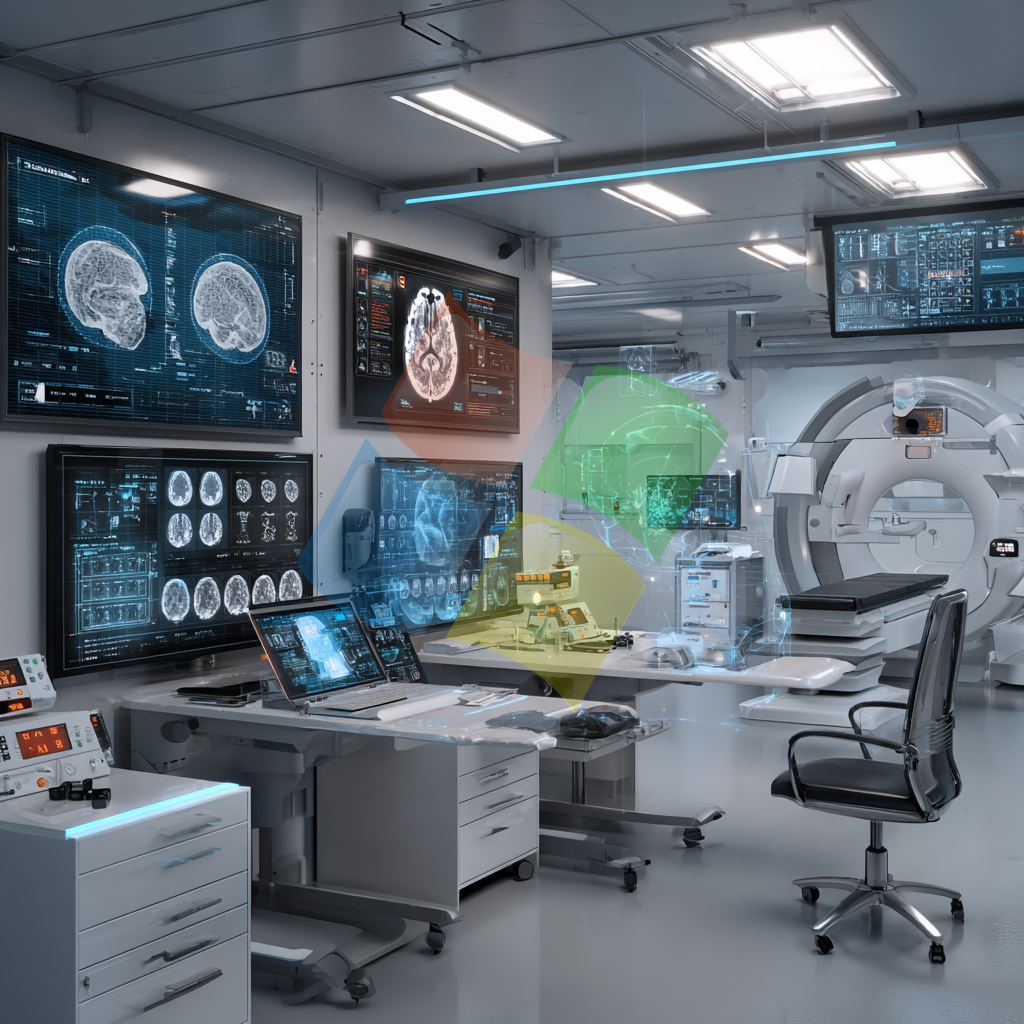
A major breakthrough in diagnostic support
Microsoft has just unveiled an artificial intelligence system that outperforms humans in complex medical diagnoses. According to a comparative study conducted on thousands of clinical scenarios, this AI is up to four times more accurate than general practitioners in certain rare or difficult-to-identify situations1.
This system builds on the advanced multimodal models developed by Microsoft Research, combining textual, visual (radiology), and patient history analysis. Unlike tools such as GPT-4 or Med-PaLM, Microsoft’s AI has been specifically trained on clinical corpora, real-world cases, and data from hospital partnerships.
AI trained for complex diagnoses
The model was trained on a massive volume of medical data, including millions of imaging reports, pathology reports, hospital discharge summaries, and patient-physician interactions. By integrating different types of data (multimodality), the AI is capable of:
- Cross-reference symptoms with medical history,
- Detecting rare diseases based on subtle clues,
- Suggest differential diagnoses and relevant follow-up tests.
According to Microsoft, in 84% of the complex cases tested, the system provided the correct diagnosis on the first suggestion, compared to 21% for a panel of experienced doctors2.
Real-world use cases in a hospital setting
Microsoft’s AI is currently being tested in partnership with several hospitals in Europe and the United States, in medical specialties where diagnostic errors remain high or treatment timelines are critical. Among the practical applications observed:
- Pediatric emergencies: early detection of rare metabolic disorders in infants, with a 60% reduction in diagnosis time.
- Thoracic radiology: identification of pulmonary embolisms or precancerous lesions on complex CT scans, with a 30% increase in accuracy.
- Neurology: Interpretation of brain MRI scans combined with analysis of medical history to refine diagnoses of degenerative diseases.
- Augmented general practice: helping to prioritize necessary tests, reducing misdiagnoses, and improving the quality of prescribing.
Toward a transformation of the doctor's role?
With the advent of this new-generation medical AI, the medical profession is not disappearing, but is undergoing a profound transformation. AI is becoming a diagnostic co-pilot, capable of filtering hypotheses, flagging inconsistencies, or suggesting more precise courses of action.
Doctors remain the only ones who can interpret the human context, make the final clinical judgment, and interact with the patient. But their role is becoming more strategic: validating algorithmic recommendations, explaining diagnoses, and resolving uncertainties or conflicts between AI and clinical intuition.
What medical skills are needed in the age of AI?
The growing prevalence of these tools necessitates a transformation of medical curricula and practices. Among the new skills expected:
- A Critical Analysis of Algorithmic Reasoning,
- Verification of the traceability and robustness of the recommendations,
- Ability to interact with generative AI using natural language,
- Training in the Ethics of Assisted Care,
- Mastery of AI systems integrated into the patient record.
According to the WHO, 72% of hospitals in G20 countries plan to integrate one or more AI modules within the next five years3.
Toward responsible, explainable, and regulated medical AI
This performance should not obscure the ethical challenges. Microsoft assures users that its system was designed to comply with current regulatory frameworks, including the GDPR and the future standards of the European AI Act. The AI records every step of its reasoning, provides justifications for its decisions, and allows users to trace recommendations back to their source.
Safeguards have been put in place to prevent abuses:
- blocking in cases of significant uncertainty,
- requirement for medical supervision by a human,
- documentation of potential model biases.
This approach emphasizes that the challenge of the future will not be so much raw accuracy as clinical trust between professionals and intelligent systems.
Augmented medicine… but not automated
The promise of this AI is not to replace doctors, but to provide them with a high-performance tool to better treat the most challenging cases. Against a backdrop of staff shortages, overburdened emergency rooms, and increasingly complex diagnoses, it can become a driver of efficiency and safety.
But this promise will only be fulfilled if it is accompanied by training, transparency, and regulation. AI alone will not fix the healthcare system—but when properly integrated, it can become the driving force behind faster, fairer, and more humane medicine.
References
1. Microsoft Research. (2025). Advancing AI-Assisted Medical Diagnostics.
http://www.microsoft.com/en-us/research/publication/ai-in-diagnosis
2. Stanford HAI. (2025). Benchmarking AI and Clinicians on Complex Diagnostic Cases.
http://www.hai.stanford.edu/research/reports/diagnostic-ai-study
3. World Health Organization. (2024). AI and the Future of Health Systems.
http://www.who.int/publications/i/item/ai-healthcare-2024