


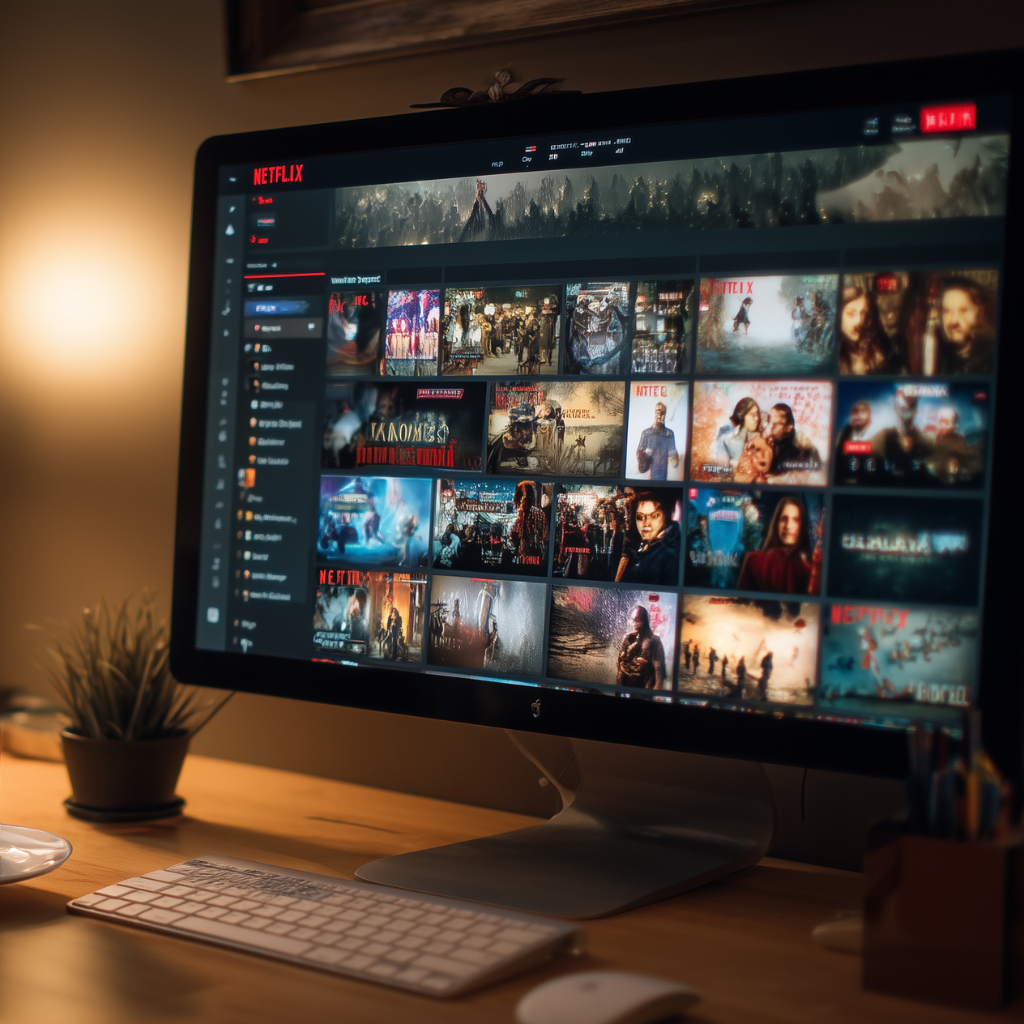
A first for Netflix: artificial intelligence integrated into the audiovisual production process
On July 3, 2025, Netflix reached a symbolic milestone: for the first time, the platform integratedgenerative artificial intelligence technology into the creative process of one of its original series.
The initiative, still in its experimental phase, does not involve the script or dialogue, but rather certain visual elements generated by an AI image generator.
It reignites an already heated debate in the creative world: to what extent can the imagination be automated? If generative AI makes its way into editing rooms, what will remain of the artist’s touch? And above all: how will professions, rights, and culture adapt to this growing algorithmic presence?
When Netflix Gives Creative Artificial Intelligence a Chance
The series involved in this experiment is titled *Let’s Be Evil* (Season 2), a science-fiction animated series with a stylized aesthetic. Netflix has confirmed that it used a generative AI model—likely based on Stable Diffusion oran equivalent—to generate backgrounds, textures, and partial set elements in order to reduce production time without replacing human animators¹.
The creative team oversaw every step, making manual adjustments to the generated results. As a result, AI was not used as a substitute, but rather as a tool for accelerated visual prototyping.
Generative AI in the audiovisual industry: What can it do (and what can’t it do)?
Generative artificial intelligence can be applied in several areas of visual and audio creation:
- Creation of graphic elements (backgrounds, textures, secondary objects)
- Text-to-speech and computer-assisted dubbing
- Background music generated or adapted by AI
- Assistance with storyboarding or narrative prototyping
But its use is still limited: AI alone cannot create a coherent work, either in terms of dramaturgy or artistic direction. It acts as a catalyst or an assistant, never as the primary creator.
What are the implications for audiovisual professionals?
Netflix’s initiative raises several potential implications for creative professions:
- Time savings for illustrators, concept artists, and animators, who can quickly generate multiple versions of a scene
- An evolution in the role of artistic directors, who are now expected to act as curators of user-generated content
- The emergence of new roles: AI integration technicians, visual model trainers, and auditors of generated content
But it also raises concerns: a decline in visual quality, a dilution of artistic identity, and economic pressure on small teams.
Legal and ethical issues: Who is the creator of a generated image?
The use of AI-generated images raises several sensitive issues:
- Copyright: Can an AI-generated image be protected? And if so, by whom: the user, the team, or the platform?
- Use of training data: Some models were trained on works without an explicit license²
- Transparency for the public: Should Netflix disclose when a scene contains computer-generated imagery?
- Social impact: How far can we automate without undermining the human balance in the creative process?
A pilot program or a full-scale rollout?
Netflix isn't alone. Other studios are testing AI to:
- Generate storyboards from scripts
- Create voices for non-human characters (using voice cloning)
- Simulate crowds in animations or previews
But the official introduction of generative AI into a widely broadcast series marks a paradigm shift.
This requires a rethinking of education, regulation, and governance in the field of audiovisual production:
- Should artists be trained to interact with AI?
- How do you audit images generated in a creative pipeline?
- Who will be held accountable for potential abuses (bias, plagiarism, lack of transparency in the models)?
And tomorrow: co-creation or dependence?
This initial use by Netflix could set a precedent. In the future, AI could assist humans in writing, music, and directing—or, if poorly regulated, it could stifle creative diversity in favor of standardized formats.
The issue, therefore, is not merely technological, but also cultural and ethical:
Do we want AI that enriches human creativity, or one that eventually replaces it without a word?
References
1. Netflix Used Generative AI for an Animated Series – The Verge, July 3, 2025
https://www.theverge.com/2025/07/03/netflix-generative-ai-animation-series
2. Stability AI Accused of Using Copyrighted Images – Ars Technica, 2024
https://arstechnica.com/tech-policy/2024/05/stable-diffusion-faces-lawsuit-over-training-data/