


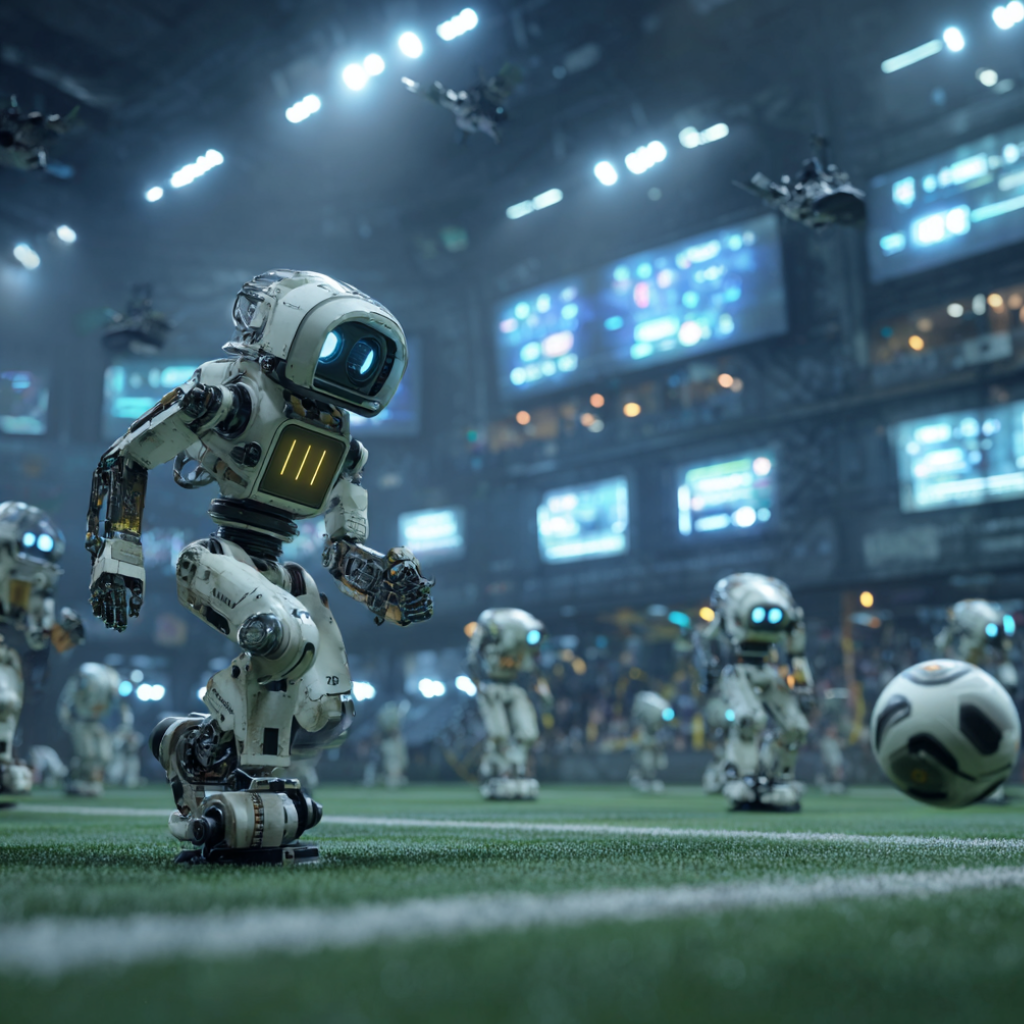
A historic soccer match without human players
This weekend, China hosted the very first official match between two teams composed entirely of robots guided by artificial intelligence. The event, held in Guangdong Province, marks a symbolic milestone in the history of embedded AI and mobile robotics. These autonomous agents did not simply follow preprogrammed scripts: they made decisions in real time, analyzing the space, collaborating with their teammates, and anticipating their opponents’ movements1.
Impressive technical performance in the field
The robots in this match are true marvels of technology:
- Stereoscopic cameras and LIDAR for 3D vision
- Convolutional Neural Networks (CNNs) for detecting the ball, field lines, and opponents
- Deep reinforcement learning algorithms for optimizing passes, dribbles, and shots
- Inertial and gyroscopic sensors for maintaining balance while in motion
According to the organizers, each robot analyzed more than 500 variables per second, incorporating visual data, tactical information, and trajectory predictions2.
A testing ground for embedded AI
This type of event goes far beyond a mere technological feat. It serves as a training ground for autonomous embedded AI systems in complex, dynamic environments where the rules change constantly. The game’s unpredictable situations—bounces, collisions, positioning errors—allow for testing the robustness of the models under real-world conditions.
Direct applications are being considered in:
- Assistive robotics: decision-making in hospitals and smart homes
- Automated logistics: autonomous navigation in warehouses
- Autonomous Vehicles: Learning Multi-Agent Coordination and How to Handle Unforeseen Events Through Sports Simulation3
Toward new robotic capabilities: speed, coordination, and intuition
This robotic match pushes the boundaries of AI in several directions. The models used are based on inter-agent collaboration and hierarchical planning techniques: the collective strategy is encoded in a higher-level layer, while motor execution is handled by a local AI for each robot.
In practice, this develops new "athletic" skills for machines:
- Real-time game analysis (overview + strategic thinking)
- Contactless coordination (pass without an explicit signal)
- Rapid decision-making in a shared and competitive environment
What are the ethical and regulatory implications in a world of autonomous AI agents?
This type of initiative reignites the debate over the decision-making capabilities of physical AI systems. While the risks are low in a recreational setting like sports, what safeguards can we demand regarding their behavior in open environments (self-driving cars, medical robots, surveillance drones)?
Key issues are emerging:
- Liability: If a robot injures another, who is liable? The designer, the manufacturer, or the AI trainer?
- Traceability: How can we explain a decision made based on 500 variables per second?
- Regulation of competitions: Should sports AI be regulated in the same way as human athletes (doping, bias, etc.)?4
A new kind of competition with significant educational and industrial potential
Beyond the spectacle, these robotics tournaments offer significant educational and economic value. They enable:
- To introduce young people to computer science and AI through a fun and engaging format
- To test vision and motor skills algorithms in real-world environments
- To develop robotic interoperability standards applicable in industry5
The Chinese Ministry of Education has also announced plans to incorporate robotics competitions into STEM curricula starting in middle school. Sponsors such as Huawei, Tencent, and DJI are already supporting future editions, offering prizes for the best innovations.
Toward augmented sports—and an open-air laboratory for AI?
This weekend’s robot match is more than just a demonstration: it paves the way for a new frontier in digital sports, where competition also takes place between artificial intelligences. But more than that, these matches serve as full-scale simulations to test how AI interacts with the physical world in semi-predictable, multi-agent, and highly reactive environments.
The question is no longer whether these robots will replace humans in the field, but how their capabilities will support critical applications in industry, healthcare, security, and education in the future.
References
1. China Daily. (2025). First AI Soccer Match Kicks Off in Guangdong.
https://www.chinadaily.com.cn/robot-football
2. Rockwell Automation. (2025). AI-powered Robotics and Real-time Decision Systems in Sports.
https://www.rockwellautomation.com/ai-sports
3. SCMP. (2025). AI and the Future of Competitive Robotics.
https://www.scmp.com/ai-robots-competition
4. European Commission. (2024). Proposal for an AI Liability Directive
https://digital-strategy.ec.europa.eu/
5. Ministry of Education of China. (2025). STEM and AI Curriculum for Schools.
https://www.moe.gov.cn/