


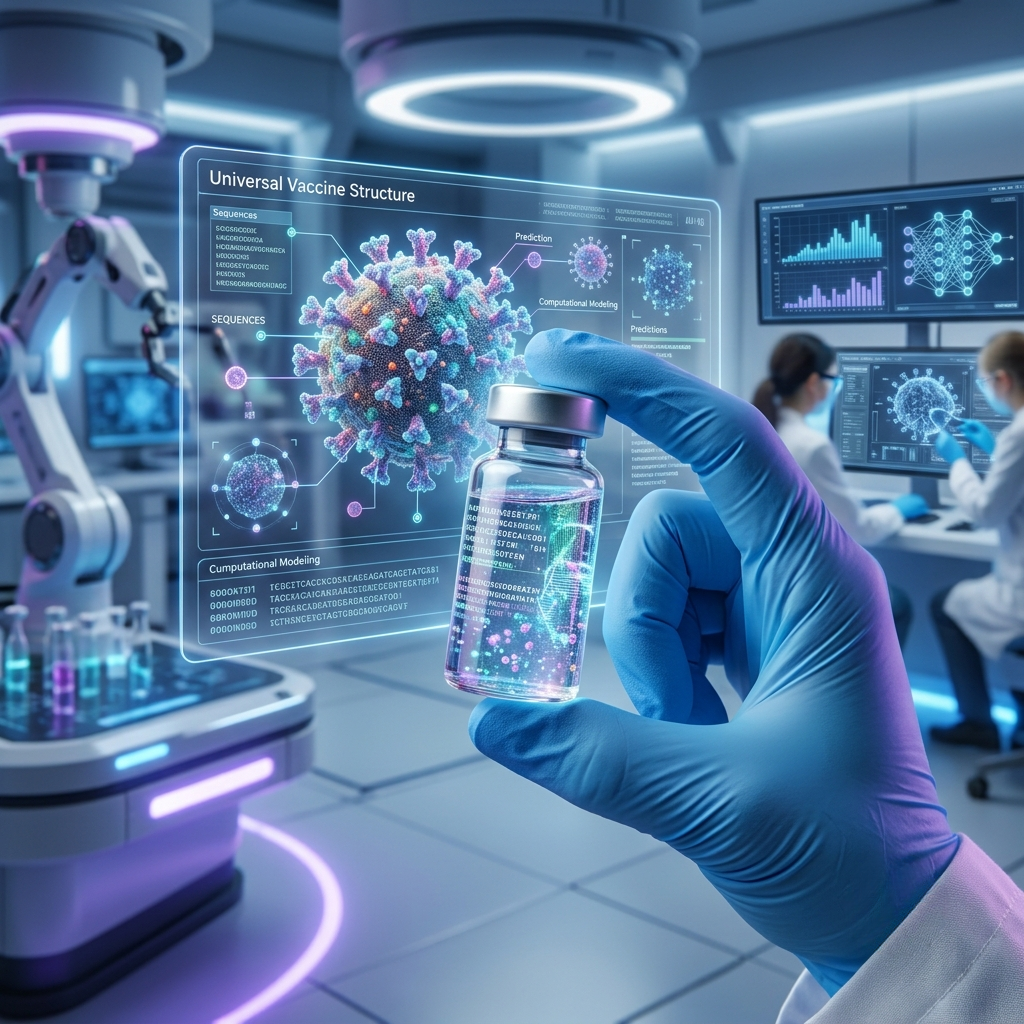
For several years, the fight against COVID-19 has felt like a constant race against the virus’s evolution. As new variants emerged, scientists had to adapt their understanding, update vaccination strategies, and monitor the emergence of new threats. Today, a breakthrough could help change this dynamic. Researchers at the University of Cambridge have presented the initial results of an experimental vaccine designed with the help of artificial intelligence and intended to protect against multiple coronaviruses at once.1
This approach is not aimed solely at SARS-CoV-2, the virus responsible for the COVID-19 pandemic. Its ambition is broader: to prepare the immune system to recognize characteristics common to an entire family of coronaviruses, including certain viruses currently found in animals that could be transmitted to humans in the future. Although this strategy is still in the early stages of development, it already illustrates how artificial intelligence is transforming biomedical research and the prevention of health crises.
When AI Looks for Common Weaknesses in Coronaviruses
The main challenge in developing vaccines against coronaviruses lies in their ability to evolve. Like many respiratory viruses, they accumulate mutations that can alter certain parts of their structure. These changes can sometimes complicate the immune system’s response and reduce the effectiveness of existing protections.
To get around this problem, the researchers used artificial intelligence models capable of analyzing vast amounts of genetic data. The goal was to identify the most stable regions present in several different coronaviruses.2
Through this analysis, AI has made it possible to identify conserved viral fragments within the Sarbecovirus family—a group that includes SARS-CoV-2, the SARS virus that emerged in 2003, and several coronaviruses identified in bats. By targeting these common elements, researchers hope to develop a broader and more durable immune response.
This approach marks a paradigm shift. Instead of developing a vaccine to target a specific virus, the goal is now to address multiple potential threats using a single vaccine platform.
A first clinical trial with encouraging results
To evaluate this strategy, the researchers launched an initial Phase I clinical trial involving 39 healthy adult volunteers.1
The primary objective of this phase was to verify the vaccine’s safety and tolerability in humans. The published results are encouraging. No serious adverse effects were observed, and the vaccine elicited immune responses against several coronaviruses.
The researchers also observed the activation of various immune defense mechanisms, suggesting that the vaccine could offer broader protection than traditional approaches focused on a single viral strain.
It should be noted, however, that a Phase I trial does not yet demonstrate a vaccine’s actual effectiveness against infection. The participants had already been exposed to SARS-CoV-2 or vaccinated against COVID-19, which naturally affects their immune profiles. Subsequent clinical phases will need to confirm the extent and duration of the protection observed.
Artificial intelligence is becoming a strategic tool for healthcare
This breakthrough is part of a broader trend in medical research. Long used for image analysis and diagnostic assistance, artificial intelligence is now playing a direct role in the development of treatments and vaccines.
According to *Nature Reviews Drug Discovery*, AI technologies can now accelerate several critical stages of pharmaceutical research, including the identification of therapeutic targets, genomic analysis, and the design of new molecules.3
The best-known example is probably AlphaFold, the system developed by DeepMind that can predict the three-dimensional structure of proteins with unprecedented accuracy. This breakthrough has profoundly changed the work of biologists and opened up new avenues for understanding the mechanisms of life.4
In the field of vaccines, AI now makes it possible to explore millions of potential combinations in just a few days—a task that would previously have taken several months. This acceleration could become a major asset during future public health emergencies.
Preventing Future Pandemics Rather Than Suffering Through Them
The COVID-19 pandemic has highlighted the vulnerability of health care systems in the face of the rapid emergence of new infectious agents. According to the World Health Organization, more than 7 million deaths have been officially attributed to COVID-19 worldwide, although the actual number could be higher.5
In light of this, many researchers are now advocating for a more preventive approach. The idea is no longer simply to rapidly develop a vaccine when a crisis arises, but to identify virus families that pose a high risk of transmission to humans.
The pEVAC-PS vaccine is based precisely on this approach. By identifying elements common to several coronaviruses, artificial intelligence makes it possible to develop vaccine responses that can be deployed more quickly in the face of new threats.
Ultimately, this methodology could also be applied to other pathogens, such as influenza viruses or certain hemorrhagic fevers like Ebola.
A promising development that still needs to be confirmed
Despite the interest these results have generated, scientists remain cautious. Developing a vaccine is a lengthy process that requires several phases of evaluation before it can be approved for marketing.
Future studies will need, in particular, to measure the vaccine’s actual effectiveness against different coronaviruses, assess the duration of the protection it provides, and confirm the results in much larger populations.
Nevertheless, this initial demonstration already illustrates the potential of artificial intelligence in the development of new prevention strategies. Beyond COVID-19 alone, it paves the way for a form of medicine that is more focused on anticipation, risk modeling, and preparedness for future health crises.
A New Step Toward Convergence Between AI and Biology
Artificial intelligence is often associated with chatbots, automation, or data analysis. Yet some of its most promising applications are currently being developed in biomedical research laboratories.
With this first experimental universal vaccine designed using AI, researchers are exploring a new approach to preventing infectious diseases. We are still a long way from a vaccine capable of neutralizing all known coronaviruses, but this breakthrough demonstrates that the combination of data, computational biology, and artificial intelligence can open up new avenues for global health.
Will the next medical revolution stem from this ability to anticipate pandemics even before they emerge? The coming years will show just how much this partnership between humans and AI can transform our approach to prevention.




Executive Training
AI & Data Science
s for Managers
Integrate AI into your business strategy. A 360° approach—Technology, Business, and Ethics—designed for decision-makers. Prerequisites: 5 years of managerial experience.
Learn more
The use of artificial intelligence in vaccine design illustrates a broader trend: AI is becoming a key tool for accelerating scientific and medical research. On a related note, check out our article“MedGPT: The Free French Medical AI That Rivals ChatGPT, ” which explores how specialized models are already transforming healthcare professionals’ practices and access to medical expertise.
References
1. University of Cambridge. (2025). Researchers report results from the first human trial of pEVAC-PS, an AI-designed pan-coronavirus vaccine.
https://www.cam.ac.uk/research/news/first-human-trial-results-for-ai-designed-pan-coronavirus-vaccine
2. DIOSynVax. (2025). Technology Platform for Broadly Protective Vaccines Against Emerging Viruses.
https://diosynvax.com/technology/
3. Paul, D., Sanap, G., Shenoy, S., Kalyane, D., Kalia, K., & Tekade, R.K. (2021). Artificial Intelligence in Drug Discovery and Development. Drug Discovery Today.
https://www.sciencedirect.com/science/article/pii/S1359644621002087
4. Jumper, J. et al. (2021). Highly Accurate Protein Structure Prediction with AlphaFold. Nature.
https://www.nature.com/articles/s41586-021-03819-2
5. World Health Organization. (2025). WHO COVID-19 Dashboard.
https://data.who.int/dashboards/covid19