


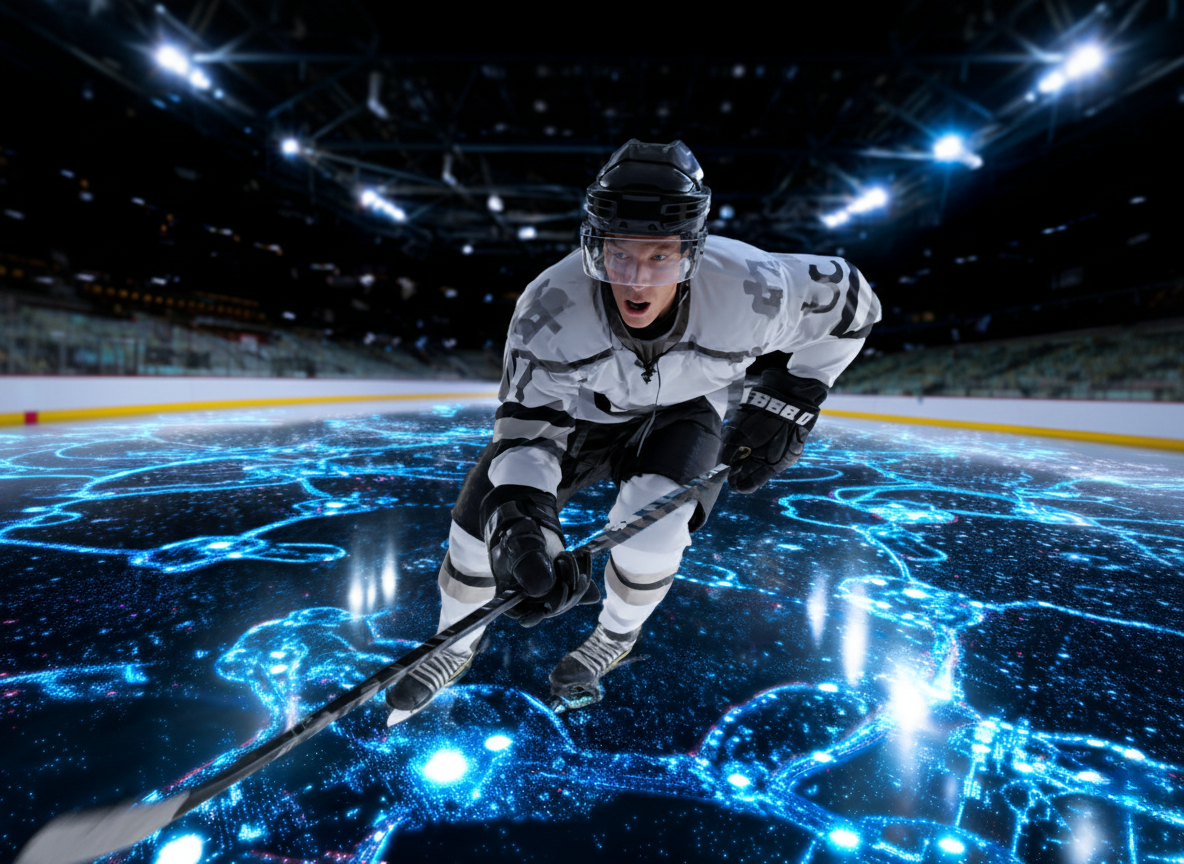
Ice hockey is one of the fastest and most physical team sports in the world. Collisions, whether intentional or accidental, are an integral part of the game and expose players to a high risk of head injuries. According to North American leagues, nearly 30% of reported injuries in junior leagues are related to head impacts, a significant portion of which do not cause immediate symptoms. It is precisely in this medical blind spot that artificial intelligence is beginning to play a decisive role. By combining onboard sensors, biomechanical analysis, and machine learning, AI is gradually transforming how impacts are detected, interpreted, and managed, paving the way for proactive rather than reactive prevention1.
Smart helmets capable of measuring the invisible
The cornerstones of this revolution lie in the integration of inertial sensors directly into helmets. Research conducted by MIT has shown that miniaturized accelerometers can accurately measure the linear and rotational acceleration of the head during an impact, even when the impact does not result in a fall or immediate injury1. These devices record hundreds of micro-impacts over the course of a season, revealing cumulative exposure that was previously invisible. In youth leagues in Canada, tests conducted on instrumented helmets showed that some players experienced more than 200 impacts exceeding a critical biomechanical threshold over a full season, without ever being officially diagnosed2.
Machine learning to detect the risk of concussion
Measuring an impact isn’t enough; we also need to assess how dangerous it is. This is where AI comes in. Studies published in *Scientific American* and *Nature Biomedical Engineering* show that machine learning models can analyze thousands of impact sequences to identify signatures associated with an increased risk of concussion3. These algorithms take into account not only the intensity of the impact, but also its angle, frequency, the player’s position, and their individual history. The results are significant: some models achieve a predictive accuracy of over 85% in identifying a high-risk event before clinical symptoms appear, marking a radical shift in the medical management of players.
Ice hockey: a real-world testing ground
Hockey is currently one of the sports leading the way in testing these technologies. Studies published in the *Journal of Biomechanics* and *Pediatrics* have documented the use of helmets equipped with accelerometers in junior and college leagues5. Hockey Canada has confirmed, through tests reported by CBC News, that these devices can alert medical staff during high-impact sequences, even in the absence of a dramatic fall2. In the NHL, pilot projects reported by The Athletic show that franchises are increasingly interested in predictive systems to adjust line rotations, limit cumulative exposure, and better manage returns to play7.
Additional sensors to improve impact detection
In addition to the helmet, other devices provide further insights. The smart mouthguards, introduced by SportsTechie, also feature sensors capable of measuring impacts directly at the jaw—an area strongly correlated with head acceleration8. At the same time, computer vision systems developed in IEEE research analyze collisions using video footage, assessing the relative speed of players and the dynamics of contact9. AI then cross-references embedded data with visual data to produce a more reliable estimate of the severity of an impact. This multimodal approach significantly reduces false positives and improves the medical contextualization of impacts.
Figures that confirm the value of preventive AI
Early data confirms the potential of these technologies. According to a summary of several recent studies, the combined use of sensors and AI reduces the time it takes to detect concussions by 20% to 30% compared to traditional protocols4. In certain pilot leagues, the number of players returning to play too soon decreased by 25% after the introduction of AI-based automated alerts2. These results do not mean the risk has disappeared, but they reflect a tangible improvement in medical decision-making.
Ethical Issues and Human Responsibility
The introduction of AI in the detection of head injuries nevertheless raises sensitive issues. The data collected is highly personal and concerns the neurological integrity of the players. Several experts, as reported by the IIHF, have warned of the need for a strict framework governing the use, storage, and interpretation of this data10.
- AI should never replace a medical diagnosis,
- Decisions regarding removal from play or return to play must remain human,
- the data may not be used for contractual or disciplinary purposes,
- Players must retain control over their biometric data.
Technology serves as a warning, not a verdict.
Toward a safer game of hockey without changing the nature of the sport
AI isn’t meant to make hockey harmless—that would be unrealistic. However, it does help reduce medical blind spots. By detecting silent impacts, modeling cumulative risks, and supporting coaching staff decisions, it ushers in a new era of protection based on prevention and knowledge rather than on emergency response and intuition. Hockey remains a sport of commitment and speed, but it is gradually becoming a sport where science watches over players’ long-term health from beneath their helmets.
Learn more
To learn about another practical application of artificial intelligence in game analysis, check out our article on PassAI and the tactical analysis of passes in soccer: AI Enters the Flow of the Ball: PassAI Reveals the Truth Behind Passes
References
1. MIT News. (2023). Smart helmets may reduce head injuries in contact sports.
https://news.mit.edu
2. CBC News. (2023). Hockey Canada tests impact-measuring helmets.
https://www.cbc.ca
3. Scientific American. (2023). AI can help detect concussions by analyzing sensor data.
https://www.scientificamerican.com
4. Nature Biomedical Engineering. (2024). Predicting concussion risk with machine learning in contact sports.
https://www.nature.com/natbiomedeng
5. Journal of Biomechanics. (2022). Sensor-based head impact monitoring in ice hockey.
https://www.jbiomech.com
6. Pediatrics. (2022). Helmets with embedded accelerometers to detect concussive events in youth hockey.
https://publications.aap.org /a>
7. The Athletic. (2022). Machine learning for concussion detection in professional hockey.
https://theathletic.com
8. SportsTechie. (2024). Smart mouthguards provide real-time impact data.
https://sportstechie.net
9. IEEE. (2023). Computer vision for detecting collision severity in hockey games.
https://ieeexplore.ieee.org
10. IIHF. (2023). Report on concussion detection tools.
https://www.iihf.com