



By Dr. Tawhid CHTIOUI, Founding President of aivancity, the leading school for AI and data
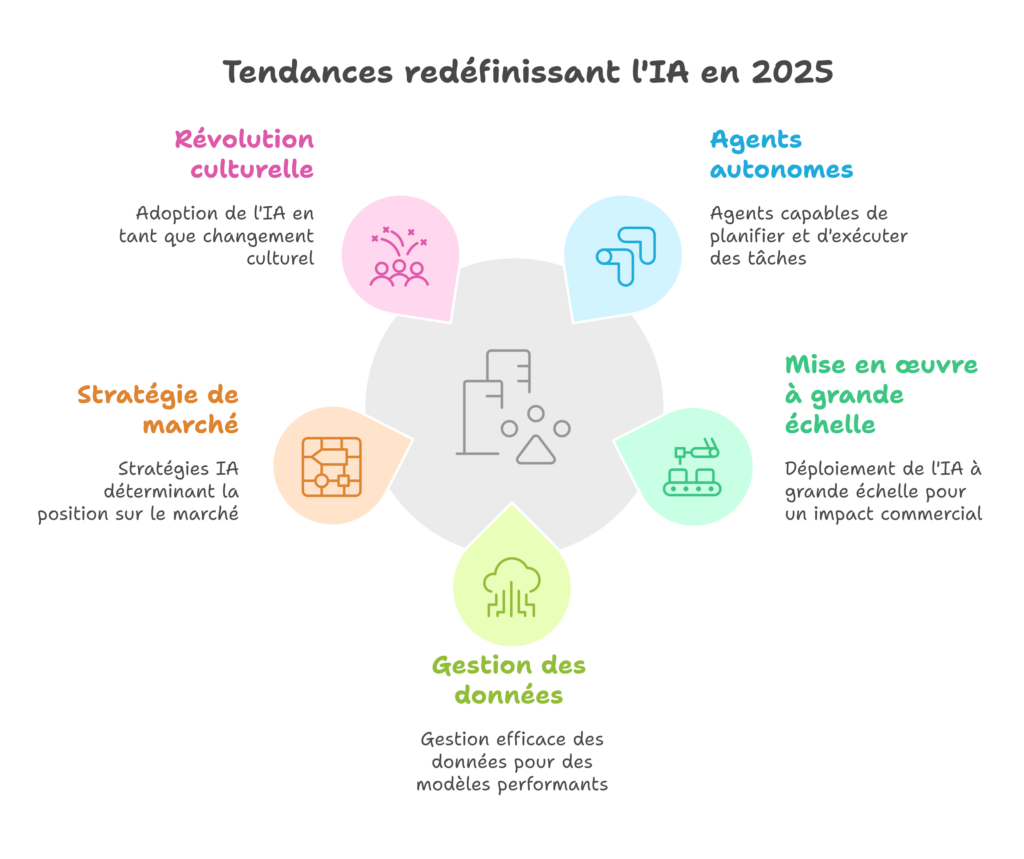
The year 2025 promises to be a major turning point for artificial intelligence. While experimentation and proof of concept still dominated the technological landscape until recently, AI is now a fundamental driver of economic, industrial, and societal transformation. The Paris AI Summit (February 2025) highlighted several structural shifts that will shape the coming years. This article presents the five key trends that will shape the future of AI and data management.
The Rise of Autonomous AI Agents: Toward Advanced Automation of Decision-Making Processes
AI systems are evolving toward more autonomous and proactive models, moving beyond the traditional scope of chatbots and content-generation tools. Autonomous AI agents are now capable of performing complex tasks, planning actions, and making strategic decisions without direct human intervention.
According to a recent Gartner study (2024), by 2028, these agents are expected to be responsible for approximately 15% of companies’ daily strategic decisions, thereby contributing to a 30% increase in operational efficiency for organizations that adopt them (Gartner, Top Strategic Technology Trends for 2025, 2024).
Example of application: In the financial sector, supervised AI agents are already being used for dynamic investment portfolio management, leveraging deep learning models to adjust strategies in response to market fluctuations (McKinsey, AI in Financial Services, 2024).
Impact: By 2025, companies that adopt these agents now will have a decisive advantage in terms of responsiveness and efficiency.
The Industrialization of AI: From Experimentation to Large-Scale Implementation
The era of AI experimentation is coming to an end. Today, companies are no longer asking whether they should adopt AI, but how to deploy it effectively on a large scale. However, this transition presents major challenges.
According to a study conducted by the Boston Consulting Group (BCG, 2024), approximately 75% of companies will fail to bring AI solutions in-house due to a lack of skills and appropriate infrastructure (BCG AI Scaling Report, 2024). The recommended approach is to adopt hybrid models that combine in-house solutions with partnerships with specialized vendors.
Comparison: This challenge of implementation can be likened to trying to build a rocket in a garage without the help of aerospace experts. Without a methodical approach and the right resources, deploying industrial AI becomes an insurmountable challenge.
Impact: By 2025, leaders who have not structured their AI strategy risk being left behind.

Data optimization: a key factor in the performance of AI systems
The effectiveness of an AI model depends largely on the quality of the data it is trained on. By 2025, data management will become a strategic priority: if mishandled, data can compromise the reliability of models; if managed effectively, it offers a decisive competitive advantage.
According to a Deloitte analysis (2024), 60% of companies report that their AI initiatives are hampered by gaps in data management (Deloitte AI Data Readiness Report, 2024). To address this issue, several approaches are emerging:
- Digital twins: These virtual replicas make it possible to test strategies and anticipate scenarios without financial risk (Capgemini, Digital Twins in Industry, 2024).
- Data mesh and distributed architectures: Evolving infrastructure is driving the decentralization of data storage and processing, leading to greater organizational agility (MIT Sloan Management Review, 2024).
- Strengthening data governance: With the implementation of the AI Act in Europe, companies must now establish robust processes to ensure the integrity and security of their data (European Commission, AI Regulation Framework, 2024).
Impact: By 2025, visionary leaders will be those who have built a truly unified, secure, and scalable data ecosystem.
AI as an essential strategic driver of business competitiveness
AI is no longer just a technological tool; it has become a central component of growth strategies. Adopting high-performance AI enables companies to optimize processes, improve decision-making, and enhance service personalization.
According to a PwC study (2024), the advanced integration of AI could boost business productivity by 26% by 2030 (PwC Global AI Impact Study, 2024). The sectors most affected in 2025 are:
- Finance & Insurance: Automated Risk Management and Portfolio Optimization (World Economic Forum AI in Finance, 2024).
- Retail: Hyper-personalized recommendations and supply chain automation (McKinsey AI Retail Study, 2024).
- Healthcare: Deployment of diagnostic support tools and optimization of care pathways (Harvard Medical AI Report, 2024).
- Industry: Predictive maintenance and improving production line efficiency (Siemens Industrial AI Report, 2024).
Impact: By 2025, any company without a clear AI strategy will gradually fall behind.
aivancity supports you in training your teams and ensuring the success of your AI strategy.
Explore our continuing education programs for businesses and professionals
AI as a Cultural and Organizational Transformation
The widespread adoption of AI depends not only on robust technological infrastructure, but also on a cultural shift within organizations.
According to a survey conducted by IBM (2024), 65% of employees report that they do not have a solid grasp of the fundamentals of AI, which is a major barrier to its adoption (IBM AI Skills Report, 2024). The challenges identified are as follows:
- Lack of employee training: A shortage of AI skills is slowing down the rollout of technological solutions.
- Organizational barriers: Internal resistance to automation and new ways of working.
- Change Management: The need to support teams to ensure a smooth and effective transition.
Recommendation: Companies that invest in ongoing AI training see a 40% increase in the successful adoption of AI technologies (Stanford AI Transformation Report, 2024).
Impact: By 2025, companies that have trained and supported their teams will be the real winners of the AI transformation.
Conclusion: 2025, a pivotal year for AI
The year 2025 will mark a turning point between companies that have successfully developed a systematic approach to AI and those that will be left behind.
- The rise of autonomous AI agents is redefining decision-making.
- The transition from pilot testing to full-scale production requires sound strategies.
- Data management is becoming a key driver of performance.
- The strategic integration of AI determines a company’s competitiveness.
- Employee training remains a key factor in the success of this transformation.
Faced with these challenges, companies must adapt quickly to take advantage of the opportunities offered by AI. The year 2025 will undoubtedly mark a turning point in the history of artificial intelligence.