


Google continues to gain significant momentum in the race for artificial intelligence. At its Google I/O 2026 conference, the Mountain View-based company unveiled Gemini 3.5 Flash, a new model touted as faster, more autonomous, and more efficient than previous generations. According to Sundar Pichai, this model now outperforms Gemini 3.1 Pro on numerous benchmarks while significantly reducing computational costs.
But beyond its technical capabilities, it is the evolution of AI’s role that is most impressive. Gemini 3.5 Flash is no longer limited to answering questions or generating text. Google presents it as an AI capable of reasoning, using tools, and performing complex tasks with increasing autonomy. This marks an important step in the rise of agent-based AI.

Gemini 3.5 Flash Becomes the New Heart of the Google Ecosystem
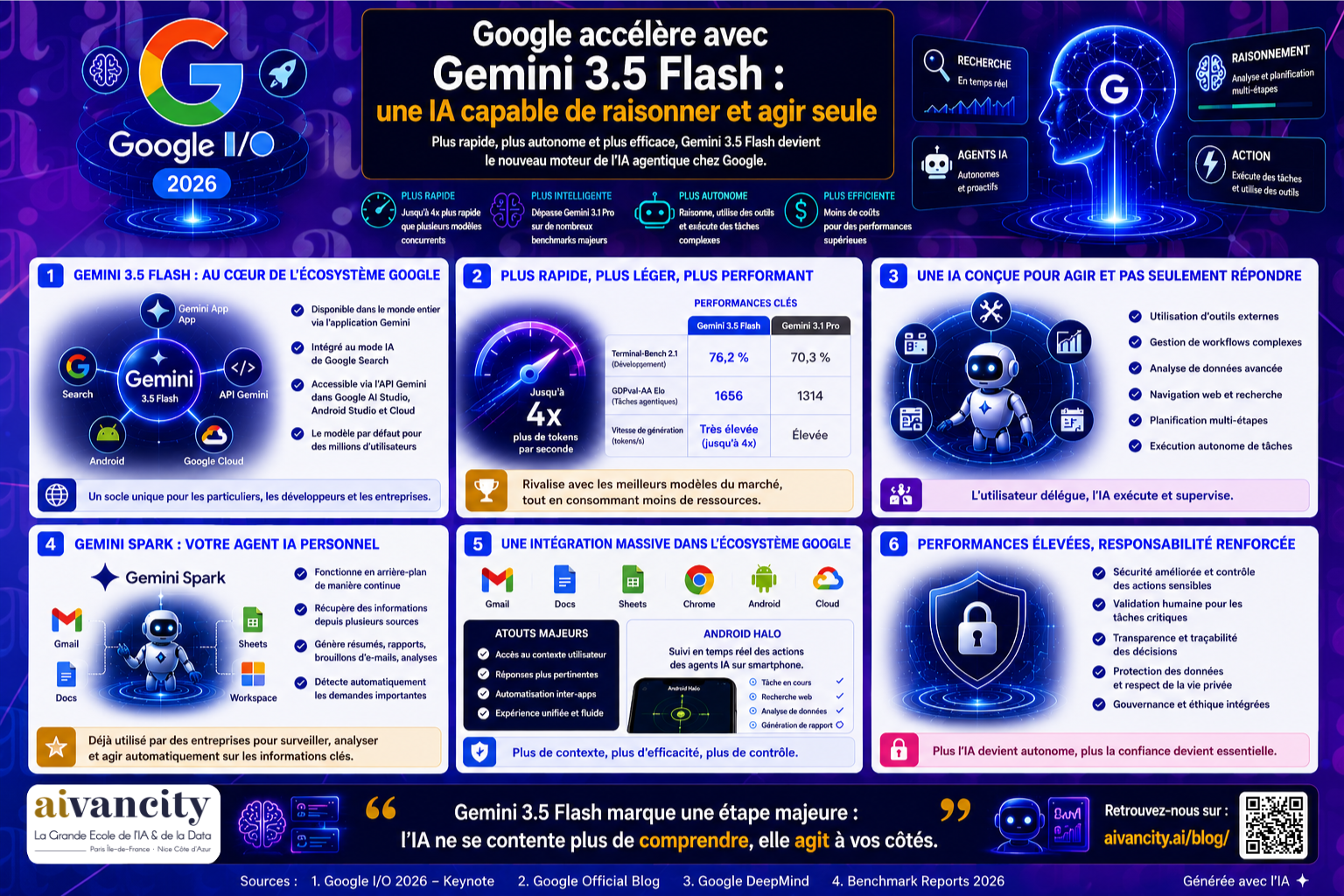
Google has confirmed that Gemini 3.5 Flash is now available worldwide through the Gemini app as well as in the AI mode built into Google Search. The model immediately becomes the default system for a significant portion of consumer use cases.
Developers can also use it via the Gemini API in Google AI Studio, Android Studio, and the company’s cloud tools. This rapid integration shows that Google wants to establish Gemini 3.5 Flash as the central pillar of its AI ecosystem, for both consumers and businesses.
The goal is clear: to make artificial intelligence ubiquitous across Google products while maintaining performance levels suitable for very large-scale use.
A model that's faster, lighter, and yet more powerful
Gemini 3.5 Flash was designed around a strategic balance between speed, cost, and power. Google claims that the model can generate up to four times as many tokens per second as several competitors while consuming fewer resources.
This optimization is becoming essential as AI-related costs skyrocket. The most advanced models require massive GPU and energy infrastructure. Google is therefore seeking to offer AI that is powerful enough for everyday use but can be deployed on a massive scale without incurring excessive costs.
Most impressive, however, are the model’s performance metrics. Despite its “Flash” designation—which is typically associated with lighter models—the Gemini 3.5 Flash outperforms the Gemini 3.1 Pro in several key benchmarks.

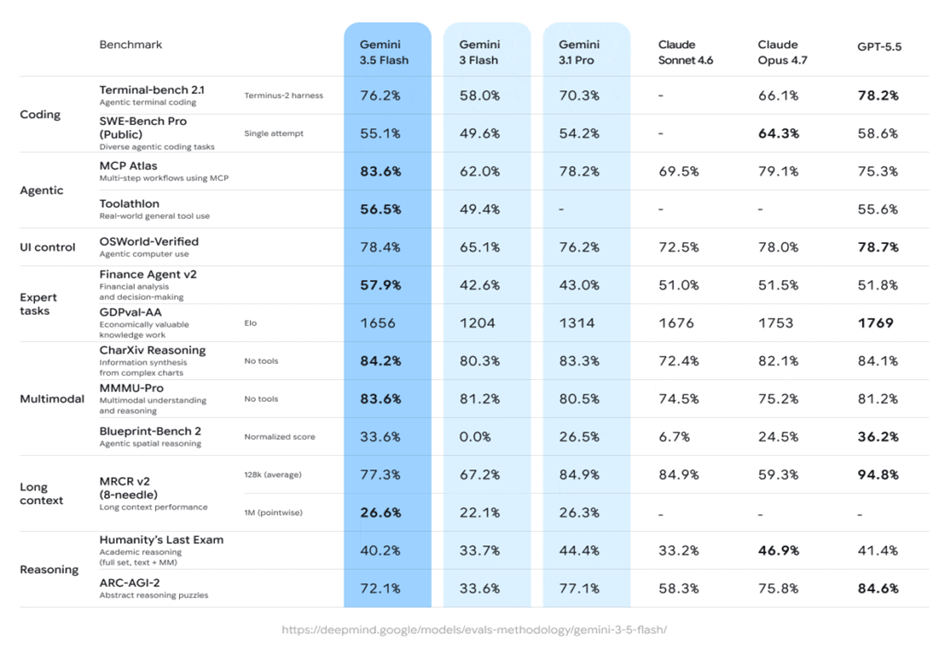
In software development, it achieved a score of 76.2% on Terminal-Bench 2.1, compared to 70.3% for Gemini 3.1Pro1. On agent-based tasks, the model scored 1,656 points on GDPval-AA Elo, well above the 1,314 points achieved by its predecessor.
Google even claims that Gemini 3.5 Flash rivals some of the best models on the market while generating its responses much more quickly.
AI designed to act, not just respond
One of the most important aspects of Gemini 3.5 Flash is its ability to function as an AI agent. Unlike traditional conversational assistants, the model can now perform longer and more structured tasks.
Google specifically highlights:
- the use of external tools,
- managing complex workflows,
- data analysis,
- web browsing,
- and multi-step planning.
This development marks a profound shift in the way AI systems are used. Users no longer simply ask for an answer; they are gradually delegating tasks to a system capable of acting semi-autonomously.
Gemini 3.5 Flash thus illustrates the transition of chatbots into operational assistants capable of collaborating with users in complex environments.




MasterAgent-Based AI
, with Claude Cowork
Move from conversational AI to operational AI. Automate your complex tasks in just two days—no technical skills required.
Gemini Spark Takes Agent-Based AI Even Further
Google also introduced Gemini Spark, a new personal AI agent built directly on Gemini 3.5 Flash. Unlike AI that is used on an ad-hoc basis, Spark runs continuously to perform background tasks for the user.
The system is integrated with Google Workspace and can interact with Gmail, Google Docs, Sheets, and other collaborative tools. Spark can retrieve information from multiple sources to automatically generate:
- abstracts,
- reports,
- draft emails,
- or contextual analyses.
Google explains that some companies are already using Spark to automatically monitor their inboxes and detect important customer requests without the need for continuous human intervention.
This approach demonstrates just how strategically important agent-based AI is becoming for Google. Models are no longer designed solely for conversation; they are evolving into systems capable of continuous operation.
Extensive integration into the Google ecosystem
One of the major advantages of Gemini 3.5 Flash is its native integration with the Google ecosystem. The AI can work directly with:
- Gmail,
- Google Docs,
- Google Sheets,
- Android,
- Chrome,
- and Google Cloud.
This integration allows the AI to access more context in order to generate more relevant and personalized responses.
Google also introduced Android Halo, a new feature that allows users to track in real time the actions performed by AI agents on smartphones. This makes it easier for users to monitor the tasks automatically carried out by Gemini Spark.
This approach is gradually transforming Android into a platform for continuous AI monitoring.
High performance, but also safety concerns
In light of the growing autonomy of AI models, Google is placing strong emphasis on the safety mechanisms built into Gemini 3.5 Flash. The company says it has strengthened its safeguards against:
- abuse,
- cyberattacks,
- harmful content,
- and certain malicious actions.
In particular, Google uses interpretive analysis systems capable of examining the model’s internal reasoning mechanisms before a response is sent to the user.
This approach reflects a growing concern among major players in the field of AI. The more capable these models become of acting on their own, the more critical issues of governance, oversight, and control become.
AI Is Becoming Increasingly Pervasive
With Gemini 3.5 Flash, Google is clearly demonstrating that artificial intelligence will gradually become an integral part of its digital products. AI is no longer just an additional tool; it is becoming the primary interface between users and digital services.
This development could bring about lasting change in:
- web search,
- office software,
- business workflows,
- software development,
- and mobile applications.
Google's goal now appears to be to create systems capable not only of understanding human intentions, but also of directly performing complex tasks across multiple digital environments.
A New Phase of the AI Competition
Gemini 3.5 Flash also highlights the intensifying competition between Google, OpenAI, Anthropic, and Microsoft over agent-based models. The battle is no longer solely about the quality of conversational responses, but about the ability of AI systems to act autonomously in real-world contexts.
Google is seeking to combine the following:
- speed,
- low cost,
- reasoning,
- software integration,
- and agency-related abilities.
This strategy could enable the company to accelerate the widespread deployment of AI across its services while maintaining a significant infrastructure advantage thanks to Google Cloud and its TPUs.
The era of simple chatbots seems to be gradually giving way to that of AI agents capable of actively collaborating with users.
How does Gemini 3.5 Flash work?
Gemini 3.5 Flash is based on a multimodal, agent-based artificial intelligence architecture designed to combine execution speed, advanced reasoning, and the automation of complex tasks. Unlike traditional conversational models, which are primarily limited to generating text or answering questions, Gemini 3.5 Flash is capable of interpreting objectives, using external tools, and performing actions semi-autonomously.
Google describes it as a model optimized for large-scale use, offering very high processing speed while retaining advanced reasoning capabilities. The system first analyzes the user’s intent, identifies the context and necessary resources, and then breaks down certain tasks into actionable sub-actions.
Gemini 3.5 Flash can then interact with various digital tools, retrieve information, generate summaries, or execute complex workflows. This capability is based on a combination of natural language processing, multi-step reasoning, agent-based orchestration, and integration with the Google ecosystem. The goal is to transform AI into a system capable not only of understanding a request, but also of taking direct action on the user’s behalf.
- Advanced reasoning: the ability to analyze complex, multi-step tasks
- Agent-based execution: automation of certain actions and workflows
- Fast generation: generating responses with high processing speed
- Multimodal integration: management of text, data, and certain visual content
- Using External Tools: Interacting with Services, Applications, and Digital Environments
- Google Compatibility: Integration with Workspace, Android, Chrome, and Google Cloud
- Cost Optimization: Architecture Designed for High-Volume Usage at Low Computational Cost
- Dependence on data and context provided by the user
- Risk of errors or delusions in certain complex lines of reasoning
- Significant cloud infrastructure needs for high-usage scenarios
- Governance Issues Related to the Autonomy of AI Agents
- The Need for Human Oversight of Sensitive Actions
- Current limitations on certain highly specialized or critical tasks
Learn more
The arrival of Gemini 3.5 Flash marks a new milestone in the evolution of models capable not only of reasoning but also of performing actions autonomously. On a related topic, check out our article “ChatGPT Agent: OpenAI Introduces an AI Capable of Planning, Executing… and Learning”, which analyzes how agent-based AIs are gradually transforming digital uses, from information retrieval to the automation of complex tasks.
References
1. Google Research. (2025). Advances in On-Device Speech Recognition.
https://ai.google
2. IDC. (2024). Edge Computing Forecast.
https://www.idc.com