


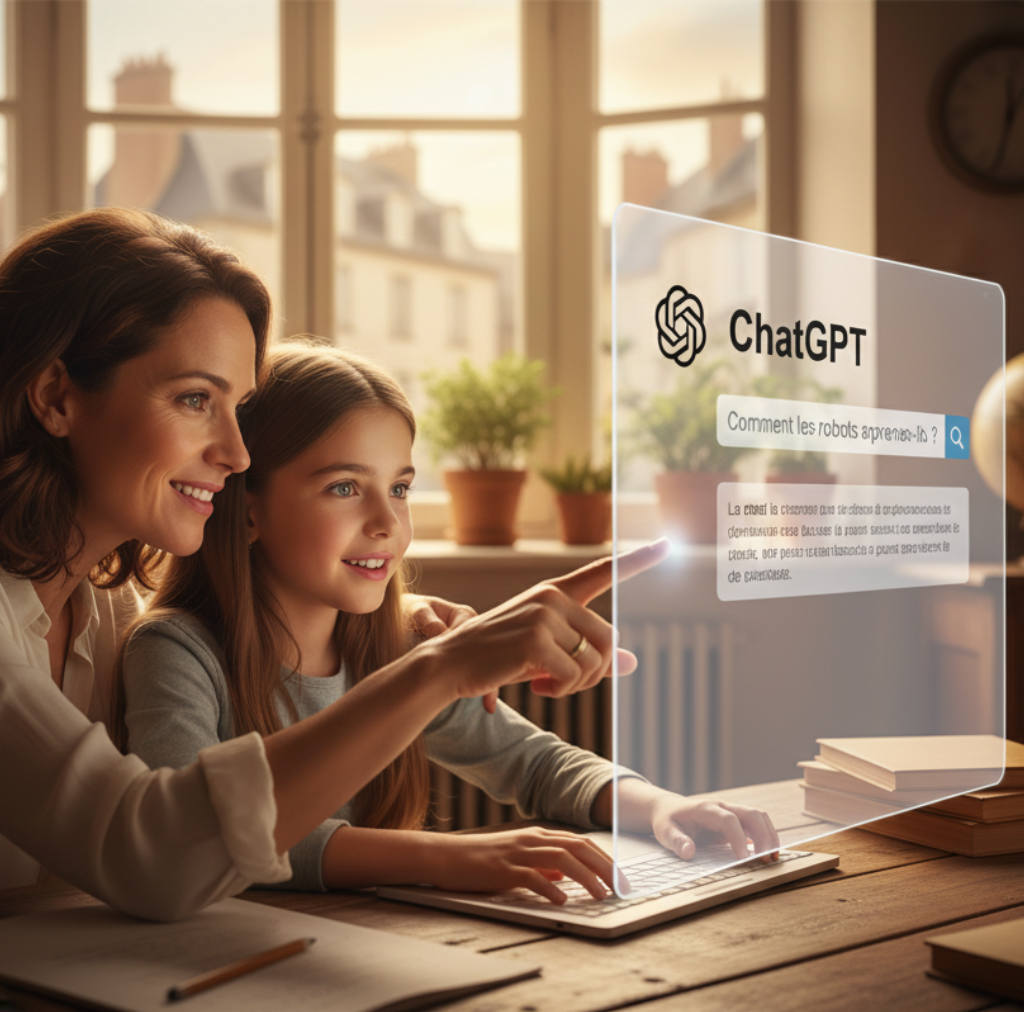
Artificial intelligence is no longer the exclusive domain of engineers or tech professionals. It is now making its way into homes, classrooms, and even family conversations. Three years after the launch of ChatGPT, OpenAI’s tool has become a global go-to for asking questions, writing, explaining, or learning. A study conducted by Kantar for BFM Business shows that its adoption extends far beyond the adult world: one in two children already uses ChatGPT or another chatbot, often with their parents’ approval.
This figure illustrates a quiet but profound transformation. Conversational AI is no longer merely a tool for assistance or entertainment; it is becoming a new force in the cognitive development of young children. Parents themselves, who were once cautious about emerging technologies, now tend to view AI as an ally in education and a catalyst for curiosity. Yet, amid a mix of enthusiasm and concern, this rapid proliferation raises crucial questions: How do children perceive these tools? What role should they play in learning? And above all, what ethical boundaries must be established in light of their growing influence?
Early adoption and already well-established practices
The survey, conducted among 2,019 people aged 18 and older, highlights the rapid adoption of AI tools by younger generations:
- 52% of children aged 11 to 15 regularly use a chatbot, 24% of whom do so entirely on their own.
- Among 16- to 18-year-olds, the proportion rises to 63%, with 52% of them using it without parental supervision.
- These figures are likely underestimated, since parents answered on behalf of their children.
Conversational AI is thus gradually establishing itself as a new tool for cognitive socialization in the home, falling somewhere between homework help and technological curiosity.
Parents: The Primary Advocates for Educational AI
The study reveals a surprising fact: parents don’t just tolerate the use of AI—they actively encourage it.
- 51% of 11- to 15-year-olds and 63% of 16- to 18-year-olds say their parents encourage them to use tools like ChatGPT.
- Parents' motivations vary depending on their children's ages:
- 21% encourage its use for homework and studying,
- 20% for recreational or creative use,
- 26% of parents of high school students value AI as a tool for academic learning,
- 15% see it as a form of intelligent entertainment.
- One in two parents would be willing to let a child under 11 use ChatGPT, and 16% would even allow them to use it completely on their own.
These figures reflect a shift in perception: AI is no longer seen as a threat to education, but rather as a tool for educational support and intellectual enrichment.
Between educational curiosity and the risk of abuse
This craze is not without its concerns. In the United States, several controversies have erupted after teenagers had inappropriate interactions with chatbots. Tech companies have since strengthened their moderation and security systems.
For French parents, ChatGPT is often seen as:
- a tool for rephrasing and understanding lessons,
- an effective proofreading tool,
- but also the risk of confusing expertise with automation.
Experts emphasize that healthy educational use requires regular adult supervision to prevent intellectual dependence, in which the child would let AI “think for them.”
Rules for minors remain unclear
Most conversational AI platforms, including ChatGPT, set an age limit of 13, allowing use only under parental supervision. In practice, however, these restrictions are often circumvented.
Experts in digital education point out that:
- The guided use of AI can foster intellectual independence and critical thinking,
- Without support, there is a risk of cognitive dependence and a loss of initiative,
- Parents need to be trained in digital mediation so they can learn how to guide their children’s online activities.
ChatGPT remains the top choice among young people and adults
According to a Kantar study, 59% of French people now use at least one chatbot.
The main tools mentioned are:
- ChatGPT (57% of regular users),
- Gemini (21%),
- Copilot (10%),
- Le Chat de Mistral, a French blend (7%).
The so-called " agent-based" function—that is, an AI’s ability to perform actions autonomously on behalf of the user—remains relatively unknown. Thirty-seven percent of French people have never heard of it, and 44% have never used it.
The Ethical Challenges of Education in the Age of AI
The growing use of ChatGPT by children raises fundamental ethical questions. It raises concerns regarding data protection, platform accountability, and parents’ ability to guide their children’s use of the tool. Experts agree that the key lies in striking a balance between educational innovation and ethical vigilance. AI can become a powerful learning tool if used within a clear, transparent framework tailored to children’s ages. UNESCO and the European Commission are calling for stronger public policies on digital safety for minors and for the promotion of critical education regarding artificial intelligence, so that young people learn to understand, question, and master these technologies rather than simply endure them1.
Toward AI-Enhanced Education
The Kantar study for BFM Business confirms that ChatGPT has become a central part of young people’s daily lives, symbolizing a generation that learns, explores, and stays informed with the help of artificial intelligence. Far from being just a passing fad, this adoption reflects a lasting shift in educational and family practices. School and home are now becoming complementary spaces for digital experimentation, where curiosity and creativity come together with technology.
But for this transformation to remain beneficial, it is essential to help children understand how these tools work, as well as their biases and limitations. AI can become a powerful ally in learning, provided it is integrated into an informed and critical educational approach. The challenge for the coming years will be to build a shared culture of artificial intelligence among parents, teachers, and students—one capable of transforming technology into a vehicle for knowledge rather than a substitute for critical thinking.
Learn more
To further explore the profound transformation of teaching in the age of Artificial Intelligence, see: What if AI forced us to stop paying teachers by the hour?
References
1. UNESCO. (2025). Guidelines on AI in Education and Child Protection.
https://unesdoc.unesco.org/ark:/48223/pf0000387219