


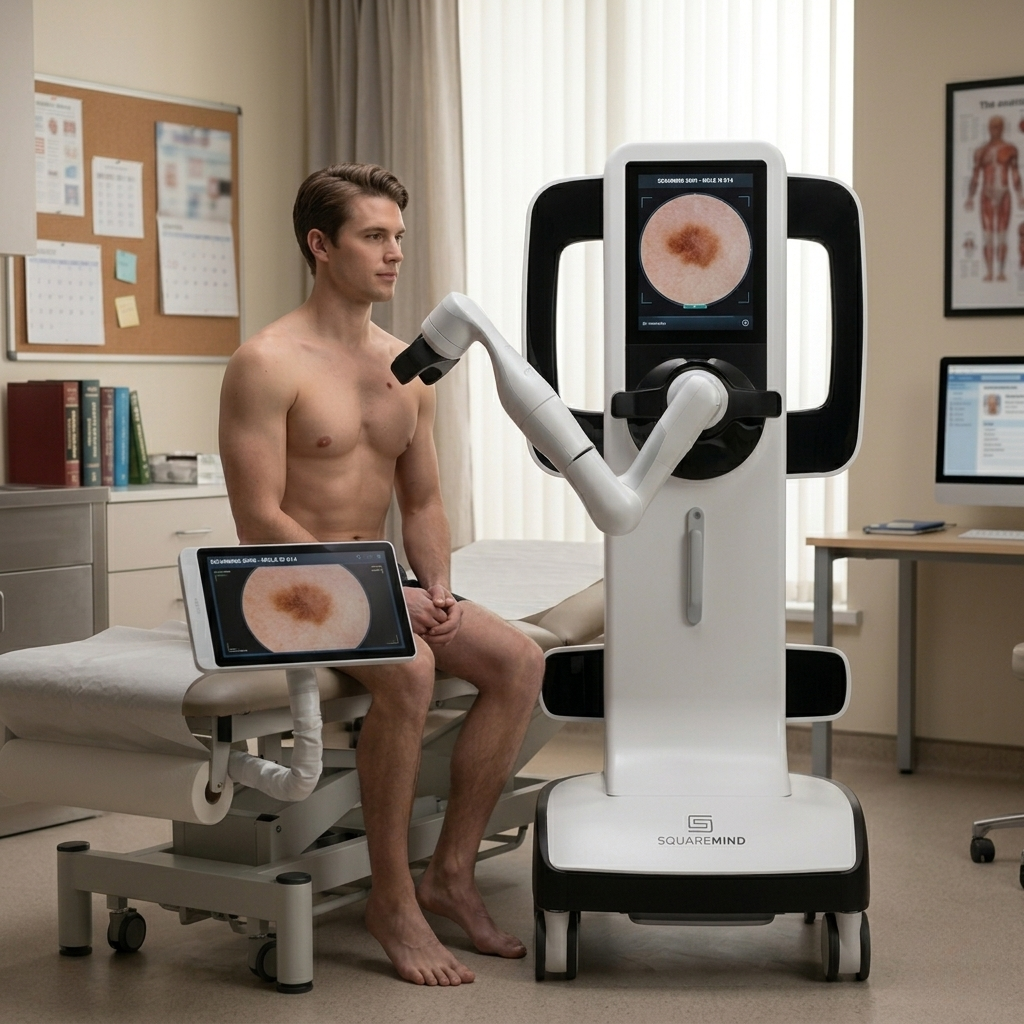
Medical diagnosis is undergoing a fundamental transformation. Long reliant on human expertise and clinical observation, it is now being enhanced by technologies capable of analyzing, comparing, and predicting outcomes with unprecedented precision. In this context, dermatology stands out as a field particularly ripe for innovation. Faced with the steady rise in skin cancers and the growing difficulty in accessing specialists, the startup Squaremind offers a radically new approach, combining robotics, advanced imaging, and artificial intelligence. With $18 million in funding, the company is accelerating the development of a solution that could profoundly transform the detection and monitoring of skin diseases.
The stakes are high. In France, approximately 150,000 cases of skin cancer are diagnosed each year, including more than 15,000 cases of melanoma, the most aggressive form1. Over the past three decades, the number of cases has tripled, while wait times to see a dermatologist continue to grow in many regions. This strain creates a twofold challenge: improving early detection while optimizing the time available for medical care. In this context, AI emerges as a tool capable of enhancing the capabilities of healthcare professionals without replacing their expertise.
A French startup founded at the intersection of AI and medical robotics
Founded in 2019 in Paris by Ali Khachlouf and Tanguy Serrat, Squaremind develops technologies that combine artificial intelligence, robotics, and medical imaging for use in dermatology. The company aims to make skin examinations more accurate, faster, and better documented through a highly data-driven and clinically automated approach. Its flagship system, called Swan, is described as a robot capable of performing comprehensive imaging of the human body with a particularly high level of precision.
To accelerate its growth, Squaremind recently raised $18 million in a funding round led by Sonder Capital, a California-based fund co-founded by Fred Moll, a leading figure in medical robotics and co-founder of Intuitive Surgical. Several investors also participated in this round, including the Deeptech 2030 Fund managed by Bpifrance on behalf of the French government, Adamed Technology, Calm/Storm Ventures, Teampact Ventures, and several entrepreneurs specializing in health technologies2.
A technological approach based on robotics and imaging
The solution developed by Squaremind is based on a robotic system capable of scanning a patient’s entire body in just a few minutes. An articulated arm equipped with high-resolution sensors moves around the patient to capture thousands of detailed images of the skin. This data allows for the creation of a comprehensive, accurate, and zoomable map covering all areas of the skin.
This approach goes far beyond traditional methods, which often rely on isolated observations limited to specific areas. By providing a comprehensive and consistent view, the system makes it possible to detect anomalies that might otherwise go unnoticed during a conventional examination. It also standardizes the diagnostic process, reducing some of the variability associated with human observation.
The digital twin of the skin: a paradigm shift
One of the key benefits of this technology is the creation of a “digital twin” of the patient’s skin. This digital representation, similar to a detailed map, can be viewed, analyzed, and compared over time. It thus makes it possible to track the progression of lesions, identify the emergence of new abnormalities, and detect subtle changes.
This ability to track changes over time represents a significant advance. Whereas diagnosis previously relied on the clinician’s memory or isolated photographs, the system provides a structured database that can be analyzed over time. It is now possible to compare two examinations conducted several months apart with algorithmic precision, thereby improving the quality of medical follow-up and early detection.
Artificial Intelligence as a Diagnostic Aid
While imaging forms the foundation of the system, artificial intelligence represents its logical extension. The algorithms developed by Squaremind analyze the collected images to identify suspicious lesions, detect changes, and assist physicians in their decision-making. In particular, AI makes it possible to identify subtle variations that a human would have difficulty detecting in a large volume of visual data.

This approach is not intended to replace dermatologists, but rather to enhance their diagnostic capabilities. AI serves as a diagnostic aid capable of processing vast amounts of data, while leaving the final validation and clinical interpretation to the healthcare professional. This concept of augmented medicine is gradually becoming one of the major drivers of medical innovation.
An innovation designed for healthcare professionals
Unlike some consumer-focused solutions, Squaremind is aimed directly at dermatologists and healthcare facilities. The system is designed to integrate into existing clinical practices, with interfaces that allow users to view data, store test results, and facilitate patient follow-up.
This collaborative approach, developed in partnership with healthcare professionals, is a key factor in the technology’s adoption. It ensures that the tool addresses real-world needs while adhering to medical guidelines. It also paves the way for new applications, particularly in teledermatology, where data can be analyzed remotely by specialists.
A fundraising campaign to accelerate deployment
The $18 million funding round is expected to enable Squaremind to take its development to the next level. The company plans to accelerate the scaling of its solution, strengthen its research and development teams, and expand its operations in Europe and the United States.
This funding is part of a broader trend in which investors are showing increasing interest in the applications of artificial intelligence in healthcare. According to several estimates, the global market for medical AI could exceed $100 billion by 20303, driven by growing needs for automation, diagnostic accuracy, and the optimization of patient care pathways.
Ethical Issues and the Transformation of Medical Diagnosis
The integration of AI into medical diagnosis raises several key questions. Health data management, privacy protection, algorithmic transparency, and liability in the event of errors are central issues in the deployment of these technologies.
In the case of Squaremind, the creation of digital twins and the centralization of medical data require strong safeguards in terms of cybersecurity and governance. More broadly, the use of AI in medicine requires a clear definition of the roles of machines and doctors in order to maintain trust in the patient-care relationship.
Toward AI-Enhanced Dermatology
With this approach, Squaremind exemplifies a broader transformation in medicine, where digital technologies are enhancing existing practices. Dermatology, a highly visual field, appears to be particularly well-suited for the integration of artificial intelligence, imaging, and robotics.
The combination of these technologies paves the way for earlier detection, more accurate monitoring, and better patient care. But this development also underscores a key point: AI does not replace human medical expertise. It serves as a tool capable of enhancing analytical and predictive capabilities, while leaving the physician to play the central role in clinical decision-making.
How does the Squaremind solution work?
The solution developed by Squaremind is based on an advanced combination of artificial intelligence, robotics, and data technologies, enabling the automation and optimization of dermatological analysis. The system relies on a robotic device capable of capturing high-resolution images of the patient’s entire body, generating a comprehensive visual database.
This data is then processed using data engineering and data analysis techniques, which enable the information to be structured, processed, and compared over time. At the heart of the system are AI models capable of identifying skin abnormalities and tracking their progression.
This approach follows a logic similar to that of agent-based AI, in which algorithms autonomously analyze variations across multiple exams and alert the clinician in the event of a significant change. At the same time, certain technological components draw on the principles of generative AI to model skin structures and better interpret complex visual data.
- Full-body imaging: high-resolution skin imaging in just a few minutes
- Digital twin: creating a comprehensive and evolving patient profile
- Data analysis: automatic comparison of images over time
- Data management: structured and secure storage of medical data
- AI for diagnostic assistance: identification of suspicious lesions and changes
- Longitudinal follow-up: early detection of skin changes
- Data quality: Depends on the accuracy of the captured imagery
- Data Infrastructure: The Need for Robust Data Engineering Systems
- Medical interpretation: must be validated by a healthcare professional
- Regulation: Compliance with Medical Data Protection Standards
- Equipment costs: deployment is still limited to certain institutions
Learn more
The use of artificial intelligence to improve early detection is part of a broader transformation in medicine, driven by data analysis and clinical decision support. On a related topic, check out our article “Artificial Intelligence Improves Cancer Detection by More Than 10%, Pioneering Study Reveals”, which shows how AI models help improve diagnostic accuracy and predict certain conditions.
References
1. Santé Publique France. (2025). Skin Cancer in France.
https://www.santepubliquefrance.fr
2. Tech Funding News. (2026). Squaremind raises $18 million to reinvent dermatology with AI and robotics.
https://techfundingnews.com
3. Statista. (2025). AI in Healthcare Market Forecast.
https://www.statista.com