


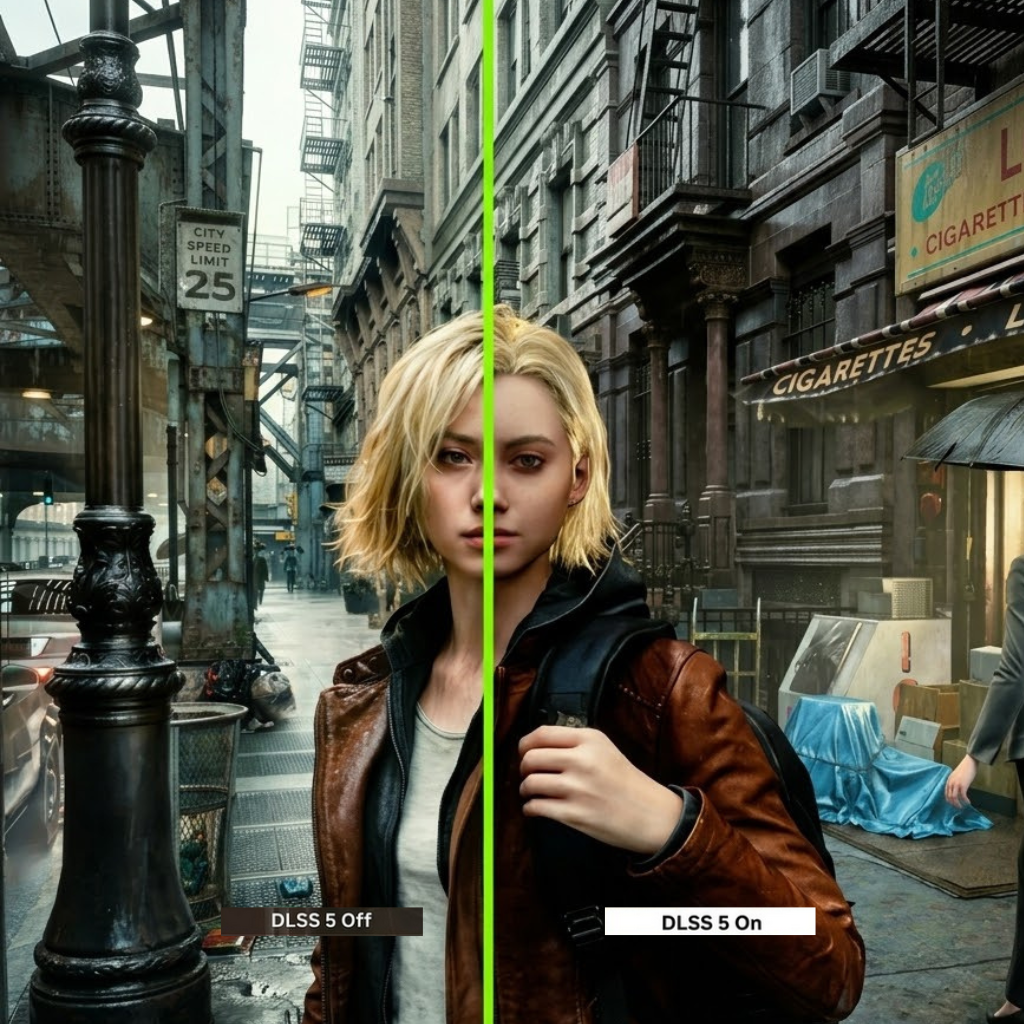
Real-time graphics rendering is entering a new phase. For several years now, the video game industry has been striving to make digital imagery more photorealistic by combining computational power with software innovations. With the announcement of DLSS 5, Nvidia is taking this approach a significant step further by relying even more heavily on artificial intelligence to generate, optimize, and reconstruct images. The goal is clear: to produce visual scenes whose quality approaches that of cinema, while maintaining performance levels compatible with real-time gameplay.

Unveiled in early 2026 at a dedicated event, this new version of Deep Learning Super Sampling builds on previous generations while introducing a more advanced approach to lighting and detail management. DLSS 5 is being gradually integrated into the Nvidia ecosystem, with availability announced for a first wave of games expected starting this fall, and access contingent on the new generation of RTX 5000 graphics cards. This hardware requirement aligns with the industry’s economic logic, where software advancements are closely tied to the renewal of GPU architectures, the cost of which can exceed several hundred or even thousands of euros depending on the configuration.
A new step in the fusion of traditional rendering and AI
Historically, DLSS has been based on the principle of upscaling, which involves generating a high-quality image from an initial, lower-resolution rendering. This approach improves performance while maintaining a high level of detail. With DLSS 5, NVIDIA is taking things a step further by incorporating advanced visual reconstruction mechanisms, where AI no longer simply enhances the image but actively participates in its generation.
One of the major advancements involves lighting management. Each pixel can now be associated with dynamic lighting, calculated in real time using deep learning models. This approach enables much more realistic reflection, transparency, and scattering effects, particularly in complex environments.

At the same time, AI is used to enhance surface textures and reconstruct fine details. The system is trained on large volumes of visual data, enabling it to anticipate and fill in certain details missing from the initial rendering. This combination of physical calculations and algorithmic generation represents a significant evolution of the traditional graphics pipeline.
According to Nvidia, this approach delivers a significant improvement in visual quality without compromising performance, since part of the computation is optimized by AI models1.
A transformation of the graphic design pipeline
Beyond visual improvements, DLSS 5 changes the way images are generated in video games. Historically, developers controlled the entire rendering process, from modeling to lighting. With the integration of AI, part of this process becomes probabilistic.
The final image is no longer merely the result of a deterministic calculation, but rather a combination of initial data and algorithmic reconstruction. This development brings graphic rendering closer to the principles already seen in generative AI.
In practice, this means that:
- Some visual information can be generated or enhanced by AI
- The graphics engine delegates part of the rendering to trained models
- The final result may vary depending on the context and optimizations
This transformation offers new possibilities for studios, particularly by reducing the production workload associated with certain visual elements. It also introduces a degree of dependence on proprietary technologies, as these models are integrated into Nvidia’s architectures.
Optimized performance, but access is still limited
One of the key selling points of DLSS 5 is its ability to enhance visual quality without significantly increasing the computational load. By optimizing the initial rendering and offloading certain tasks to AI, Nvidia aims to strike a balance between performance and realism.
However, this promise comes with significant limitations. Access to DLSS 5 is initially limited to users with RTX 5000 series graphics cards, which restricts its immediate adoption. The barrier to entry therefore remains high, particularly for gamers or studios with older hardware.
The technology also depends on how well it’s integrated into games. Only certain titles will support DLSS 5 at launch, with wider adoption expected in the coming years as developers adapt their engines and pipelines.
This transition phase is typical in the industry. Major graphical innovations, such as ray tracing, have also been adopted gradually before becoming widespread.
Between photorealism and user perception
While technical demonstrations showcase visually impressive results, players’ reactions are more mixed. On social media and in specialized analyses, questions are being raised about the nature of the image produced.
One point of discussion concerns AI’s ability to generate details that were not explicitly designed by the developers. In some cases, this reconstruction can alter the characters’ appearance or introduce variations that are perceived as artificial.
Technical analyses, particularly those by Digital Foundry, point out that while environments benefit greatly from this technology, human models remain more susceptible to reconstruction artifacts. Faces, in particular, may exhibit subtle deviations from the original intent.
This perception raises a broader question: At what point does an AI-generated image remain faithful to the original artistic vision? Photorealism is not limited to visual accuracy; it also involves aesthetic and narrative coherence.
Ethical Issues and the Changing Role of Developers
The integration of artificial intelligence into graphics rendering raises several issues. The first concerns creative control. If part of the image is generated or modified by AI, the developer’s role changes. They no longer simply design assets, but oversee a system capable of producing them or transforming certain aspects of them.
The second issue concerns transparency. Can players tell the difference between traditional rendering and AI-generated content? This question ties into broader debates about the use of AI in the creative industries.
Finally, the issue of technological standardization arises. Since DLSS is a proprietary technology, its adoption increases dependence on a specific provider. In a context where open innovation and interoperability are becoming key issues, this aspect warrants careful consideration.
These considerations are part of emerging frameworks for regulating AI, which emphasize the need to ensure transparency, human oversight, and explainability2.
Toward Generative Rendering in Video Games
With DLSS 5, Nvidia isn’t just offering a graphical enhancement. The company is paving the way for a more profound transformation of real-time rendering. The image is no longer simply calculated; it is partially generated.
This trend could extend to other areas, such as animation, physics, or environment generation. Video games would then enter a hybrid model, where computation and generation coexist.
From this perspective, the line between rendering and creation becomes increasingly blurred. AI no longer merely optimizes existing content; it actively participates in the visual production process.
It remains to be seen how developers will adapt to this trend and how players will perceive it. Photorealism is a technical goal, but the gaming experience also relies on subjective, artistic, and narrative elements. The balance between performance, realism, and creative intent will continue to be at the heart of future developments.
How does DLSS 5 work?
Le DLSS 5 repose sur une architecture combinant rendu graphique traditionnel et modèles d’intelligence artificielle entraînés sur de vastes ensembles de données visuelles. Contrairement aux approches classiques où chaque pixel est calculé de manière déterministe, le système introduit une phase de reconstruction intelligente de l’image. Le moteur graphique génère une base visuelle partielle que l’IA complète en estimant les détails manquants, notamment en matière de lumière, de texture et de profondeur :contentReference[oaicite:0]{index=0}.
Un élément clé du dispositif réside dans l’intégration avancée du ray tracing et de la gestion dynamique de l’éclairage. L’intelligence artificielle intervient pour affiner les interactions lumineuses, simuler des réflexions complexes et améliorer la cohérence visuelle globale, tout en optimisant les performances grâce aux capacités de calcul embarquées dans les GPU de nouvelle génération :contentReference[oaicite:1]{index=1}.
- Advanced image reconstruction: generating details from an initial lightweight rendering
- Dynamic lighting management: realistic pixel-by-pixel lighting
- Improved textures: refined surfaces, transparencies, and visual effects
- Ray Tracing Integration: Optimizing Complex Light Interactions
- Optimized frame generation: creation of intermediate frames to ensure smooth rendering
- Hardware requirements: Requires an RTX 5000 series graphics card or higher
- Developer-side integration: activation depends on the game engine
- Proprietary models: closed technology, not interoperable with all ecosystems
- Variability in rendering: results depend on training data and visual context
- Potential latency: adjustments needed to maintain a smooth experience
Learn more
The promise of photorealism delivered by DLSS 5 highlights a broader transformation in visual technologies, where artificial intelligence is redefining the standards of real-time rendering and digital perception. On a related topic, check out our article “Meta x Midjourney: A Strategic Alliance to Revolutionize AI Images and Video”, which analyzes how advances in visual generation are disrupting the creative industries and digital applications.
References
1. Nvidia. (2026). DLSS 5 Technical Overview.
https://www.nvidia.com/en-us/geforce/news/dlss5-breakthrough-in-visual-fidelity-for-games/
2. European Commission. (2024). AI Act Overview.
https://digital-strategy.ec.europa.eu