


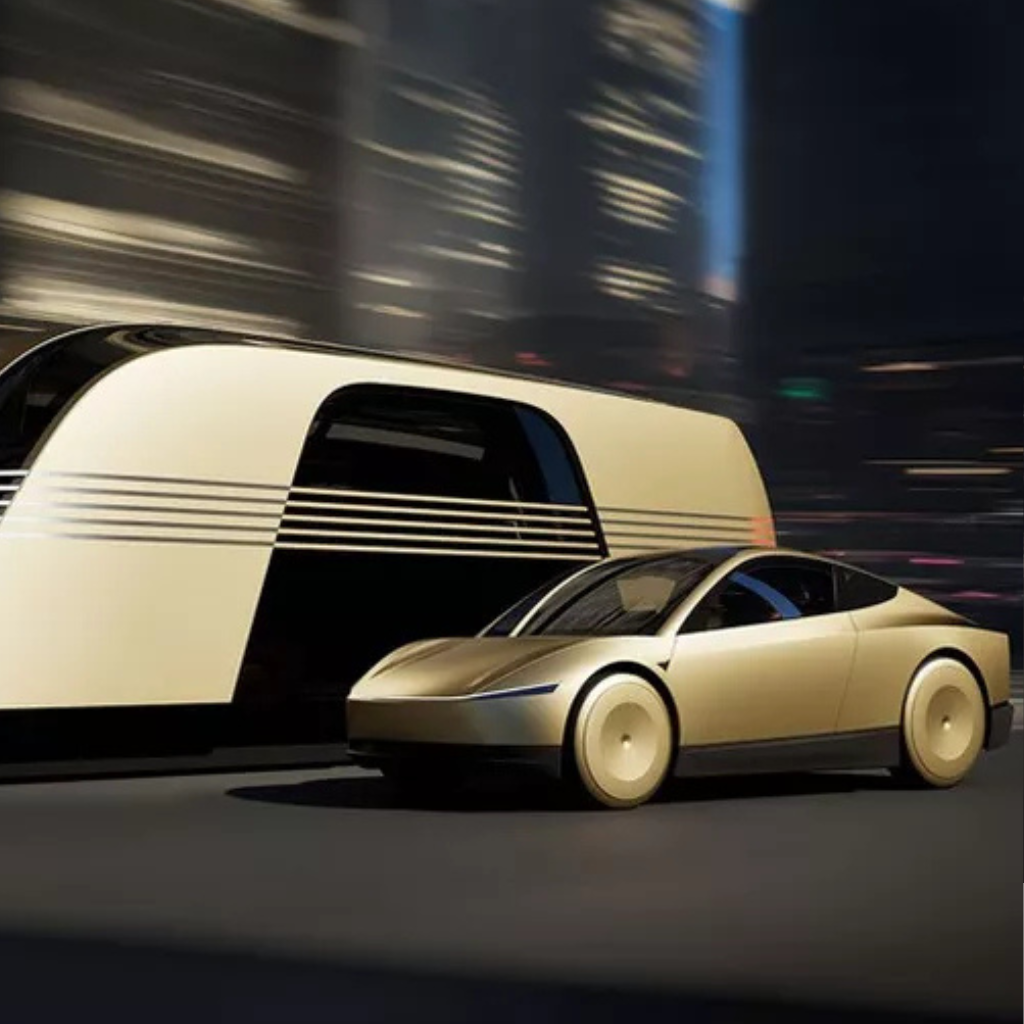
A spectacular demonstration of autonomous driving in an urban setting
In the heart of Paris, at a low-key but significant event, Tesla unveiled the Cybercab, a fully autonomous taxi with no steering wheel or pedals, driven entirely by on-board artificial intelligence. This vehicle, based on the Cybertruck platform, is not just a prototype: it marks a decisive step toward the commercial launch of robo-taxis in Europe.
The Cybercab combines several technological advancements: a multi-sensor perception system (lidar, HD cameras, radar), an onboard computer based on the Dojo supercomputer, and, above all, a proprietary artificial intelligence model trained on billions of kilometers of virtual driving.
Tesla is using AI to redefine urban mobility
The key feature of Cybercab is its ability to make real-time decisions, made possible by a multimodal AI agent. This agent can anticipate traffic conditions, respond to unexpected events, navigate complex intersections, and even communicate verbally with passengers.
Unlike conventional driver-assistance systems (such as Autopilot or Full Self-Driving), the Cybercab does not offer any manual takeover options. It is a fully autonomous system at SAE Level 5, which is exceptional in practice.1.
Elon Musk noted that France could become one of the first countries in the world to host a pilot fleet, thanks in particular to the regulatory framework established by the French Mobility Orientation Law (LOM).
A user experience reimagined by artificial intelligence
Inside the Cybercab, the ergonomics are radically different from those of traditional vehicles. The absence of a steering wheel frees up space for a cabin designed as a mobile lounge. The onboard voice interface, powered by a specialized version of ChatGPT, enables:
- communication with the vehicle,
- give instructions (change of route, stop, music…),
- receive personalized recommendations based on the user’s habits.
This integration marks the arrival of an autonomous vehicle capable of conversation, designed not just to get around, but to interact intelligently with its passengers.
Data, regulation, and acceptability: the challenges ahead
While the arrival of the Cybercab is fascinating from a technological standpoint, it also raises a number of legal, ethical, and social questions:
- Traceability of decisions: Who is responsible in the event of an accident? The AI, the manufacturer, or the user?
- Data protection: Tesla collects and processes massive amounts of behavioral data.
- Social acceptability: An IFOP study conducted in 2024 showed that only 38% of French people had confidence in driverless vehicles.2.
Tesla will also have to convincethe European Union, whose requirements for the certification of autonomous systems are stricter than those in the United States or China.
A revolution driven by the convergence of AI, sensors, and computing power
The Cybercab is not just a gadget, but a milestone in the history of the automobile. It represents years of progress in:
- embedded deep learning,
- dynamic mapping,
- fast, low-power inference (thanks to optimized chips),
- cloud-to-edge monitoring of autonomous fleets.
Tesla isn’t alone in this race. Competitors such as Waymo (Alphabet), Zoox (Amazon), and Baidu Apollo are also testing autonomous taxis in Asia and the United States. But the arrival of a working prototype in Europe gives Tesla a head start… at least symbolically.
References
1. SAE International. (2024). Taxonomy and Definitions for Terms Related to Driving Automation Systems.
https://www.sae.org/standards/content/j3016_202401/
2. IFOP. (2024). The French and autonomous vehicles.
https://www.ifop.com/publication/francais-voiture-autonome/