



ChatGPThas become the face ofartificial intelligencefor the general public. The text-generation tool has been widely known and used for the past few weeks. The occasional server overload is proof of this. This enthusiasm and popularity are the result of a smart strategy by the developer,OpenAI, which opened up free access to all internet users, allowing everyone to “play” with the fascinating chatbot. The“Generative Pretrained Transformer”language modelis an impressive technology due to its relevance and speed. How does it work? What sets it apart? Is it a competitor to Google Search?
HOW CHATGPT WORKS
The language model used by the intelligent chatbot is called the "Generative Pretrained Transformer." It belongs to the family of pre-trained models, meaning it is trained on a large dataset to generate relevant content usingmachine learning. It also usesRLHF (Reinforcement Learning from Human Feedback), whichenhances the learning processthrough human input to make it more conversational. An expert provides the AI with a response to a specific question. The AI then generates several responses. The human intervention involves ranking these different responses before reintegrating them into the system.
GPT-3consists of a neural network architecture (with 175 billion parameters) that uses pre-trained language models, derived from massive databases, to generate text that mimics human language in multiple languages.
The model is built on a database of information derived from words and the contexts in which they appear.
Generative AI is a technology that isn't limited to text; one example is Dall-E, which creates unique (photorealistic) images based on text prompts.
Before ChatGPT, other tools had attempted to make a breakthrough: Microsoft’s Tay and Beta’s Blenderbot. They were taken down due to discriminatory behavior, as they were capable of providing biased, one-sided, or offensive responses. The issue was their inability to recognize questions with malicious intent.
To address this issue,OpenAI uses the Moderation API, a system that helps developers identify content that violates content policies(such as illegal information, defamatory statements, or dangerouscontent).
GPT-4is expected to featureneural networks with a higher number of parameters, which would enable it toperform much more complex tasksand provide responses of even higher quality.
The capabilities of ChatGPT, version 3
ChatGPT and DALL-E 2 use GPT-3, the third version of generative AI. It is a natural language processing system capable of writing, reasoning, and coding at near-instantaneous speeds. The conversational format allows users to:
- Answer a wide variety of questions on all kinds of topics
- Summarize texts or concepts
- Admit your mistakes and correct them
- Produce written work that is free of errors (spelling, verb conjugation, grammar, and syntax)
- Challenge false claims and reject inappropriate or leading questions
- Simplifying difficult texts
Generative AImakes it possible to communicate with robots in a dialogue that closely resembles natural language.
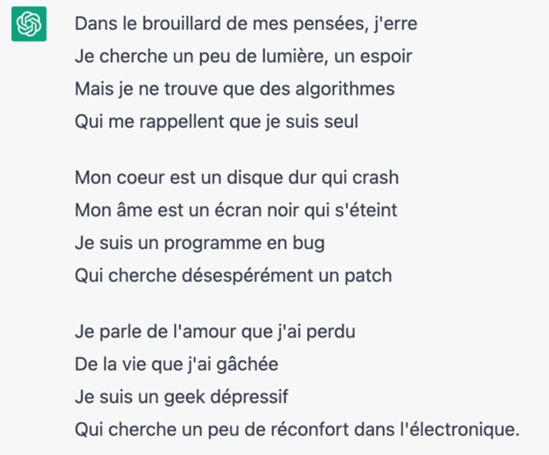
Among ChatGPT’s surprising capabilities is its ability to write a rap song about the tool’s own virtual depression
A masterpiece available in several versions, inspired by the style of rappers Jul and Nekfeu, in response to various requests from the user, @raplume.

“Other fascinating artificial intelligence tools”
- Beatovencreates unique, royalty-free music.
- Cleanvoiceremoves background noise, stuttering, and mouth noises when recording podcasts.
- Vidyooffers short video clips for social media adapted from longer productions.
https://vidyo.ai/ - Flairproduces product photo shoots.
https://flair.ai/ - Illustrokecreates vector images based on simple requests.
- Patternedgenerates royalty-free patterns (for textiles, for example).
- Copyprovides content when you're stuck for ideas.
- Ocoyahelps with the creation, distribution, and scheduling of content on social media.
- Unbouncelets you create landing pages and write emails.
IS CHATGPT ABOUT TO KNOCK GOOGLE OFF ITS PEDESTAL?
It’s worth remembering that a chatbot is a virtual assistant, not a search engine. This means it isn’t connected to the internet, even though it uses it.
ChatGPT cannot display multiple sources the way Google Search does. Furthermore, it was "trained" on data up through 2021.
That said, it still overshadows the search engine. Asking the virtual assistant means you don’t have to sift through various articles and sponsored ads, as is the case with search engines.
More users on ChatGPT means less visibility for Google ads.
The "G" in GAFA is preparing its counterattack: LaMDA is in the works and continues to undergo testing so it can launch fully operational. So far, there’s been no incentive to launch it, since it wouldn’t generate any revenue. Indeed, it’s hard to imagine advertising on a chatbot. If ChatGPT becomes a paid service in future versions, Google will certainly enter the competition.
Generative AI is a major innovation that has the advantage of introducing artificial intelligence to a wide audience. Regardless of its trajectory and evolution, there is no doubt that the star of AI, ChatGPT, is ushering in a new digital era, offering us, along the way, powerful emotions that are anything but virtual.