


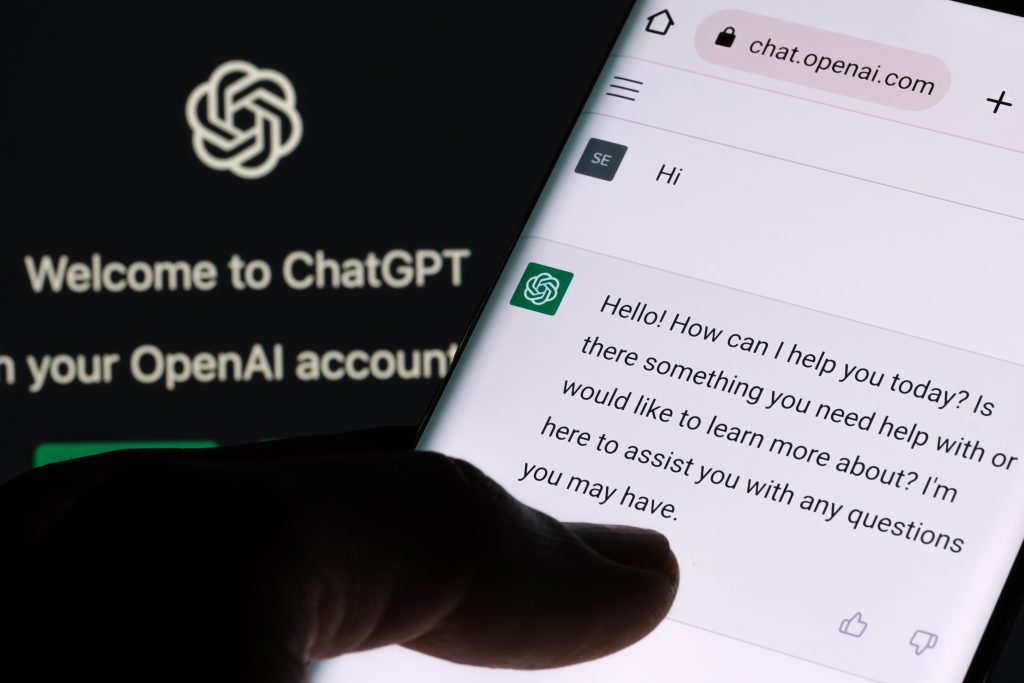
ChatGPThas becomethe hot topic of early 2023. Whether you’re a tech enthusiast or not, this content-generation tool has gained immense popularity in a very short time. A digital revolution, ChatGPT is unsettling some and galvanizing others. Although everyone is familiar withartificial intelligence, it remains abstract when integrated into tools such asconnected devices, for example. ChatGPT has brought AI into the spotlight by isolating one of its roles and demonstrating its practical application through a single chatbot.What is the story behind ChatGPT? In what context and for what purposes was it designed? What are the potential and limitations of this tool?
WHAT CAN YOU ASK CHATGPT?
The applications and possibilities are endless. Any topic can be covered, even the most specialized ones.
Here’s a selection of prompts for users who haven’t tried the genius chatbot yet:
- ChatGPT, can you write an 800-word essay on Impressionist painting?
- Can you suggest a vegetarian menu with the corresponding recipes?
- Can you provide me with a summary of my thesis?
- Can you solve this complex calculation?
- Can you write a fantasy story featuring elves?
- Can you translate Beyoncé's song "Love on Top"?
- Can you spot the bugs in this program's code?…
Here is the link to explore and try out the Prodige chatbot: https://openai.com/blog/chatgpt/
The History of ChatGPT
ChatGPT is a free tool developed by OpenAI, an American company specializing in AI research and based in San Francisco. The company was founded in 2016 by Sam Altman and Elon Musk. Musk stepped down a year later but remained a financial backer. OpenAI has developed a unique language model: GPT, which stands for “Generative Pre-trained Transformer.” The technology selects, retrieves, and transforms information from texts published on the internet to create new content.
This powerful chatbot is designed to generate text that provides smooth and relevant answers to users’ questions (in multiple languages), regardless of the field of knowledge or activity. ChatGPT was created to handle a vast array of topics, providing detailed answers and demonstrating expertise.
OpenAI has released several versions of its chatbot, each one more capable than the last. The best-known versions of GPT are:
| Version | Details |
| GPT-1 | Released in 2018, it was the first version of GPT to feature one million parameters. |
| GPT-2 | Released in 2019, this version was significantly larger than GPT-1, with over 1.5 billion parameters. |
| GPT-3 | Released in 2020, it is the largest version of GPT to date, with over 175 billion parameters. |
OpenAI is working on more advanced and powerful versions to achieve a better understanding of language and even more refined text-generation capabilities.
Here are some of the other tools offered by OpenAI:
- OpenAI RoboSumo: This program teaches robots to move and adapt to conditions in real time when faced with unexpected situations.
- Debate Game: a debate game designed to help analyze AI decisions and thereby develop explainable technology.
- MuseNet: a deep neural network, this tool allows users to create musical compositions featuring 10 instruments across 15 different musical styles (jazz, pop, rock, etc.).
- Dall-E: creating images from text data—generating graphics in just a few clicks.
Does ChatGPT generate unique, original, and non-duplicated text?
Trained on a corpus of existing online texts, ChatGPT generates content that is not strictly unique or original, as it draws on existing material based on the user’s query. Strictly speaking, the chatbot does not invent anything; it retrieves and processes information to provide an accurate response to a request. That said, the responses it generates vary depending on how the question is phrased—a process known as a “prompt.”
Since the tool uses existing content, the responses may result in duplicate text, which is a serious mistake in Google’s eyes, as it penalizes this practice by lowering websites’ rankings.
Are ChatGPT's texts SEO-friendly?
Content generated by this exceptional chatbot can be useful for SEO, provided it includes keywords, follows SEO best practices (such as proper use of tags), and contains relevant information. It’s up to you to request the content, review it, and assess its relevance. This is subjective—just as much as ChatGPT’s response when asked about it.
Google's search algorithms are becoming increasingly sophisticated and precise. As a result, they may be able to detect automatically generated text and decide to penalize it (which is not yet the case). It therefore remains important not to rely solely on automated content generators when writing text intended for search engine optimization.
At this stage of development, ChatGPT remains a tool that requires supervision, additional editing, and the application of SEO techniques.
What are ChatGPT's competitors?
In the field of natural language processing, some tools use similar technologies:
- Google's Dialogflow
- Microsoft’s LUIS (Language Understanding)
- IBM’s Watson Assistant
- Amazon’s Alexa Skills Kit
The choice of the appropriate tool depends on the project's objective:
- Chatsonic (very similar to the ChatGPT app)
- YouChat (writing emails, social media posts, texts, etc.).
- Jasper (content creation with SEO best practices in mind)
- Deepl (free translation tool)
- Deepl Write (for checking grammar and syntax)
- Copilot (for generating code)
The downsides of ChatGPT
Despite its many advantages, ChatGPT also has a few shortcomings—but given its vast potential, these are easily overlooked.
- The system is overwhelmed by the massive demand
- Obsolescence: The database draws on data from 2021 and earlier years, which may make the results outdated.
- The risk of bias or discrimination: The chatbot can retrieve text from all over the web and may therefore draw on biased content. Even though OpenAI uses the Moderation API to help identify content that violates its content policy, it is important to remain vigilant and not take the results at face value.
- The accuracy of information: You can find all sorts of things online, including both accurate and inaccurate information. Since ChatGPT uses online text without being able to verify the accuracy of the information, it is essential to proofread and fact-check the content.
- The answer in 99% of cases: the vegetarian menu and related recipes arrived without the ingredient quantities, and the 800-word essay on Impressionist painting cut off at the 800th word without finishing the sentence… So it’s crucial to be precise in your request to avoid frustration, missing out on dinner, and having your essay cut short!
- The wrong question: if the query is vague or doesn't match the intended search, the results will be just as vague. Off-topic results are therefore a potential risk.
- Plagiarism: As mentioned earlier, content can be duplicated. Google and authors don’t like that. It’s all about balance and verification.
- Text quality: Although the writing is generally correct, there are still a few errors, and the style lacks a certain lightness.
- Detecting text generated by chatbots: Google and other search engines can identify websites that use text generated by virtual assistants; however, these algorithms are not yet highly effective in this area, and some text may still slip through the cracks, but the technology will continue to improve. Officially, Google does not currently penalize websites by lowering their rankings.
A powerful content creation tool, ChatGPT has introduced the general public to the extraordinary potential of artificial intelligence. Although revolutionary, the chatbot still needs to be supervised and verified. Let’s not forget that AI is a human creation, and that only humans are capable of adding value to the technology. The reverse is not true—at least not yet!