


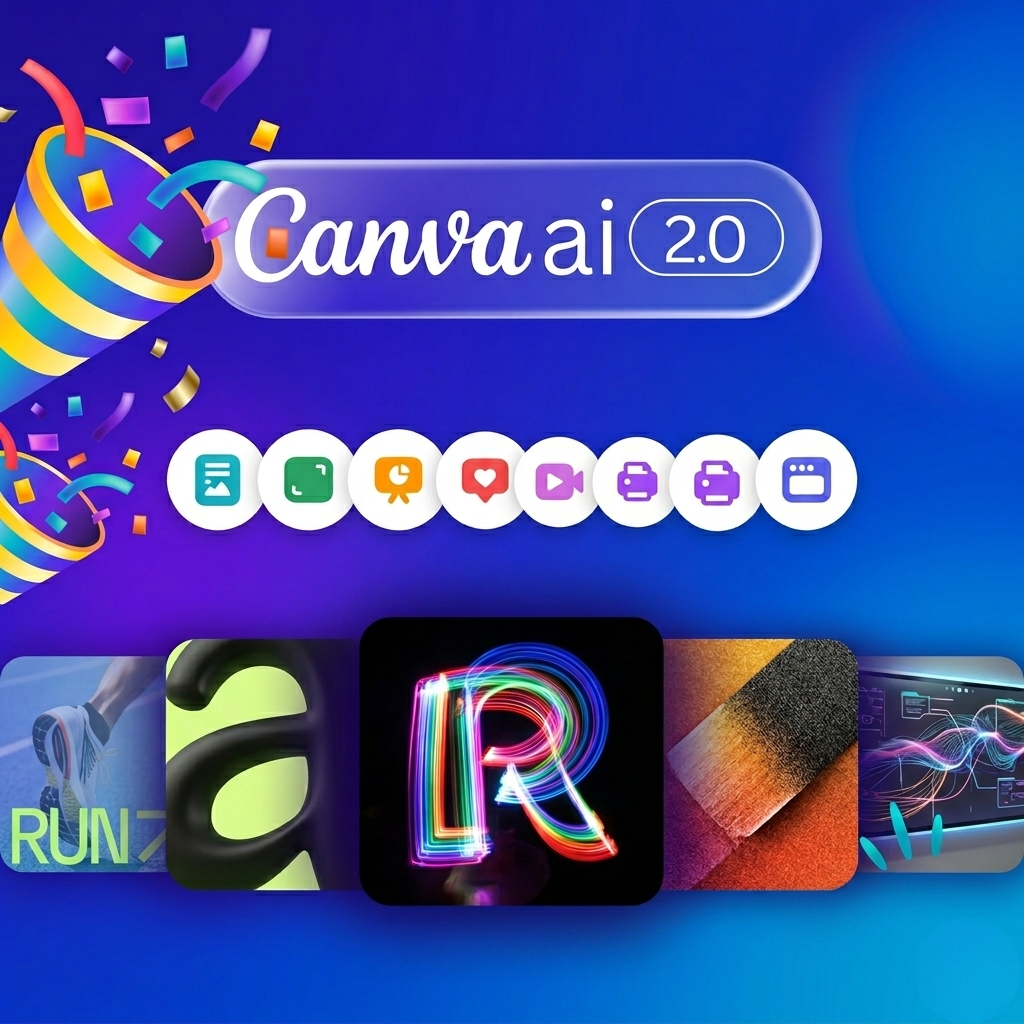
The digital design market is undergoing a major transformation. Long dominated by complex professional tools, it is now being redefined by the widespread integration of artificial intelligence. With Canva AI 2.0, the Australian company is taking a new step by repositioning its platform not merely as a visual creation tool, but as an intelligent environment capable of designing, structuring, and automating entire projects. This evolution marks a strategic turning point, placing Canva in direct competition with Adobe in segments historically reserved for professionals.
At its annual Canva Create conference, attended by several thousand participants, the company unveiled an ambitious vision: AI-driven design that is accessible to everyone yet powerful enough to meet the needs of businesses. With more than 250 million users worldwide, Canva is no longer just a consumer-focused solution; it is becoming a key player in the creative ecosystem.
A platform redesigned around artificial intelligence
The key innovation introduced by Canva AI 2.0 lies in the complete overhaul of its technological architecture. Unlike a simple integration of AI features, the entire platform has been redesigned to allow AI models to interact directly with the creative tools. This transformation, which took several years to develop, enables the AI to go beyond simply generating content and instead orchestrate projects in their entirety.
In practical terms, users no longer simply create a visual; they can now describe their intent, and the platform generates a cohesive package that includes design, structure, content, and formatting. This approach marks the transition from a creation tool to a true execution platform, where AI becomes the primary entry point.
A new generation of conversational design
One of the most notable new features in this version is the advanced integration of conversational design. Based on a simple prompt, Canva can generate visuals, presentations, or structured documents, taking into account the user’s context and objectives.
This approach is part of a broader trend in creative tools, particularly with the generative models developed by Adobe. However, Canva stands out for the simplicity of its interface and its ability to make these features accessible to a non-expert audience. Here, AI acts as a facilitator, lowering the technical barrier and speeding up content production.
According to Adobe, tools with generative capabilities can reduce creation time by more than 50% in certain use cases1, illustrating the potential impact of these technologies on creative workflows.
Layered object intelligence: Toward a more flexible design
Among the innovations introduced, the concept of “Layered Object Intelligence” stands out as a key differentiator. Unlike traditional image generators, which produce static visuals, Canva is now capable of creating designs structured in layers that are fully editable.
This capability brings AI-generated content closer to professional standards by allowing users to edit each design element individually. It also offers greater interoperability with other tools on the platform, which can interact with these layers to adjust or enhance the content.
This hybrid approach, which combines automatic generation with fine-tuning, strikes a balance between accessibility and control—a key challenge in the adoption of creative AI tools.
Agent-based project coordination
Canva AI 2.0 also introduces an agent-based orchestration model, in which the AI no longer simply responds to a request but structures the entire project. Users can thus initiate a marketing campaign, a document, or a presentation, and the platform automatically generates the various necessary elements.
This capability is based on the integration of several modules, including:
- creation of visual and textual content
- automated creation of structured documents
- project planning and organization
- integration with external tools
This development brings Canva closer to integrated AI platforms, which are capable of centralizing multiple functions within a single environment.
An integration and ecosystem strategy
Beyond its features, Canva is developing an integration strategy aimed at connecting its platform to a broad ecosystem of tools. Integration with services such as Google Workspace, Slack, and Notion allows the AI to access contextual data and enhance creative outputs.
This integration transforms Canva into a central hub capable of aggregating information, organizing it, and leveraging it to generate relevant content. It is part of a broader trend toward the convergence of digital tools, where the boundaries between creation, collaboration, and project management are becoming increasingly blurred.
A move upmarket to compete with Adobe
Historically positioned as an affordable alternative to professional tools, Canva is now moving upmarket, putting it in direct competition with Adobe. The integration of advanced features, combined with a streamlined interface, gives it a significant competitive advantage.
Adobe maintains a dominant position, with specialized tools and a strong presence in professional environments. However, Canva’s strategy—based on simplicity, accessibility, and AI integration—could redefine user expectations.
According to Statista, the global creative software market is expected to exceed $20 billion by 20272, intensifying competition among players.
Ethical Issues and the Transformation of Creative Professions
The rise of AI tools in design also raises questions about the future of creative professions. The automation of certain tasks may reduce the need for technical work, while increasing the demand for strategic and creative skills.
It also raises questions related to intellectual property, the authenticity of creative works, and the standardization of content. In this context, striking a balance between automation and human creativity becomes a key issue.
These changes are part of a broader trend in which AI serves as a catalyst for enhancing human capabilities while redefining professional practices.
Toward a new generation of creative tools
With Canva AI 2.0, the company isn’t just improving its features—it’s redefining the role of design tools. AI is becoming an active partner, capable of understanding intentions, suggesting solutions, and performing complex tasks.
This trend could bring about lasting changes in design practices, making design more accessible, faster, and more integrated. It also raises a fundamental question: should creative tools remain specialized, or should they evolve into unified platforms powered by artificial intelligence?
How does Canva AI 2.0 work?
Canva AI 2.0 is built on a hybrid architecture that combines generative artificial intelligence, agent-based orchestration, and structured design tools. Unlike previous versions, which focused on isolated features, this new generation integrates AI into the very core of the system, enabling direct interaction between models and creative components.
Users no longer simply manipulate tools; they interact with a system capable of understanding an overall intent and producing a coherent set of content. The system relies on several technological components, including image and text generation models, layer management systems, and an orchestration layer capable of coordinating various actions.
This architecture enables the AI to generate not only visual elements but also the entire structure of a project, incorporating content, layout, and editorial logic.
- Conversational design: creating visuals and documents based on prompts
- Multimodal generation: combined production of text, images, and layouts
- Advanced layer management: fine-tuning of generated elements
- Project orchestration: automated creation of comprehensive documentation
- Ecosystem integration: integration with external tools (Google, Slack, Notion)
- Variable quality: Depends on the accuracy of generative models
- Risk of standardization: homogenization of visual styles
- Data dependency: the need for relevant content to guide AI
- Hidden complexity: automation that can obscure the creative process
- Ownership Issues: Questions About Rights Related to User-Generated Content
Learn more
Canva’s rise to prominence is a broader illustration of how artificial intelligence is transforming creative tools, amid increasing competition among platforms. On a related topic, check out our article “Meta x Midjourney: A Strategic Alliance to Revolutionize AI Images and Video”, which analyzes how partnerships and technological innovations are reshaping the balance of power in the visual creation industries.
References
1. Adobe. (2024). The Future of Creative Workflows.
https://www.adobe.com
2. Statista. (2025). Creative Software Market Forecast.
https://www.statista.com