


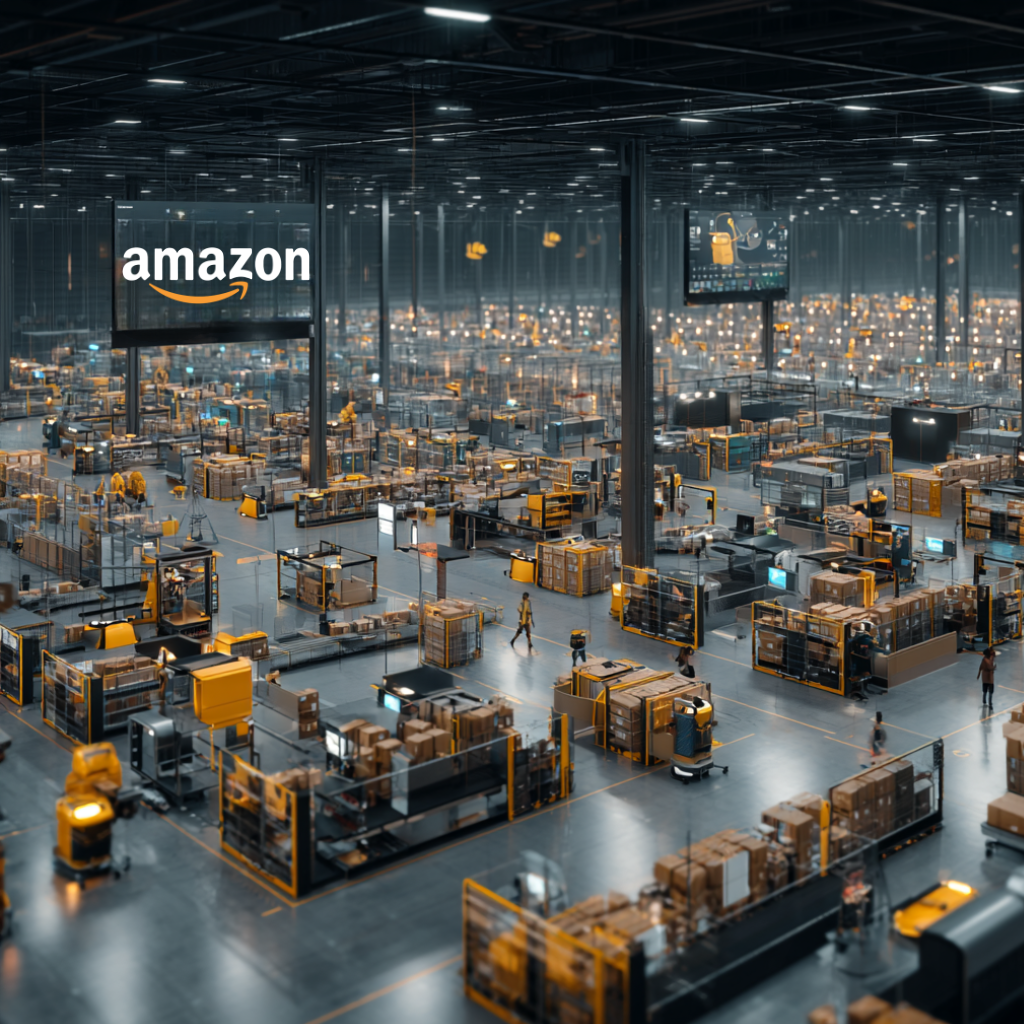
Changes in logistics driven by AI and robotics
In 2024, Amazon officially reached a symbolic milestone: more than one million robots deployed in its warehouses worldwide. This unprecedented expansion of physical automation is accompanied by a major technological shift: the integration of in-house artificial intelligence, interconnected with its entire robotic infrastructure. The objective is clear: to coordinate a fleet of autonomous units in real time, in order to optimize, streamline, and increase the reliability of the supply chain.
But the convergence of advanced AI and mass-market robotics raises both hopes and questions. What specific applications will it have? How will human skills evolve? And what is the legal and ethical framework for this unprecedentedly large-scale automated system?
From Kiva to Proteus: The Evolution of a Robotic Fleet
It all began in 2012, when Amazon acquired Kiva Systems, a startup specializing in mobile warehouse robots.¹. This technology already allowed shelves to come to the operator, rather than the other way around. Since then, Amazon’s robotic lineup has expanded to include models such as Proteus (an autonomous mobile robot safe for human environments), Cardinal (a robotic sorting system), and Sparrow, capable of handling a wide variety of objects²capable of handling a wide variety of objects.
The announcement of the millionth robot in 2024 marks a shift in scale… but also a paradigm shift, with the arrival of a central AI responsible for coordinating these systems.
AI at the heart of smart warehouses: What specific capabilities does it offer?
This new AI, developed in-house, aims to optimize every aspect of logistics:
- Real-time navigation: dynamically adjusts robot trajectories to avoid traffic jams and maximize traffic flow.
- Multi-agent orchestration: coordinates hundreds of machines based on order priorities, inventory availability, and human constraints.
- Predictive maintenance: by analyzing sensor data, it anticipates breakdowns and schedules maintenance.
- Intelligent allocation: resources (robots, personnel, storage areas) are automatically assigned based on peak workloads and local conditions.
Interfaces allow human supervisors to interact with the AI, adjust its parameters, or challenge its decisions if necessary.
Which jobs are being transformed by this combination of AI and robotics?
Intelligent automation radically changes the skills required:
- Logistics operators are shifting from an operational role to that of fleet supervisor or manager of human-machine collaboration.
- Maintenance technicians need to understand how cyber-physical systems, sensors, and embedded AI work.
- Hybrid roles are emerging: flow analyst, robotics coordinator, and AI logistics specialist.
This change calls for rapid skills upgrading through continuing education and targeted training programs.
Ethical, legal, and social issues
AI-driven mass robotization raises several concerns:
- Transparency: AI must be explainable to human decision-makers.
- Liability: In the event of a malfunction, who is legally liable?
- Algorithmic surveillance: What rights do employees have when faced with automated assessment tools?
- Social acceptability: How can we maintain a sustainable balance between humans and machines?
The European AI Act and ISO standards for industrial robotics provide frameworks, but will need to evolve to keep pace with these tightly integrated systems.
Is Amazon hinting at the autonomous warehouse of the future?
While Amazon currently boasts the world’s most advanced automated logistics infrastructure, other companies are following a similar path:
- Ocado in the UK uses self-learning robotic systems.
- JD.com and Cainiao (Alibaba) are investing in fully autonomous hubs.
However, full autonomy is still hindered by technical limitations: software interoperability, reliability in an open environment, and energy consumption.
Augmented logistics—but what does the future hold for work?
Amazon is exploring a new frontier in automation: one where machines no longer simply execute tasks, but coordinate, anticipate, and learn³. This dynamic redefines the boundaries of logistics work and raises the question of a new industrial social contract. While technology enables significant gains in efficiency, it also calls for a rethinking of the role of humans in the production ecosystem. Warehouses are becoming complex cyber-physical systems, in which supervision, critical analysis, and human adaptability remain essential.
The widespread use of these devices could signal further changes in the manufacturing, distribution, and urban logistics sectors. This raises the question of what skills will need to be developed in the future: knowing how to work with AI, interpreting its decisions, and maintaining the ability to make independent judgments.
The challenge in the years ahead will not simply be to design smarter systems, but to ensure that they remain inclusive, equitable, and attuned to human aspirations. The rise of logistics AI therefore raises not so much the question of what machines can do for us, but rather what we choose to do together with them.
Amazon is exploring new frontiers in automation: a realm where machines no longer merely carry out tasks, but coordinate, anticipate, and learn.
This development is redefining the boundaries of logistics work and raising the question of a new industrial social contract.
Is AI designed to enhance performance and efficiency—or should it also serve as a tool for professional empowerment?
References
1. Amazon Robotics. (2024). One Million Robots and Counting.
https://www.aboutamazon.com/
2. MIT Technology Review. (2024). “Inside Amazon’s Intelligent Warehouses.”
https://www.technologyreview.com/
3. European Commission. (2024). Artificial Intelligence Act – Final Text.
https://eur-lex.europa.eu/